
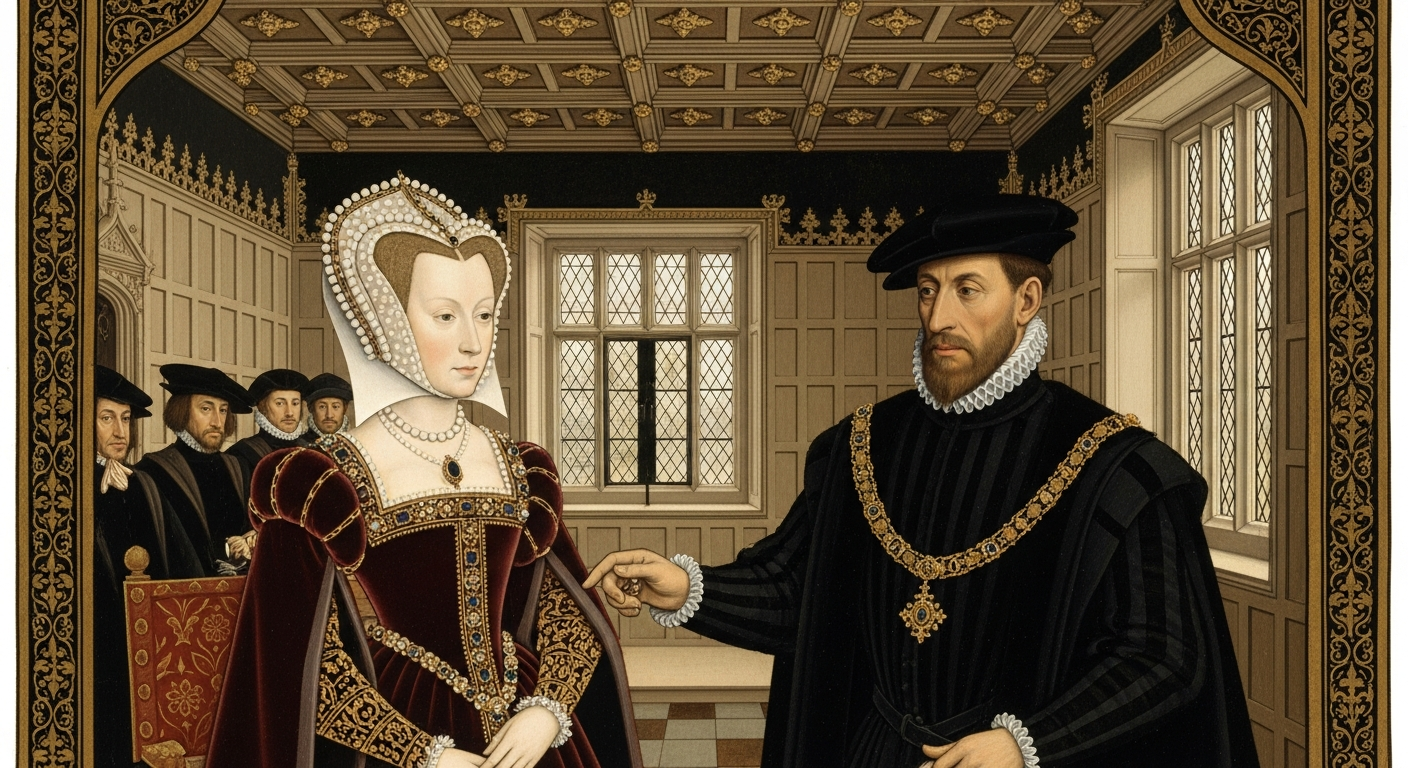
The Royal Match That Never Was: Mary Tudor’s Failed Betrothal to Holy Roman Emperor Charles V
Introduction
Imagine if history had taken a different turn: what if Mary I of England had become Holy Roman Empress instead of the feared ‘Bloody Mary’ of English memory? For four crucial years during the 1520s, this alternative timeline seemed entirely possible. Princess Mary Tudor, daughter of Henry VIII and Catherine of Aragon, was seriously considered as a bride for her own first cousin, the mighty Holy Roman Emperor Charles V, despite a substantial sixteen-year age gap that would have seen a nine-year-old girl wed to a twenty-five-year-old man.
This forgotten chapter of Tudor matrimonial diplomacy reveals the complex web of European politics that shaped the early sixteenth century. The proposed union between Mary and Charles V wasn’t merely a family arrangement; it represented a potential alliance that could have fundamentally altered the course of English, Spanish, and European history. Instead of this imperial marriage, Mary would eventually wed Charles’s son, Philip II of Spain, three decades later in 1554, a union that would define her controversial reign and earn her lasting infamy.
The story of this failed betrothal illuminates the harsh realities of royal childhood in the Tudor era, the intricate dance of Renaissance diplomacy, and the pivotal moments when individual decisions shaped the destiny of nations.
Historical Background
To understand this remarkable matrimonial proposal, we must first examine the key players in this royal drama. Mary Tudor, born in February 1516, was the long-awaited heir of Henry VIII and his first wife, Catherine of Aragon. Though Henry desperately wanted a male heir, Mary represented his legitimate succession and a valuable diplomatic asset. Charles V, born in 1500, had inherited an unprecedented collection of titles: Holy Roman Emperor, King of Spain, ruler of the Netherlands, and lord of vast territories in the New World.
The relationship between Mary and Charles was not merely political, they were first cousins through Catherine of Aragon, who was Charles’s aunt. This family connection provided a natural foundation for the proposed alliance, though it also created canonical complications that would require papal dispensation. The Calendar of State Papers from this period reveals the serious nature of these negotiations, with detailed discussions about dowries, inheritance rights, and the practicalities of such a union.
The betrothal negotiations began in earnest around 1521, when Mary was just five years old and Charles had recently been crowned Holy Roman Emperor at Aachen. The discussions continued intermittently until 1525, with various treaties and provisional agreements drafted during this period. The Imperial ambassador to England regularly reported on Mary’s education, health, and development, all crucial factors in determining her suitability as a future empress.
These marriage negotiations took place against the backdrop of the Italian Wars, the ongoing conflict between the Habsburg and Valois dynasties, and the emerging Protestant Reformation. Henry VIII saw an alliance with Charles V as essential for England’s security and international standing, whilst Charles viewed English support as valuable in his struggles against France and the Ottoman Empire.
Significance and Impact
The proposed marriage between Mary Tudor and Charles V held profound implications that extended far beyond personal compatibility. Had this union succeeded, it would have created an unprecedented concentration of power linking England directly to the vast Habsburg empire that stretched from Spain to Austria, from the Netherlands to Naples, and across the Atlantic to the Americas.
For Henry VIII, the alliance represented a masterstroke of diplomatic positioning. England in the 1520s remained a relatively minor European power compared to France and the Habsburg domains. A marriage between his daughter and the Holy Roman Emperor would have elevated England’s status dramatically and provided security against French aggression. The match would also have reinforced the legitimacy of Mary’s position as Henry’s heir, something that became increasingly important as the years passed without a male successor.
From Charles V’s perspective, the marriage offered strategic advantages in his ongoing rivalry with Francis I of France. English support, backed by a family alliance, could provide crucial assistance in his Italian campaigns and help secure his northern European territories. Additionally, the union would have prevented any potential English alliance with France, a constant fear for Habsburg strategists.
The failure of these marriage negotiations had equally significant consequences. As historian Anna Whitelock notes in her comprehensive biography of Mary Tudor, the collapse of the Imperial marriage plans coincided with Henry VIII’s growing matrimonial difficulties and his eventual break with Rome. The King’s Great Matter, his attempt to annul his marriage to Catherine of Aragon, was complicated by Charles V’s opposition, partly motivated by family loyalty to his aunt Catherine.
Connections and Context
The Mary-Charles marriage negotiations cannot be understood in isolation from the broader tapestry of Tudor foreign policy and European diplomacy. These discussions occurred during the same period when Henry VIII was earning his title as ‘Defender of the Faith’ for his treatise against Martin Luther, and when Thomas Wolsey was at the height of his power as Lord Chancellor.
Interestingly, the marriage negotiations coincided with other significant royal marriages and betrothals across Europe. Charles V himself was simultaneously considering various matrimonial options, including potential brides from Portugal and France. The complex web of Renaissance marriage diplomacy meant that multiple negotiations often proceeded simultaneously, with rulers keeping several options open until the most advantageous match could be secured.
The timing of these negotiations also intersected with crucial developments in the New World. Charles’s Spanish territories were yielding unprecedented wealth from the Americas, making him an increasingly attractive ally for Henry VIII. The English king was keenly aware of the potential benefits of accessing Spanish trade routes and colonial wealth through a family alliance.
Did you know that during these negotiations, special arrangements were discussed for Mary’s education in preparation for her potential role as Empress? Plans included instruction in Spanish, German, and Latin, as well as training in the complex ceremonial requirements of the Holy Roman Empire. These preparations demonstrate how seriously both courts considered the proposed union.
Modern Relevance and Fascinating Details
The story of Mary Tudor’s potential marriage to Charles V continues to fascinate modern audiences because it represents one of history’s great ‘what ifs.’ Historical fiction authors often explore this alternative timeline, imagining how different Mary’s life might have been as Holy Roman Empress rather than the troubled Queen of England who became synonymous with religious persecution.
Lesser-known details about these negotiations reveal the practical realities of sixteenth-century royal marriages. Correspondence from the period discusses everything from Mary’s physical development to the specific territories she might govern as Empress. One particularly intriguing aspect is the detailed financial negotiations: Mary’s dowry was calculated not just in monetary terms but also in terms of English military support and trading privileges.
The age gap that ultimately contributed to the failure of these negotiations, Mary’s youth compared to Charles’s maturity, reflects the different attitudes towards royal marriages in the Tudor era compared to modern sensibilities. However, even by sixteenth-century standards, the sixteen-year age difference raised eyebrows, particularly given Mary’s extreme youth when negotiations began.
Popular culture has largely overlooked this fascinating chapter of Tudor history, focusing instead on Henry VIII’s six wives or Mary’s later marriage to Philip II. Yet this earlier negotiation arguably had greater potential historical significance, as it could have prevented the English Reformation entirely by maintaining the Habsburg-Tudor alliance that supported papal authority.
Conclusion
The failed betrothal between Mary Tudor and Holy Roman Emperor Charles V represents a pivotal moment when European history balanced on a knife’s edge. Had these marriage negotiations succeeded, the subsequent centuries might have unfolded dramatically differently: no English Reformation, no Protestant succession through Elizabeth I, and no eventual decline of Spanish power through overextension across multiple European fronts.
Instead, Mary’s eventual marriage to Charles’s son Philip II in 1554 created many of the same political complications without the stabilising influence that an earlier alliance might have provided. By then, religious divisions had hardened, Mary’s legitimacy was questioned by Protestant subjects, and the age of Habsburg dominance was beginning to wane.
This forgotten chapter of Tudor history reminds us how individual decisions, or in this case, the failure to reach a decision, can reshape the destiny of nations. For those interested in exploring the complex world of Tudor diplomacy further, the marriage negotiations of the 1520s offer a fascinating window into the intersection of personal relationships and international politics that defined Renaissance Europe. The young princess who might have become Holy Roman Empress instead became one of England’s most controversial monarchs – a transformation that continues to captivate historians and historical fiction enthusiasts alike.