
Introduction
When we think of Henry VIII’s marriages, the dramatic stories of Anne Boleyn’s execution or Catherine Howard’s downfall often capture our imagination. Yet the most remarkable statistic about the Tudor king’s matrimonial history is surprisingly overlooked: his first marriage to Catherine of Aragon lasted an extraordinary 24 years, from 1509 to 1533. This union endured longer than all of his other five marriages combined, spanning nearly his entire adult life before he became the serial husband of popular imagination.
The marriage between Henry VIII and Catherine of Aragon represents one of the most politically significant relationships in English history, ultimately reshaping the religious landscape of England forever. What began as a diplomatic alliance became a passionate love match, then deteriorated into a bitter legal battle that would split England from Rome and establish the Church of England.
This extraordinary quarter-century relationship reveals the complex interplay between personal desire, political necessity, and religious conviction that defined Tudor England. From their wedding ceremony in 1509 to the final annulment in 1533, their marriage encapsulates the transformation of both a king and a kingdom.
Historical Background
Catherine of Aragon arrived in England in 1501 as a teenage Spanish princess, daughter of the powerful Catholic Monarchs Ferdinand and Isabella. Her initial purpose was dynastic: to marry Arthur, Prince of Wales, Henry VIII’s elder brother, thereby cementing the alliance between England and Spain against their mutual enemy, France. However, tragedy struck when Arthur died in April 1502, just months after their wedding, leaving the question of Catherine’s future hanging in the balance.
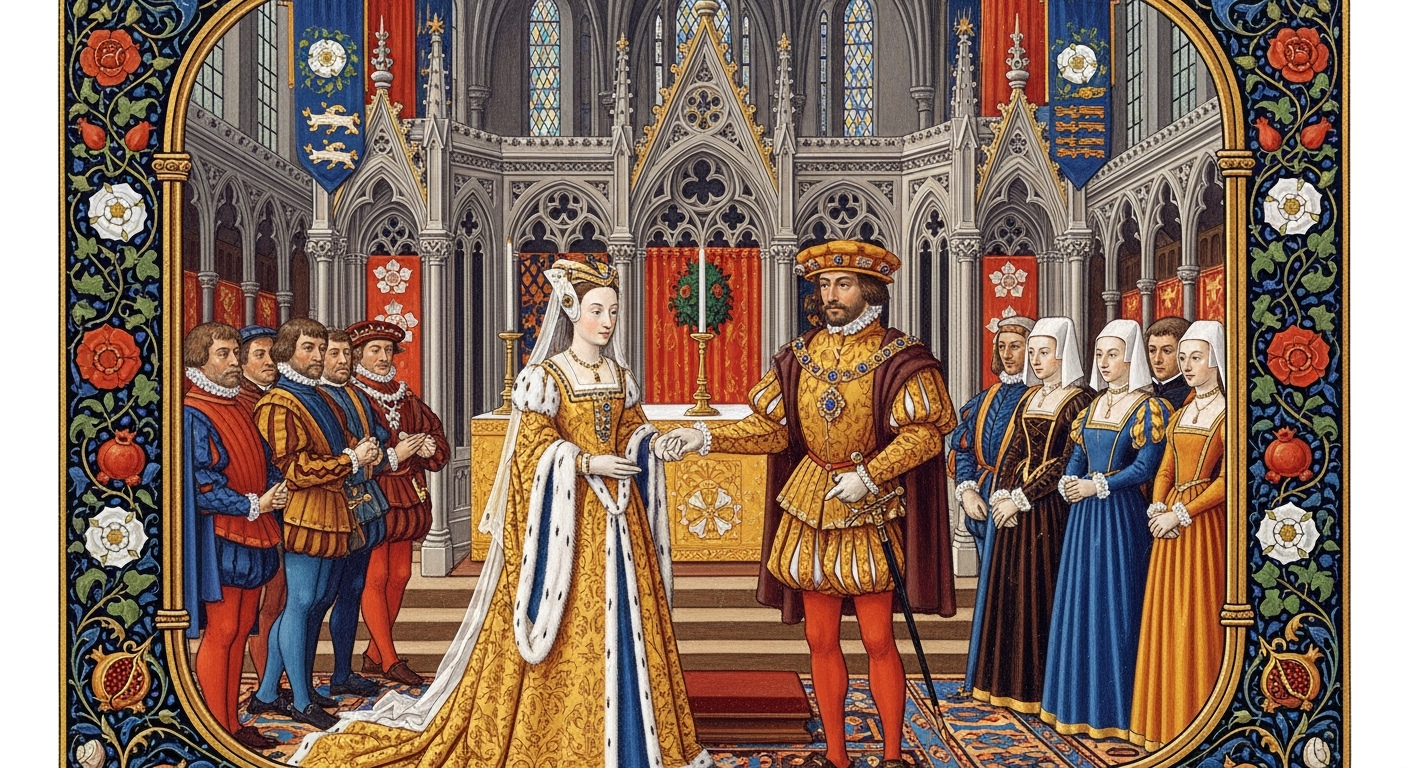
The young widow found herself in an impossible position. Her marriage to Arthur had been brief and, by her own testimony, never consummated. This detail would prove crucial decades later, but at the time, it was her potential value as a bride that mattered most. After years of diplomatic negotiations and uncertainty, Catherine married the newly crowned Henry VIII on 11 June 1509, just weeks after he ascended the throne following his father’s death.
The early years of their marriage appeared blessed. Contemporary accounts describe Henry as utterly besotted with his wife, who was both beautiful and intellectually accomplished. Catherine was six years Henry’s senior and brought considerable sophistication to the English court. She spoke multiple languages, was well-educated in classical literature, and possessed the political acumen expected of a daughter of the Spanish monarchs who had completed the Reconquista and funded Christopher Columbus’s voyages.
However, the marriage’s greatest challenge emerged early: the couple’s struggle to produce a surviving male heir. Catherine endured multiple pregnancies, miscarriages, and infant deaths. Their only surviving child was Princess Mary, born in 1516. As documented in J.J. Scarisbrick’s definitive biography ‘Henry VIII’ (1997), this lack of a male heir increasingly consumed Henry’s thoughts and began to strain their relationship, particularly as the king approached his forties.
Significance and Impact
The breakdown of Henry and Catherine’s marriage triggered the most significant religious and political upheaval in English history since the Norman Conquest. By the late 1520s, Henry had convinced himself that his marriage was cursed by God due to the biblical prohibition in Leviticus against marrying one’s brother’s widow. This ‘great matter’, as it became known, would consume English politics for years and ultimately lead to England’s break with Rome.
The annulment proceedings, which began in earnest around 1527, represented far more than a personal dispute. They challenged the very foundations of papal authority in England. When Pope Clement VII refused to annul the marriage, partly due to pressure from Catherine’s nephew, the Holy Roman Emperor Charles V, Henry took the unprecedented step of declaring himself Supreme Head of the Church of England through the Act of Supremacy in 1534.
Catherine’s steadfast refusal to accept the annulment demonstrated remarkable personal courage and had profound political consequences. She maintained until her death in 1536 that she was Henry’s only true wife and England’s rightful queen. Her resistance wasn’t merely personal; it represented the last stand of the old Catholic order in England. As recorded in the Letters and Papers, Foreign and Domestic, Henry VIII, Volume 6 (1533), her dignity throughout the proceedings earned widespread public sympathy and made her a symbol of resistance to religious change.
The social impact extended far beyond the royal court. The annulment proceedings divided English society, with many ordinary people supporting Catherine while the political establishment gradually aligned with the king. The dissolution of the marriage also meant that Princess Mary was declared illegitimate, creating a succession crisis that would haunt England for decades and ultimately contribute to the religious instability of the mid-sixteenth century.
Connections and Context
The timing of Henry’s pursuit of annulment coincided with his passionate infatuation with Anne Boleyn, who had arrived at court around 1522. Unlike Catherine, Anne represented youth, fertility, and the promise of sons. The contrast between the two women symbolised Henry’s desperate desire to start afresh and secure his dynasty. Anne’s pregnancy in 1532 forced Henry’s hand, leading to their secret marriage and the final break with Catherine.
The annulment also occurred against the backdrop of the wider European Reformation. While Henry’s motives were primarily dynastic rather than theological, his break with Rome aligned England with the broader Protestant movement sweeping across northern Europe. This religious revolution was simultaneously taking place in German states, Switzerland, and Scandinavia, suggesting that England’s break with Rome, while triggered by the ‘King’s Great Matter’, was part of a larger historical transformation.
The marriage’s end coincided with other significant developments in Henry’s reign, including the rise of Thomas Cromwell as his chief minister and the beginning of the Dissolution of the Monasteries. These events were interconnected: the wealth seized from dissolved religious houses helped fund Henry’s increasingly expensive court and military ambitions, while Cromwell’s administrative genius made the complex legal and political manoeuvres of the annulment possible.
Modern Relevance and Fascinating Details
The story of Henry and Catherine’s marriage continues to fascinate modern audiences partly because it demonstrates how personal relationships can reshape entire nations. Their quarter-century union reminds us that behind the grand narratives of historical change lie deeply human stories of love, disappointment, and stubborn pride. Contemporary audiences, familiar with high-profile divorces and custody battles, can easily relate to the personal dynamics involved, even when the stakes seem impossibly high.
Popular culture has embraced this story repeatedly, from Shakespeare’s ‘Henry VIII’ to recent television series like ‘The Tudors’ and ‘Six’. However, these dramatisations often focus on the marriage’s dramatic end rather than its remarkable longevity. The fact that Henry remained faithful to Catherine for the vast majority of their marriage challenges the popular image of him as a serial philanderer. Evidence suggests he had few, if any, extramarital affairs before his pursuit of Anne Boleyn began in earnest.
Did you know that Catherine was almost certainly the first woman to act as regent of England in her own right? During Henry’s military campaigns in France in 1513, she governed the kingdom and even oversaw the defeat of Scottish forces at the Battle of Flodden. This demonstrates the genuine partnership that existed in their marriage’s early years, when Henry trusted her with the kingdom’s governance. Such was her capability that she continued to correspond with European monarchs about English foreign policy long after her marriage had been annulled, much to Henry’s irritation.
Conclusion
The 24-year marriage between Henry VIII and Catherine of Aragon stands as one of history’s most consequential relationships. What began as a diplomatic arrangement became a genuine partnership that shaped English politics, religion, and culture for a generation. Their union’s ultimate failure triggered the English Reformation, established the Church of England, and set precedents for royal supremacy that would influence English governance for centuries.
Understanding this marriage’s true significance requires looking beyond its dramatic end to appreciate its remarkable duration and the profound changes it witnessed and caused. From the young couple who married in 1509 to the bitter adversaries of 1533, Henry and Catherine’s relationship encapsulates the personal cost of political power and the enduring human drama that lies at the heart of all historical change. For those interested in exploring Tudor history further, their story offers an ideal starting point for understanding how individual choices can reshape entire civilisations.