
Introduction
In the annals of British history, few events carry the dramatic weight and lasting consequences of the Battle of Flodden, fought on 9th September 1513. This wasn’t merely another medieval skirmish, but a catastrophic turning point that would see Scotland’s King James IV become the last reigning monarch to die in battle on British soil. The battlefield in Northumberland would claim not only a king’s life but virtually wipe out an entire generation of Scottish nobility, leaving the northern kingdom devastated and vulnerable for decades to come.
The battle emerged from the complex web of early Tudor politics, where Henry VIII’s ambitions on the continent collided with Scotland’s ancient alliance with France. What began as a strategic move in Henry’s French campaigns would culminate in one of the most decisive and devastating battles ever fought between England and Scotland, fundamentally altering the balance of power across the British Isles.
Understanding Flodden requires examining not just the clash of arms on that September day, but the personalities, politics, and consequences that made this battle a pivotal moment in Tudor history, one whose effects would resonate through the reigns of Henry VIII and beyond.
Historical Background
King James IV of Scotland was, by all accounts, a Renaissance prince in the truest sense. Cultured, multilingual, and ambitious, he had transformed Scotland into a more modern kingdom during his reign that began in 1488. However, his relationship with his brother-in-law Henry VIII was complex and increasingly strained. Despite being married to Henry’s sister Margaret Tudor in 1503, a union designed to secure peace between the kingdoms, James found himself caught between his family ties to England and Scotland’s traditional alliance with France.
The immediate catalyst for conflict came in 1513 when Henry VIII launched his invasion of France, seeking military glory and territorial gains. Louis XII of France, facing English forces, activated the ‘Auld Alliance’ with Scotland, calling upon James IV to honour the ancient pact by opening a second front against England. Contemporary chronicler John Stow recorded how French gold and promises influenced the Scottish decision, though James needed little encouragement given his own ambitions and concerns about English expansion.
James assembled what was arguably the finest army Scotland had ever fielded. Drawing from across his kingdom, he gathered approximately 30,000 men, including virtually the entire Scottish nobility. The army was well-equipped by the standards of the day, featuring both traditional Scottish weapons and newer continental innovations. James had invested heavily in artillery, importing guns from France and establishing foundries in Edinburgh, making his force one of the most modern in Europe.
The English response was initially led by Thomas Howard, Earl of Surrey, a veteran soldier in his seventies who had served the Tudor dynasty faithfully. With Henry VIII campaigning in France, Surrey commanded perhaps 20,000 English troops, including experienced border fighters familiar with Scottish tactics. The two armies met near the village of Branxton in Northumberland, after James had conducted a successful siege of Norham Castle and ravaged the English borderlands.
Significance and Impact
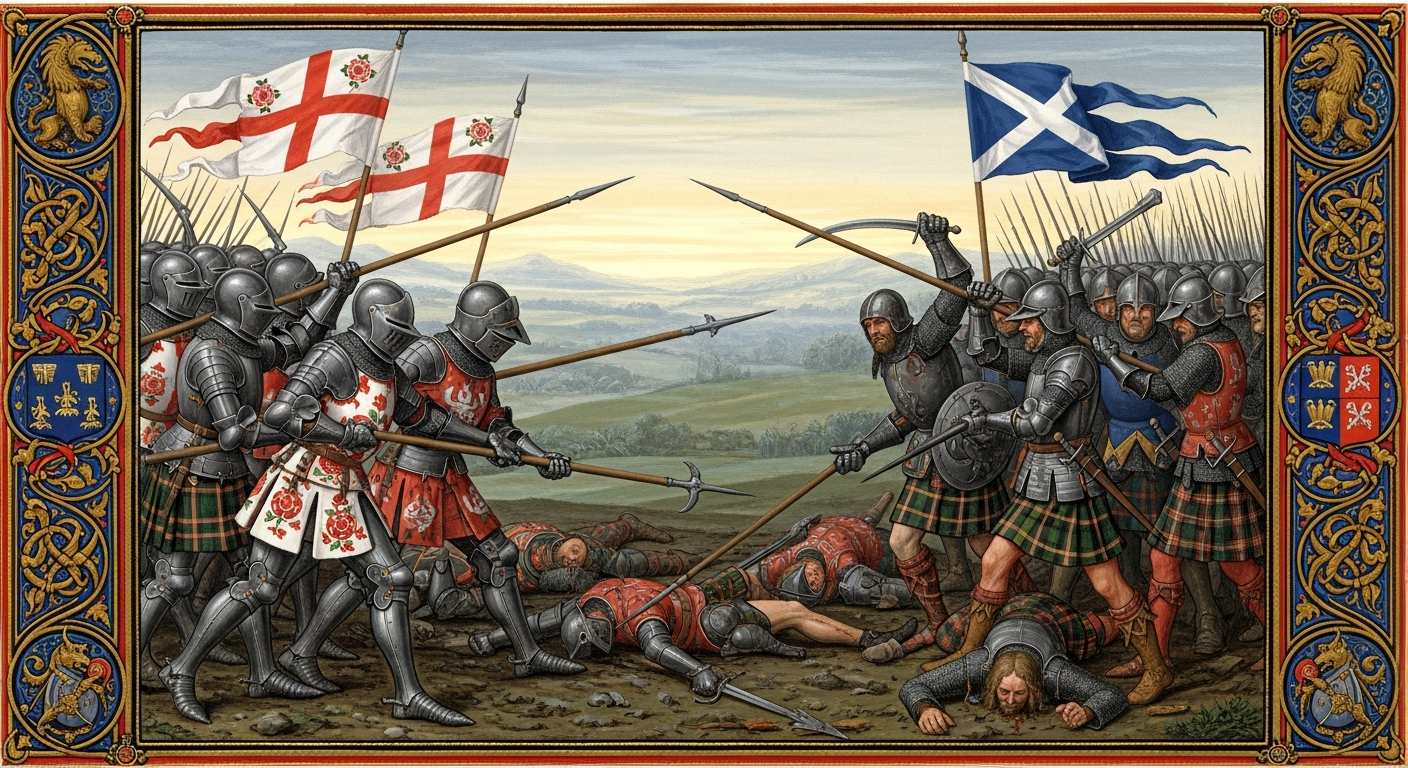
The battle itself was a tactical disaster for Scotland. Despite initial advantages in position and artillery, James IV made the fatal decision to abandon his strong defensive position on Flodden Hill to engage the English in close combat. Norman Macdougall, in his authoritative biography ‘James IV’, argues that the king’s chivalric ideals and personal courage ultimately doomed his army, as medieval notions of knightly honour clashed with early modern military realities.
The human cost was staggering. James IV died fighting in the front ranks alongside his men, his body later identified among the Scottish dead by the English. The contemporary estimate of 10,000 Scottish casualties, recorded by John Stow and other chroniclers, represented a demographic catastrophe for Scotland. Among the dead were an archbishop, two bishops, two abbots, twelve earls, thirteen lords, and five eldest sons of peers. Entire noble families were extinguished in a single afternoon.
The political ramifications were immediate and profound. James IV’s heir, James V, was barely seventeen months old, necessitating a regency that would struggle with internal divisions and English interference for years. Scotland’s military capacity was so diminished that the kingdom could no longer function as an effective counterweight to English power. This weakness would plague Scottish politics throughout Henry VIII’s reign and beyond, creating opportunities for English influence that previous generations of Scottish kings had successfully resisted.
The victory also transformed Henry VIII’s position. Though he was campaigning in France when the battle occurred, Flodden eliminated England’s most persistent strategic threat. The success allowed Henry to pursue his continental ambitions with greater confidence, knowing that Scotland could no longer effectively support France through the Auld Alliance. Surrey’s victory elevated the Howard family’s standing at court, though this would later prove a double-edged sword in Tudor politics.
Connections and Context
Flodden occurred during a crucial period in European politics, when the League of Cambrai and subsequent Holy League were reshaping alliances across the continent. Henry VIII’s French campaign of 1513 was part of his broader attempt to establish England as a major European power, competing with France and the Holy Roman Empire. The Scottish campaign, therefore, must be understood not as an isolated Anglo-Scottish conflict but as part of these wider continental struggles.
The battle also marked a significant moment in military history. The effectiveness of English billmen against Scottish pikemen demonstrated the continuing evolution of infantry tactics, while the relatively limited impact of artillery foreshadowed debates about military innovation that would continue throughout the Tudor period. The lessons learned at Flodden would influence English military thinking for generations, particularly regarding border warfare and the integration of different weapon systems.
Interestingly, Flodden’s aftermath would eventually contribute to one of Henry VIII’s most famous problems. The regency of Scotland under Margaret Tudor, James IV’s widow and Henry’s sister, created complex diplomatic situations that would later influence Henry’s approach to the ‘Great Matter’ of his marriage to Catherine of Aragon. The weakness of Scotland also affected Henry’s later attempts to arrange marriages for his own heirs, as the reduced status of the Scottish royal house changed the calculus of dynastic alliances.
Modern Relevance and Fascinating Details
Five centuries later, Flodden continues to fascinate historians and the general public alike, largely because it represents such a complete reversal of fortune achieved in a single day. Did you know that James IV’s body wasn’t immediately recognised among the Scottish dead? English soldiers initially failed to identify the fallen king, and it was only when Surrey himself examined the corpse that James was positively identified by courtiers who had known him personally.
The battle has inspired numerous works of historical fiction, from Sir Walter Scott’s ‘Marmion’ to modern novels exploring the personal tragedies behind the political catastrophe. As a historical fiction author, I’m particularly drawn to the human stories embedded within this vast tragedy: the nobles who saw their entire world collapse in an afternoon, the widows left to navigate a dangerous political landscape, and the young James V who would grow up in the shadow of his father’s defeat.
Modern archaeological work at the battlefield has revealed fascinating details about the actual fighting. Metal detecting has uncovered arrows, gun parts, and personal effects that illuminate how the battle unfolded. These discoveries have challenged some traditional accounts of the fighting, suggesting that the battle was more complex and protracted than earlier historians believed. The finds also reveal the international nature of the armies, with weapons and equipment from across Europe represented in the archaeological record.
Perhaps most intriguingly, recent research has highlighted the role of weather and terrain in the battle’s outcome. The boggy ground that hampered the Scottish advance, the rain that affected the effectiveness of firearms, and the late afternoon light that may have confused Scottish formations all played crucial roles in determining the result. These factors remind us that even the grandest political strategies can founder on the most basic environmental realities.
Conclusion
The Battle of Flodden stands as one of the most consequential single days in British history. In the space of a few hours, the political landscape of the British Isles was permanently altered, Scotland’s independence was compromised for generations, and the Tudor dynasty’s security was immeasurably strengthened. The death of James IV marked not just the end of a king but the conclusion of Scotland’s medieval independence and the beginning of a long decline that would ultimately lead to the Union of Crowns under James VI and I.
For students of Tudor history, Flodden offers crucial insights into the period’s military, political, and social dynamics. It demonstrates how personal relationships between monarchs could escalate into national catastrophes, how military technology and tactics were evolving, and how a single battle could reshape the balance of power across multiple kingdoms. The echoes of that September day in 1513 would reverberate through the courts of Henry VIII, Elizabeth I, and beyond, making Flodden not just a Scottish tragedy but a defining moment in the broader story of early modern Britain.