
Introduction
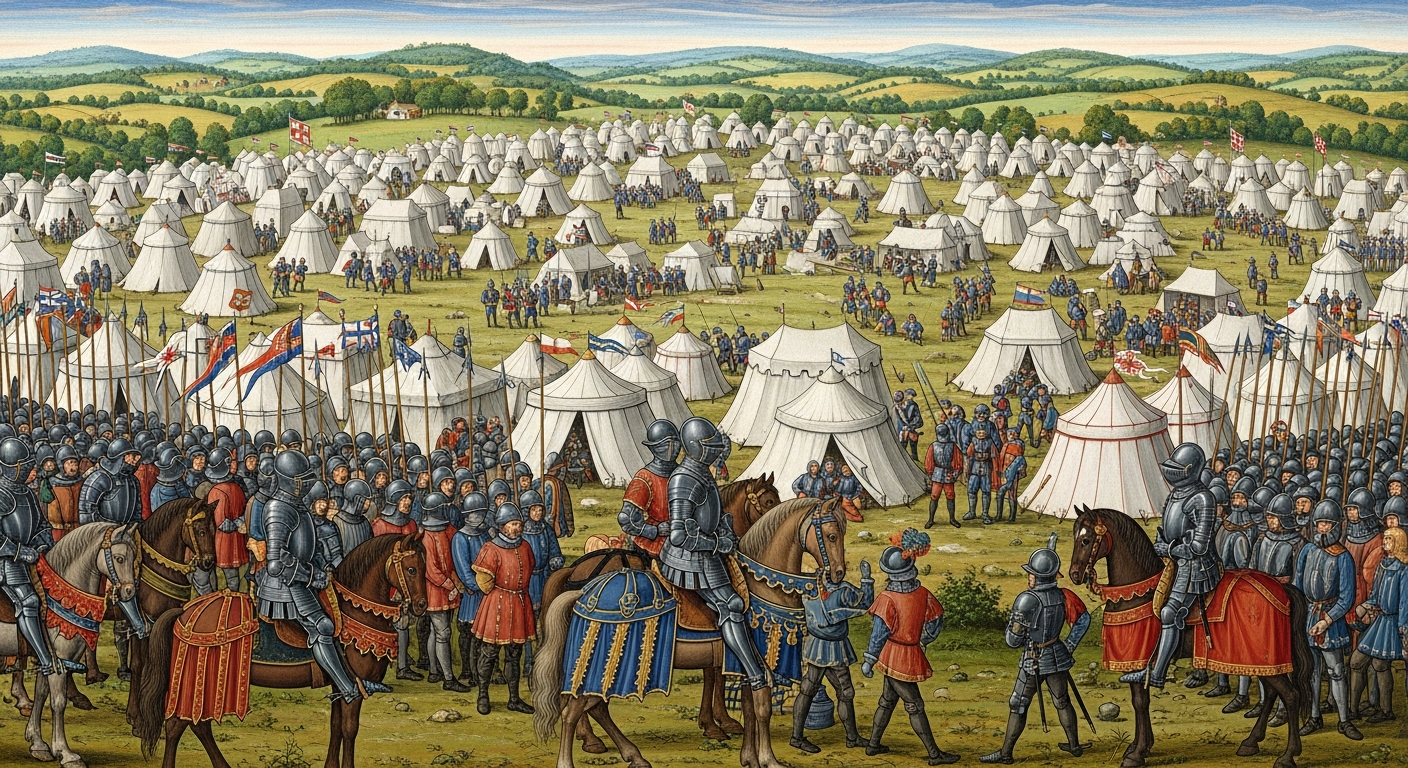
Picture this: it’s 1544, and England’s most infamous monarch, Henry VIII, is personally leading over 40,000 troops across the Channel into France. At 53 years old, overweight, and struggling with painful leg ulcers, the aging king still insisted on commanding what would become one of the largest English armies ever assembled during the Tudor period. This wasn’t just another royal military adventure – it was Henry’s final and most ambitious campaign, targeting the strategic French port city of Boulogne.
The Siege of Boulogne represents a fascinating paradox in Tudor history: a military success that nearly destroyed England’s finances – very nearly a pyrrhic victory. Whilst Henry VIII achieved his objective of capturing this important fortified city, the astronomical costs of maintaining such a massive army would haunt English treasury records for years to come. This campaign offers us a unique window into the complexities of 16th-century warfare, royal ambition, and the delicate balance between military glory and fiscal responsibility.
In exploring this pivotal moment, we’ll uncover how Henry’s personal command shaped the siege, examine the staggering financial implications of Tudor military campaigns, and discover why this ‘successful’ victory marked both the pinnacle and the beginning of the end of Henry’s military ambitions.
Historical Background
The Siege of Boulogne took place during the later phase of the Italian Wars, a series of conflicts that had embroiled European powers for decades. By 1544, Henry VIII found himself in an unusual alliance with Holy Roman Emperor Charles V against their common enemy, France. The strategic importance of Boulogne cannot be overstated – this heavily fortified port city served as a crucial gateway between France and England, controlling vital shipping routes across the English Channel.
Henry’s decision to personally lead this campaign stemmed from both strategic considerations and personal motivations. According to the Letters and Papers of Henry VIII, Volume 19, housed in the National Archives, the king was determined to prove that England could project military power on a scale comparable to its European rivals. The timing was significant: this campaign represented Henry’s attempt to capitalise on French vulnerabilities whilst maintaining his alliance with Charles V.
The siege officially commenced in July 1544, with Henry establishing his headquarters and overseeing the complex logistics required to maintain over 40,000 troops in enemy territory. As historian Charles Cruickshank details in ‘Henry VIII and the Invasion of France’, the sheer scale of this operation required unprecedented coordination of supplies, artillery, and personnel across the Channel. The English forces included professional soldiers, foreign mercenaries, and levied troops from across Henry’s domains.
The campaign itself lasted through the summer months, with English forces systematically reducing French defensive positions around Boulogne. Henry’s presence on the battlefield wasn’t merely ceremonial – contemporary accounts describe him actively participating in strategic planning sessions and maintaining direct communication with his commanders. The city finally capitulated in September 1544, marking what appeared to be a triumphant conclusion to Henry’s military leadership.
Significance and Impact
The capture of Boulogne represented far more than a tactical victory; it demonstrated the evolved nature of Tudor military capabilities under Henry VIII’s reign. This campaign showcased England’s ability to project substantial military force across the Channel, coordinate complex siege operations, and maintain extended supply lines – achievements that positioned England as a serious European military power rather than merely an island kingdom.
However, the financial implications proved devastating for the English treasury. The costs of maintaining over 40,000 troops, transporting massive artillery pieces, and sustaining a months-long siege operation stretched England’s resources to breaking point. Contemporary financial records reveal that the campaign consumed approximately £650,000 – an astronomical sum that represented nearly twice the crown’s annual income. This expenditure forced Henry to resort to debasing the currency and selling off monastic lands at an accelerated pace.
The siege also marked a significant evolution in English military organisation and technology. Henry’s army employed some of the most advanced siege artillery of the period, including massive cannons specifically designed for reducing fortified positions. The logistical achievement of transporting and coordinating such forces demonstrated sophisticated administrative capabilities that would influence English military planning for generations.
Perhaps most significantly, this campaign represented Henry VIII’s final personal military command. The physical strain of the campaign, combined with the king’s deteriorating health, meant that future military operations would be delegated to his commanders. In many ways, Boulogne marked the end of an era in which English monarchs personally led their armies into battle, transitioning towards the more administrative royal military oversight that would characterise later Tudor reigns.
Connections and Context
The Siege of Boulogne occurred during a particularly turbulent period in Henry VIII’s reign, coinciding with ongoing religious reforms and domestic political challenges. Whilst Henry was campaigning in France, his regime continued implementing Protestant reforms at home, creating an interesting juxtaposition between external military adventure and internal religious transformation. This timing reflects Henry’s complex political calculations – foreign military success could bolster domestic authority whilst distracting from controversial religious policies.
The campaign also connects to broader patterns in Henry’s foreign policy throughout the 1540s. Following his break with Rome and the dissolution of the monasteries, Henry needed to establish England’s continued relevance in European politics. The alliance with Charles V and the successful siege of Boulogne served to demonstrate that England remained a formidable European power despite its religious isolation from Catholic Europe.
Interestingly, the siege occurred just two years after Henry’s previous French campaign and the Battle of the Spurs, suggesting a sustained period of military ambition during the latter part of his reign. This military focus also coincided with significant naval developments, including the expansion of the Royal Navy and the construction of coastal fortifications. The resources devoted to Boulogne must be understood within this broader context of comprehensive military modernisation.
Modern Relevance and Fascinating Details
Modern military historians find the Siege of Boulogne particularly fascinating for its insights into 16th-century logistics and command structures. The challenge of coordinating over 40,000 troops using pre-industrial communication methods offers valuable perspectives on historical military organisation. Contemporary project managers might recognise familiar challenges in Henry’s coordination of multiple supply chains, personnel management, and strategic planning across international boundaries.
Did you know that Henry VIII’s personal involvement in the siege included detailed correspondence about artillery placement and supply routes? The surviving letters reveal a monarch deeply engaged with tactical details, contradicting popular images of Henry as merely a ceremonial commander. His communications demonstrate sophisticated understanding of siege warfare principles and practical military logistics.
The siege also provides excellent material for historical fiction authors exploring themes of leadership, ambition, and the costs of power. The inherent drama of an aging, physically compromised king insisting on personal military command whilst his kingdom’s finances hemorrhaged creates compelling narrative possibilities. Popular culture has generally overlooked this campaign in favour of Henry’s more famous domestic dramas, yet the siege offers rich material for exploring Tudor military culture and royal authority.
Archaeological investigations around Boulogne have uncovered fascinating details about the siege, including English artillery positions and temporary fortifications. These discoveries help us understand the practical realities of 16th-century siege warfare and the physical evidence of Henry’s military ambitions. Such findings continue to refine our understanding of Tudor military capabilities and the historical accuracy of contemporary accounts.
Conclusion
The Siege of Boulogne stands as a remarkable culmination of Henry VIII’s military ambitions and a sobering reminder of the relationship between royal glory and national resources. Whilst Henry successfully demonstrated England’s military capabilities and secured a strategically important French port, the campaign’s astronomical costs fundamentally weakened England’s financial position and constrained future policy options.
This campaign deserves recognition not merely as Henry’s final military adventure, but as a pivotal moment that reveals the complexities of Tudor statecraft, the evolution of English military capabilities, and the personal costs of royal ambition. For anyone seeking to understand Henry VIII beyond his matrimonial dramas, the Siege of Boulogne offers invaluable insights into the king’s military leadership, strategic thinking, and the broader challenges facing Tudor England in an increasingly complex European political landscape.