
Introduction
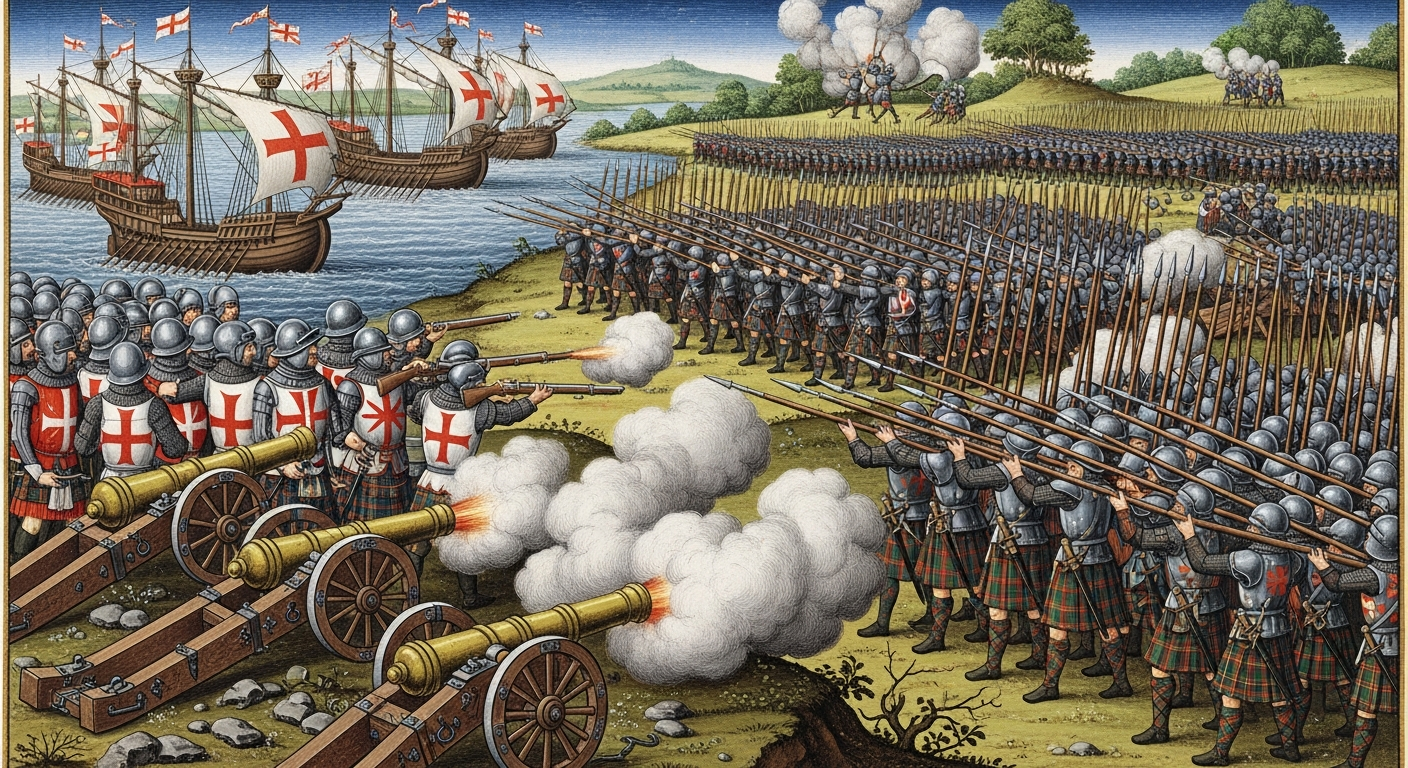
On a misty September morning in 1547, the thunder of cannons and the crash of naval bombardment forever changed the nature of warfare on British soil. The Battle of Pinkie Cleugh, fought on 10th September 1547, represents a pivotal moment when medieval warfare gave way to early modern military tactics, marking the first major English victory achieved primarily through coordinated artillery and naval gunfire. As English ships positioned in the Firth of Forth rained destruction upon Scottish positions whilst land-based cannons systematically dismantled traditional pike formations, this engagement demonstrated the devastating effectiveness of combined arms tactics that would define military strategy for centuries to come.
This battle, occurring during what historians call ‘the rough wooing’ of Scotland, was far more than a simple military engagement. It represented the culmination of English attempts to force a marriage between the infant Mary, Queen of Scots, and the young Edward VI, thereby uniting the crowns of England and Scotland under English dominance. The resounding English victory at Pinkie Cleugh would have profound implications for Anglo-Scottish relations, military technology, and the broader political landscape of 16th-century Britain.
Through examining this remarkable battle, we’ll discover how innovative military tactics, political ambition, and technological advancement converged to create one of the most significant yet underappreciated conflicts of the Tudor era. From the eyewitness accounts of William Patten to modern historical analysis, the story of Pinkie Cleugh reveals fascinating insights into warfare, diplomacy, and the relentless march of military innovation.
Historical Background
The Battle of Pinkie Cleugh emerged from a complex web of dynastic politics and military ambition that had been brewing since the death of James V of Scotland in December 1542. When James died, leaving behind his six-day-old daughter Mary as Queen of Scots, it presented an irresistible opportunity for Henry VIII of England. The English king immediately proposed a marriage between the infant Mary and his own son Edward, then Prince of Wales, which would effectively bring Scotland under English control through dynastic union.
However, the Scottish Parliament and regent, James Hamilton, Earl of Arran, ultimately rejected this proposal in favour of maintaining Scotland’s traditional alliance with France. This decision infuriated Henry VIII, who launched a series of brutal military campaigns designed to coerce Scottish compliance through force. These campaigns, mockingly dubbed ‘the rough wooing’ by contemporaries, devastated the Scottish Borders and culminated in significant English victories, including the Battle of Solway Moss in 1542.
By 1547, Henry VIII had died, but his successor, Edward Seymour (now Duke of Somerset and Lord Protector for the young Edward VI), continued the aggressive policy towards Scotland with renewed vigour. Somerset assembled a formidable invasion force of approximately 16,000 men, supported by a substantial naval fleet under Lord Clinton. This represented one of the largest and most technologically advanced military expeditions ever launched against Scotland, featuring extensive artillery trains and coordinated naval support.
The Scottish response was led by James Hamilton, Earl of Arran, who managed to assemble roughly 23,000 troops near Musselburgh, just east of Edinburgh. Despite their numerical advantage, the Scots remained heavily dependent on traditional pike formations and had limited artillery support. When the two armies met near the village of Pinkie Cleugh on 10th September 1547, the stage was set for a confrontation that would demonstrate the revolutionary impact of gunpowder technology on battlefield tactics.
Significance and Impact
The Battle of Pinkie Cleugh marked a watershed moment in military history, representing the first time that coordinated artillery and naval gunfire determined the outcome of a major engagement on British soil. William Patten, who accompanied Somerset’s expedition and later published ‘The Expedition into Scotland’ in 1548, provided a vivid eyewitness account of how English cannons systematically destroyed Scottish pike squares whilst naval bombardment from the Firth of Forth prevented Scottish manoeuvres and escape routes. This tactical innovation would influence military thinking across Europe and herald the decline of traditional medieval warfare.
The immediate political consequences proved equally significant. The crushing Scottish defeat, which resulted in an estimated 5,000 to 10,000 Scottish casualties compared to fewer than 500 English losses, effectively ended organised Scottish resistance for several years. Somerset’s forces occupied Edinburgh and established a series of fortified positions throughout southern Scotland, bringing English control closer to reality than at any point since the Wars of Scottish Independence. The victory also demonstrated England’s growing military sophistication under Tudor rule, showcasing the kingdom’s ability to project power through technological superiority rather than mere numerical advantage.
Perhaps most importantly, Pinkie Cleugh accelerated Scotland’s pivot towards France and ultimately contributed to the failure of English unification plans. The devastating defeat convinced many Scots that accommodation with England was impossible, strengthening support for the Auld Alliance with France. In 1548, the young Mary Queen of Scots was spirited away to France for her protection, where she would eventually marry the Dauphin Francis, completely undermining English matrimonial schemes. As historian Gervase Phillips notes in ‘The Anglo-Scots Wars 1513-1550’, the very completeness of the English victory at Pinkie Cleugh may have made Scottish submission politically impossible.
The battle also had profound implications for military development across Europe. News of the coordinated artillery and naval tactics employed at Pinkie Cleugh spread rapidly among military theorists and commanders, contributing to the evolution of early modern warfare. The success of combined arms tactics demonstrated at this battle would influence military thinking from the Italian Wars to the conflicts of the following century, establishing principles that remained relevant well into the gunpowder age.
Connections and Context
The Battle of Pinkie Cleugh cannot be understood in isolation from the broader context of Tudor military and political development. The tactics employed by Somerset’s forces built directly upon innovations developed during Henry VIII’s later campaigns, particularly the increasing emphasis on artillery that characterised English military thinking from the 1540s onwards. The battle also demonstrated the growing importance of naval power in supporting land operations, a concept that would become central to English military doctrine and ultimately contribute to the nation’s later maritime supremacy.
The timing of Pinkie Cleugh proved particularly significant within the broader European context of 1547. Whilst England was demonstrating its military prowess against Scotland, the Holy Roman Emperor Charles V was achieving his great victory over Protestant forces at the Battle of Mühlberg in April of the same year. These simultaneous conflicts illustrated the religious and political tensions that characterised mid-16th-century Europe, with military innovation driven by the constant warfare between competing dynasties and faiths.
The battle also connects to the broader narrative of English state-building under the Tudors. Somerset’s campaign represented not merely military conquest but an attempt at administrative integration, with plans to establish permanent English garrisons and governmental structures throughout Scotland. This ambitious vision of unified British government under English leadership would resurface repeatedly in subsequent centuries, making Pinkie Cleugh an important precursor to later union attempts. The failure of this particular effort highlights the persistent challenges of imposing political unity through military conquest, lessons that would prove relevant to English policy in Ireland and, much later, imperial ventures worldwide.
Modern Relevance and Fascinating Details
The Battle of Pinkie Cleugh offers remarkable insights into the revolution in military affairs that characterised the early modern period, making it particularly relevant to contemporary discussions about technological disruption in warfare. Just as 16th-century commanders grappled with the implications of gunpowder technology for traditional tactics, modern military theorists continue to analyse how emerging technologies transform battlefield dynamics. The coordination between land and naval forces at Pinkie Cleugh also prefigures modern joint operations doctrine, demonstrating principles that remain fundamental to military planning today.
Did you know that the English naval bombardment at Pinkie Cleugh was so precise that Scottish survivors reported being unable to distinguish between the sound of incoming naval gunfire and land-based artillery? This level of coordination was unprecedented for its time and required sophisticated communication systems between ship-based and land-based commanders. The battle also featured one of the earliest recorded uses of mobile field artillery in British warfare, with English guns being repositioned during the engagement to exploit tactical advantages.
Despite its historical significance, Pinkie Cleugh remains relatively unknown compared to more famous battles like Flodden or Culloden, perhaps because its technical innovations overshadowed the traditional heroic narratives that capture popular imagination. However, the battle has begun to attract attention from historical fiction writers and military historians interested in the technological transformation of warfare. The dramatic contrast between medieval Scottish tactics and early modern English innovations provides compelling material for understanding how societies adapt to technological change, making Pinkie Cleugh increasingly relevant to contemporary audiences interested in military history and technological disruption.
Conclusion
The Battle of Pinkie Cleugh stands as a fascinating intersection of military innovation, political ambition, and historical transformation that deserves greater recognition in the narrative of British history. As the first major victory achieved primarily through coordinated artillery and naval gunfire, it marked a decisive shift from medieval to early modern warfare whilst simultaneously illustrating the complex relationship between military success and political achievement. The battle’s immediate tactical brilliance ultimately contributed to the strategic failure of English unification plans, demonstrating that overwhelming military victory does not necessarily translate into lasting political control.
For modern readers interested in Tudor history, military innovation, or the complex relationship between England and Scotland, Pinkie Cleugh offers a wealth of insights into how technological advancement, strategic thinking, and political calculation shaped the development of early modern Britain. The eyewitness accounts, archaeological evidence, and scholarly analysis surrounding this battle continue to provide new perspectives on the transformation of warfare and the persistent challenges of creating political unity through military conquest. Whether viewed as a triumph of military innovation or a cautionary tale about the limits of force in achieving political objectives, the Battle of Pinkie Cleugh remains a compelling chapter in the story of Tudor England and its enduring impact on British history.