
Introduction
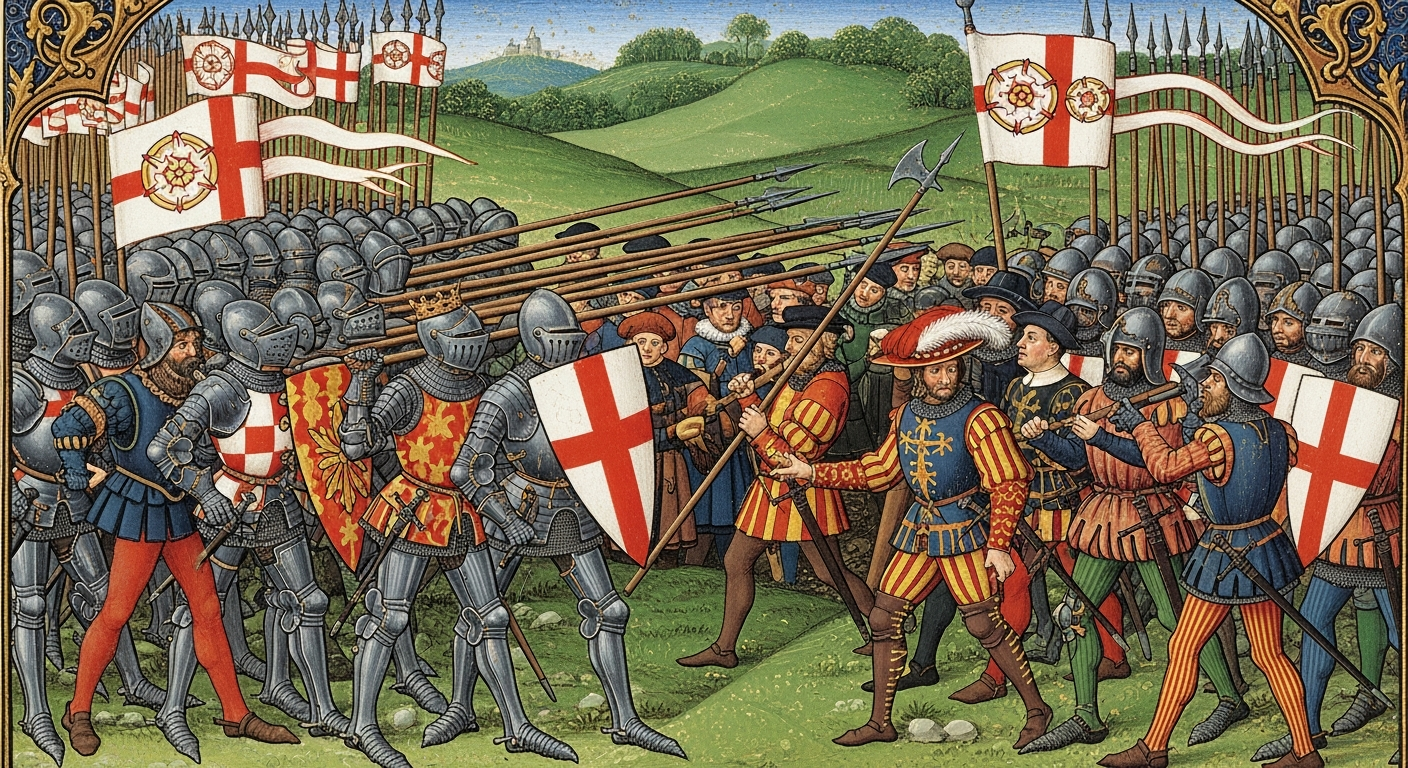
On a summer’s day in 1487, the clatter of arms and the war cries of German mercenaries echoed across the fields of Nottinghamshire as Henry VII faced what would prove to be his greatest military test. The Battle of Stoke Field on June 16, 1487, was far more than a domestic rebellion – it was an international conflict that brought over 2,000 foreign professional soldiers to English soil to challenge the Tudor dynasty’s right to rule. This extraordinary confrontation would mark the final battle of the Wars of the Roses and represent the last time a reigning English monarch would personally face German troops in combat on home ground.
What makes this battle particularly fascinating is how it combined the dying gasps of medieval feudal warfare with the emerging realities of Renaissance military professionalism. Here was a king barely two years on the throne, having won his crown at Bosworth Field, now forced to defend it against a ten-year-old pretender backed by some of Europe’s most feared mercenaries. The stakes could not have been higher – the very survival of the Tudor dynasty hung in the balance.
This pivotal moment reveals much about the precarious nature of royal authority in late 15th-century England, the international dimensions of English politics, and the transition from the chaotic Wars of the Roses to the more stable Tudor era that would follow.
Historical Background
The central figure in this drama was Lambert Simnel, a young boy of humble origins who became the unlikely focal point for Yorkist resistance to Henry VII’s rule. Simnel, probably the son of an Oxford joiner, was coached by a priest named Richard Simon to impersonate Edward, Earl of Warwick, the legitimate Yorkist claimant to the throne who was actually imprisoned in the Tower of London. The choice of this particular identity was shrewd – Warwick had a stronger hereditary claim to the English throne than Henry VII himself.
The rebellion gained serious momentum when it attracted the support of John de la Pole, Earl of Lincoln, who was himself a potential claimant to the throne as the nephew of both Edward IV and Richard III. More crucially, the conspiracy secured the backing of Margaret of Burgundy, Edward IV’s sister, who provided the funds to hire a formidable force of German mercenaries. These professional soldiers, numbering around 2,000, were seasoned veterans who brought continental military expertise to what might otherwise have been a straightforward domestic uprising.
The Great Chronicle of London, a contemporary civic record, documents how news of the rebellion’s international support caused considerable alarm in the capital. Henry VII was forced to recognise that this was no mere pretender’s revolt but a serious military threat backed by foreign powers with their own reasons for wanting to destabilise his regime. The involvement of Margaret of Burgundy was particularly concerning, as it suggested that European powers were testing the strength of the new Tudor monarchy.
The rebel army, comprising German mercenaries, Irish troops, and English Yorkist supporters, landed in Ireland where Simnel was actually crowned as ‘Edward VI’ in Dublin Cathedral. This ceremony, whilst lacking legitimacy, provided a powerful propaganda tool and demonstrated the rebels’ serious intent. From Ireland, the combined force crossed to Lancashire in June 1487, hoping to rally support as they marched towards London. However, they found the English countryside largely unreceptive to their cause, forcing a confrontation with Henry’s royal army near the village of East Stoke in Nottinghamshire.
Significance and Impact
The Battle of Stoke Field proved to be a watershed moment that effectively ended the Wars of the Roses, though this significance was not immediately apparent to contemporaries. Michael Bennett, in his detailed study ‘Lambert Simnel and the Battle of Stoke’, argues that this confrontation was more decisive than many better-known battles precisely because it dealt with the last serious military challenge to Henry VII’s throne backed by substantial foreign support.
The battle’s outcome had profound implications for Tudor governance and English foreign policy. Henry VII’s victory demonstrated that his regime could survive not just domestic opposition but also well-funded international conspiracies. This success allowed the king to begin the process of stabilising royal finances and establishing the administrative foundations that would characterise Tudor rule. The defeat of the German mercenaries also sent a clear message to European powers that England under the Tudors was not a weak state ripe for manipulation.
Perhaps most significantly, the battle established important precedents for how the Tudor monarchy would handle future threats. Henry VII’s decision to fight personally alongside his troops, rather than delegate command to nobles whose loyalty might be questionable, became a hallmark of early Tudor kingship. This hands-on approach to royal authority would influence how his son, Henry VIII, later approached military campaigns and royal power.
The aftermath of Stoke Field also revealed Henry VII’s characteristic blend of ruthlessness and pragmatism. Whilst the leaders of the rebellion were executed, the king showed remarkable clemency towards Lambert Simnel himself, employing the boy as a spit-turner in the royal kitchens – a calculated humiliation that demonstrated the pretender’s humble origins whilst avoiding the creation of a martyr. This treatment became part of Tudor political theatre, showing that the dynasty was confident enough to show mercy to defeated enemies.
Connections and Context
The Battle of Stoke Field cannot be understood in isolation from the broader European political landscape of the 1480s. England in this period was emerging from decades of civil war just as other European kingdoms were consolidating their power through professional armies and diplomatic alliances. The involvement of German mercenaries in the Simnel rebellion reflected the increasingly international nature of late medieval warfare, where skilled soldiers moved freely between conflicts across the continent.
The battle also connects to the broader story of Henry VII’s efforts to secure international recognition for his dynasty. The defeat of foreign-backed opposition at Stoke Field strengthened Henry’s position in subsequent negotiations with European powers, including his successful arrangement of the marriage between his eldest son Arthur and Catherine of Aragon. This diplomatic success would have seemed far less likely had Henry failed to demonstrate military competence against international opposition.
Interestingly, the German mercenaries at Stoke Field represented part of a wider trend towards military professionalisation that was transforming European warfare. These soldiers brought with them tactical innovations and disciplined fighting techniques that were becoming standard across the continent. Their defeat by Henry’s largely English army demonstrated that traditional English military methods, when properly organised and led, could still compete with continental innovations.
Modern Relevance and Fascinating Details
Modern historians and historical fiction authors find the Battle of Stoke Field particularly compelling because it encapsulates so many themes that resonate today: fake news and propaganda, international interference in domestic politics, and the role of mercenaries in warfare. The story of Lambert Simnel – a child manipulated by adults for political gain – offers a poignant human dimension to these larger historical forces.
Did you know that the battlefield at Stoke Field remained largely unchanged for centuries, allowing archaeologists and historians to study the site extensively? Recent archaeological work has revealed fascinating details about the deployment of troops and the intensity of the fighting, particularly in the area where the German mercenaries made their final stand. Metal detector finds have included crossbow bolts and other military equipment that provide tangible links to this pivotal day.
The battle has appeared in several historical novels, though often overshadowed by more famous conflicts like Bosworth Field. However, for authors writing about the early Tudor period, Stoke Field offers rich material: the exotic presence of German mercenaries, the pathos of a child pretender, and the high stakes of a dynasty’s survival. The international dimension of the conflict also allows writers to explore the broader European context of English politics, something often missing from more domestically focused historical fiction about this period.
Perhaps most fascinating of all is how the battle demonstrates the rapid transformation of English politics between 1485 and 1487. In just two years, Henry VII had evolved from a relatively unknown exile to a monarch capable of commanding loyalty against professional foreign troops. This transformation speaks to both Henry’s political skill and the war-weariness of a nation ready for stable government after decades of civil conflict.
Conclusion
The Battle of Stoke Field stands as a remarkable testament to the precarious nature of royal authority in late medieval England and the international dimensions of domestic English politics. Henry VII’s victory over Lambert Simnel’s foreign-backed rebellion effectively ended the Wars of the Roses and established the Tudor dynasty on a firmer foundation than many contemporaries thought possible. The presence of over 2,000 German mercenaries on English soil made this far more than a typical pretender’s revolt – it was a serious international challenge that required all of Henry’s military and political skill to overcome.
For modern readers, whether historians, students, or enthusiasts of historical fiction, the Battle of Stoke Field offers insights into a pivotal moment when medieval England was transforming into the early modern state that would dominate European politics under the later Tudors. The human drama of Lambert Simnel, the international intrigue surrounding Margaret of Burgundy’s involvement, and the military significance of professional German soldiers fighting on English soil combine to create a historical episode that deserves to be better known and understood as a crucial chapter in the Tudor story.