
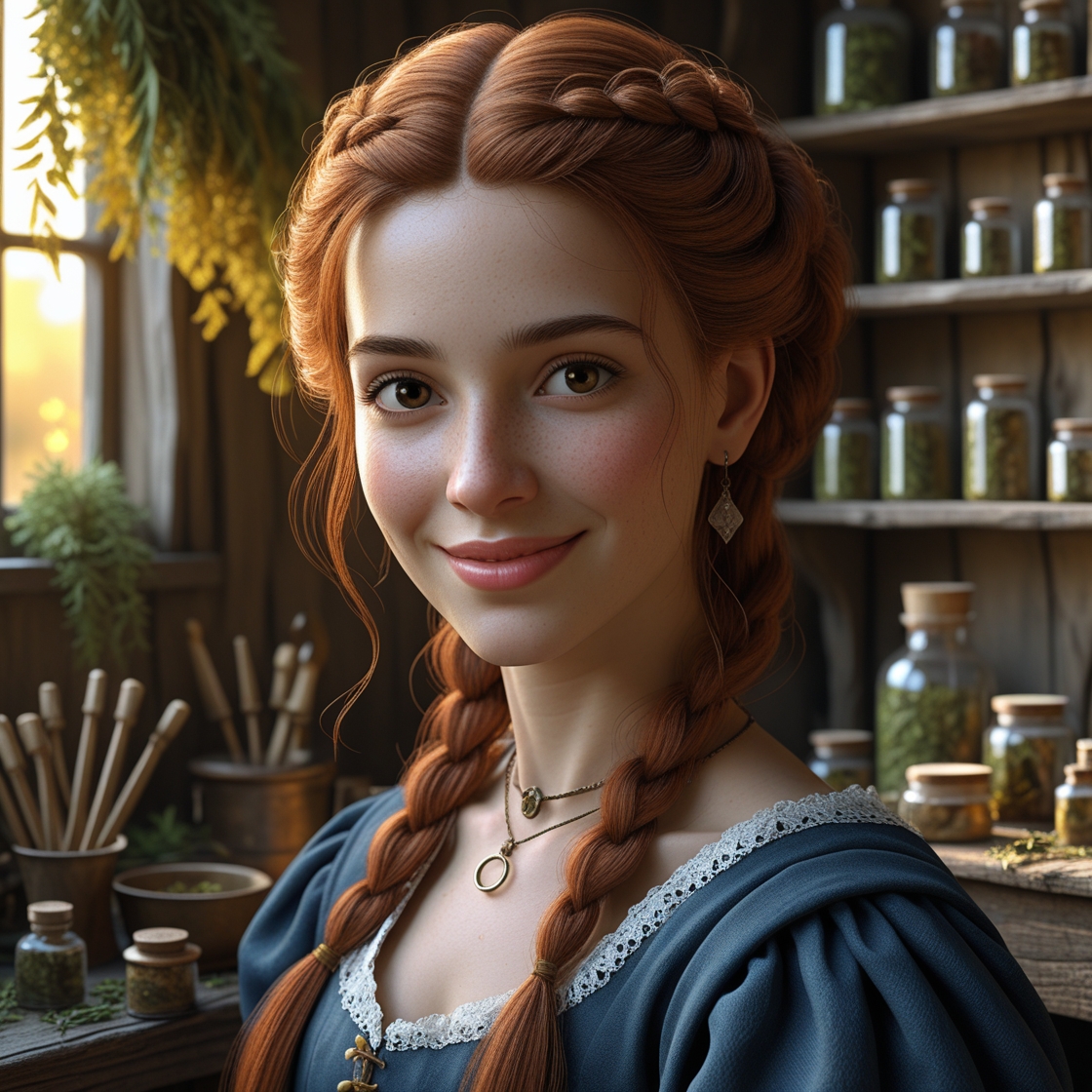
We visit the talented herbalist in her workshop behind the Sorbonne, where she’s grinding willow bark with practiced efficiency
Renaissance Weekly: Madeleine, you’ve become quite the talk of Paris – the youngest licensed apothecary in the city, we’re told. How does it feel to break into such a male-dominated profession?
She pauses in her grinding, wiping her hands on her apron before settling onto a stool. Her dark eyes flash with a mixture of pride and wariness.
Madeleine: It’s… complicated. Every day I have to prove myself twice as capable as any man just to be taken seriously. The guild masters still look at me like I’m playing dress-up in my mother’s workshop.
[She gestures around the neat rows of jars and bottles]
But when Madame Dubois’s colic remedy works perfectly, or when I cure a merchant’s persistent headache, suddenly they forget I’m “just a girl.”
Results speak louder than prejudice, thankfully.
RW: Speaking of your mother, we understand she left quite a legacy. How do you balance honouring her memory with forging your own path?
Her expression softens, and she touches a worn pestle on the workbench – clearly a treasured item.
Madeleine: Maman taught me that plants hold secrets most people never dream of. She was… ambitious. Perhaps too much so.
[Her voice drops to barely above a whisper]
She died pursuing something beyond healing – the great work: The Philosopher’s Stone. Papa thinks I don’t know, but I found her hidden laboratory years ago.
RW: How intriguing! And do you share her… broader interests in the alchemical arts?
She stands abruptly, busying herself with organising already-neat shelves. When she speaks, there’s steel in her voice.
Madeleine: A woman must be very careful about what she admits to knowing. There are things I’ve learned… experiments I’ve conducted… that would see me branded a witch if the wrong people discovered them.
[She turns back, eyes blazing]
But knowledge shouldn’t be hoarded by men in universities while people suffer. If I can create something that heals faster, burns brighter, or protects the innocent – shouldn’t I?
RW: You’ve had some rather exciting adventures recently, we hear. How do you balance a quiet medical life with… well, explosions and underground chases?
She laughs, a genuine sound this time, and her whole demeanour lightens.
Madeleine: [Still grinning mischievously]
Who says I want a quiet life? When John came to us with his problems, when we realised people needed our help… how could I just stay here grinding herbs?
His smoke bombs and my somnus spray may have saved lives down in those tunnels.
[Her expression grows serious]
Besides, what good is knowledge if you never use it to help others?
RW: Ah yes, the mysterious John Dee. Our readers are fascinated by your relationship with the young English scholar. Can you tell us about that?
She blushes deeply, her fingers unconsciously moving to touch something at her throat – perhaps a locket?
Madeleine: John is… was… [She struggles for words, pain flickering across her features]
He has the most brilliant mind I’ve ever encountered. When he watches me work, he doesn’t see a woman playing at being an apothecary – he sees a fellow scholar. We could discuss Bacon’s writings for hours, or work together creating new compounds…
[Her voice breaks slightly]
But some things aren’t meant to be, are they?
RW: That sounds rather final. Are you saying there’s no hope for reconciliation?
She straightens, composing herself with visible effort.
Madeleine: John has his path, and I have mine. Papa needs me here, Medart needs guidance, and Paris needs healers more than it needs lovesick girls mooning over impossible dreams.
[She picks up her pestle again, her movements sharp with suppressed emotion]
But if he ever returns… if circumstances were different…
[She trails off, then shakes her head firmly]
No. I won’t torture myself with “what-ifs.”
RW: What advice would you give to other young women who want to pursue learning and knowledge?
She sets down her tools and looks directly at our correspondent, her voice gaining strength.
Madeleine: Never apologise for being intelligent. Never let anyone convince you that your curiosity is unfeminine or dangerous – well, unless you’re literally playing with explosive compounds, then perhaps a bit of caution…
[She smiles wryly]
Find mentors where you can, even if they’re unconventional. My father taught me as much about precision and attention to detail through bookbinding as any professor could have. Learn everything – you never know when seemingly unrelated knowledge will save your life or someone else’s.
RW: Any final thoughts for our readers about balancing family duty with personal ambitions?
She moves to the window, gazing out toward the university buildings visible in the distance.
Madeleine: Family isn’t a chain that holds you back – it’s the foundation that gives you strength to reach higher. Papa doesn’t fully understand my work, but he supports it because he sees how much it means to me.
Medart and the boys… they’re not just apprentices, they’re my family too.
[She turns back, resolve clear in her expression]
I may have chosen duty over love, but that doesn’t mean I’ve given up on having both someday. After all, the best alchemical reactions require patience, precise timing, and the right conditions. Perhaps love works the same way?
As we prepare to leave, Madeleine returns to her grinding with renewed focus, though we notice her occasionally glancing toward a small portrait tucked between the bottles on her shelf. Her workshop feels like a place where magic and science dance together, much like the woman herself – rooted in tradition yet reaching toward revolutionary possibilities. There’s something about her quiet determination that suggests great things ahead, whether in the realm of healing arts or matters of the heart.
You can read the full story starring Madeleine in Resurrection: The Heresy of a Jesuit. This is possibly my favourite novel. ❤️ Paris 🇫🇷