
Introduction
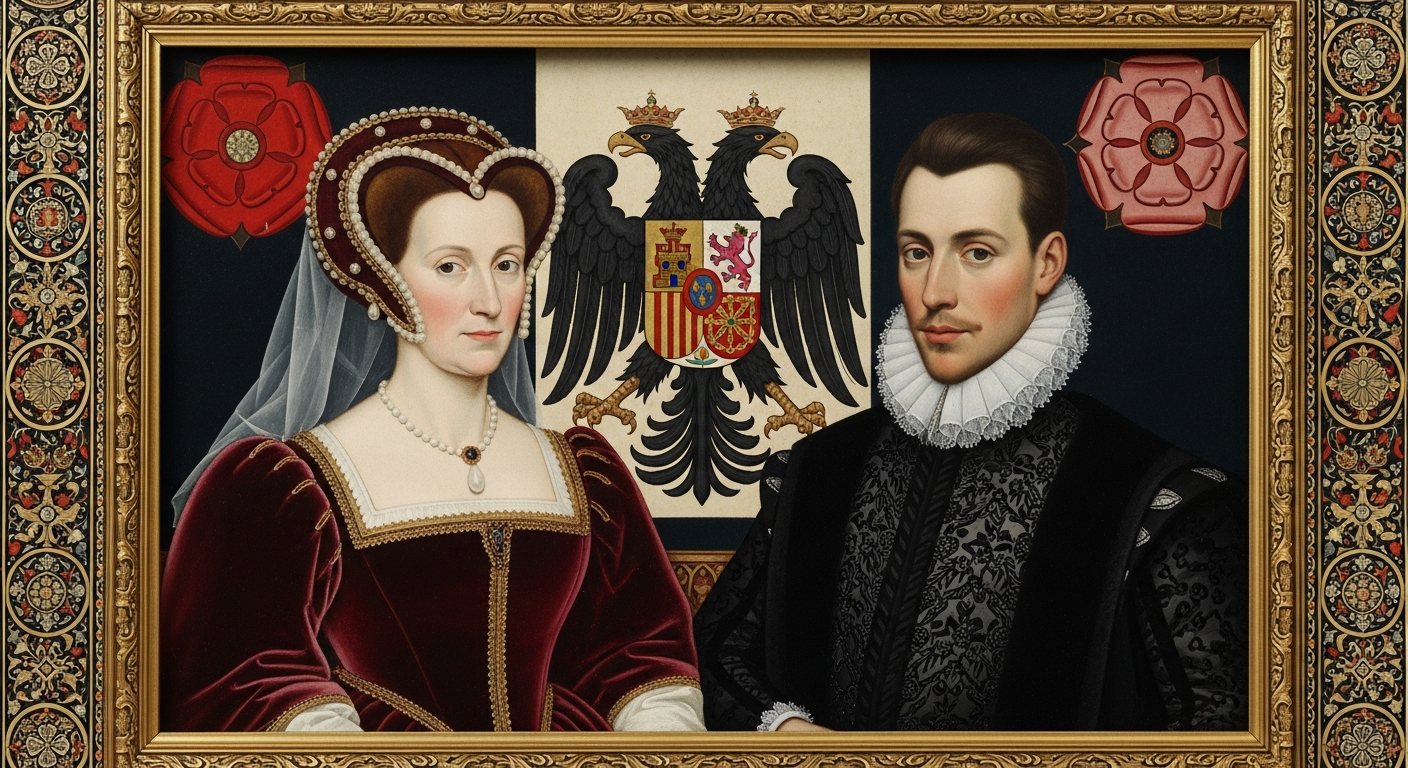
In the annals of Tudor history, few royal marriages caused as much controversy as the union between England’s first crowned queen regnant and the future king of the world’s most powerful empire. When Mary I of England married Philip II of Spain in 1554, she wasn’t merely choosing a husband – she was making a political decision that would define her reign and potentially alter the religious and cultural landscape of England forever. At 37 years old, Mary became the oldest Tudor monarch to marry, wedding a man eleven years her junior in what many considered a dangerous alliance with Catholic Spain.
The marriage between Mary and Philip represents one of the most politically charged royal unions in English history, occurring at a time when religious tensions were at their peak and national identity was closely tied to independence from foreign influence. This controversial match would have far-reaching consequences for Mary’s reign, her relationship with her subjects, and ultimately the future of the Tudor dynasty.
Understanding this marriage provides crucial insight into the challenges facing England’s first queen regnant, the complexities of 16th-century international politics, and the personal struggles of a woman who desperately wanted both love and an heir to secure her Catholic restoration.
Historical Background
Mary Tudor ascended to the throne in 1553 following the tumultuous reigns of her younger brother Edward VI and the brief usurpation attempt by Lady Jane Grey. As the daughter of Henry VIII and Catherine of Aragon, Mary had spent much of her early adulthood declared illegitimate and excluded from court life. Her path to the throne had been neither smooth nor certain, and once crowned, she faced the enormous challenge of ruling as England’s first successfully reigning queen.
Philip II of Spain, born in 1527, was the son and heir of the Holy Roman Emperor Charles V, making him one of the most eligible bachelors in Europe. At 26, he was already a widower, having been married to Maria Manuela of Portugal, who died in 1545 shortly after giving birth to their son, Don Carlos. Philip’s marriage prospects were inevitably tied to the political ambitions of the Habsburg dynasty, which controlled vast territories across Europe and the New World.
The marriage negotiations began almost immediately after Mary’s accession, driven largely by the political calculations of both England and Spain. Charles V saw an opportunity to bring England firmly into the Habsburg sphere of influence, whilst Mary viewed the match as essential for her plans to restore Catholicism to England. The marriage treaty was signed in January 1554, despite fierce opposition from Mary’s councillors and the English Parliament, who feared that England would become merely a Spanish province.
Even the prospect of a foreign match, especially one to a Spanish prince, was anathema to many of the English – nobles and commoners alike. Thomas Wyatt was one, who led the eponymous rebellion which fizzled and failed, but nonetheless showed the resistance to the whole concept. For a light (-ish) introduction to this rebellion, see Insurrection: Weddings can be murder, by J.A.Downes.
The wedding ceremony took place on 25 July 1554 at Winchester Cathedral, deliberately chosen for its historical associations with King Arthur rather than the more obvious Westminster Abbey. According to contemporary accounts in The Chronicle of Queen Jane and of Two Years of Queen Mary, the ceremony was magnificent but notably lacked the popular enthusiasm typically associated with royal weddings. Philip had arrived in England just days before, and many observers noted the cool reception he received from the English people.
Significance and Impact
The marriage between Mary and Philip had profound implications for English politics, religion, and national identity. Most immediately, it intensified fears about Spanish influence over English affairs. Despite treaty provisions stating that Philip would have no independent authority in England and that English interests would take precedence, many subjects remained convinced that their country would become subordinate to Spanish policy. These fears were not entirely unfounded, as Philip did attempt to influence English foreign policy, particularly regarding England’s relationship with France.
From a religious perspective, the marriage strengthened Mary’s hand in her campaign to restore Catholic worship in England. Philip brought with him not only political support but also access to the wider Catholic Reformation movement spreading across Europe. The presence of Spanish clergy and courtiers in England provided Mary with additional resources for her religious programme, though it also made her restoration efforts appear more foreign and imposed rather than organically English.
The age and gender dynamics of the marriage also had significant cultural impact. Mary’s position as a queen regnant married to a king from another realm created unprecedented constitutional questions about authority and precedence. As historian John Edwards notes in Mary I: England’s Catholic Queen, the marriage highlighted the complexities facing female rulers in the 16th century, where marriage was expected for dynastic reasons but potentially threatened a queen’s independent authority.
Perhaps most significantly, the marriage’s failure to produce an heir had lasting consequences for the Tudor dynasty. Mary’s desperate hope for children, which would have secured both her personal happiness and her religious settlement, remained unfulfilled. This failure meant that her Protestant half-sister Elizabeth would eventually inherit the throne, ultimately undoing much of Mary’s religious work and establishing a firmly Protestant England.
Connections and Context
The Mary-Philip marriage cannot be understood in isolation from the broader European political context of the 1550s. This was the height of the Habsburg-Valois rivalry, with Charles V and his son Philip locked in competition with France’s Henri II for dominance in Europe. England’s position in this struggle was crucial, and Mary’s marriage effectively brought England into the Habsburg camp, with significant consequences for English foreign policy.
The timing of the marriage also coincided with the Counter-Reformation, the Catholic Church’s response to Protestant challenges across Europe. Mary’s restoration of Catholicism in England was part of this broader movement, and her marriage to Philip connected England to the wider Catholic revival. This context helps explain why the marriage was so threatening to English Protestants, who saw it not just as a foreign alliance but as part of an international Catholic conspiracy.
The marriage also relates directly to the earlier marital history of the Tudor dynasty. Henry VIII’s matrimonial adventures had been driven by his desperate need for a male heir, and Mary’s marriage represented a continuation of this dynastic pressure. The irony that Mary, whose legitimacy had been questioned due to her father’s divorce from her mother, would herself enter a childless marriage that failed to resolve the succession question, was not lost on contemporary observers.
Modern Relevance and Fascinating Details
Modern audiences often find Mary and Philip’s marriage fascinating precisely because it challenges conventional narratives about love, power, and gender in royal marriages. Unlike the romantic story often told about her half-sister Elizabeth’s relationship with Robert Dudley, Mary’s marriage was openly political, yet contemporary accounts suggest she genuinely cared for Philip, making his frequent absences from England particularly painful for her.
Did you know that Philip spent less than 14 months in England during their four-year marriage? His departures were often motivated by Habsburg political interests elsewhere in Europe, leaving Mary to rule alone whilst desperately hoping for his return and for the pregnancy that never came. This personal dimension of their relationship adds a human element to what might otherwise seem merely a political arrangement.
The marriage has found new relevance in historical fiction and popular culture, where writers have explored the psychological complexity of Mary’s position as a powerful queen who was also a woman seeking love and motherhood in an age when these desires were fraught with political implications. The marriage serves as a compelling case study in the constraints faced by female rulers and the ways personal and political considerations inevitably intertwined in royal marriages.
Contemporary accounts also reveal fascinating details about cultural clashes between the Spanish and English courts. Philip’s Spanish retinue often struggled with English customs, whilst the English courtiers resented what they saw as foreign arrogance. These cultural tensions reflected broader national anxieties about English independence and identity that would continue to shape Anglo-Spanish relations for decades.
Conclusion
The marriage between Mary I and Philip II of Spain represents one of the most politically significant and personally complex royal unions in Tudor history. As the oldest Tudor to marry, Mary’s choice of a younger foreign prince reflected both the diplomatic realities of 16th-century Europe and her personal determination to restore Catholic England through international alliance. The marriage’s failure to produce an heir, combined with its unpopularity among the English people, ultimately contributed to the temporary nature of Mary’s religious restoration.
This fascinating chapter in Tudor history reminds us that royal marriages were never simply personal choices but complex political instruments that could reshape nations and religions. For those interested in exploring further, Mary’s marriage provides an excellent lens through which to examine questions of female rule, religious conflict, and national identity in early modern England – themes that continue to resonate in our understanding of power, politics, and personal agency today.