
Introduction
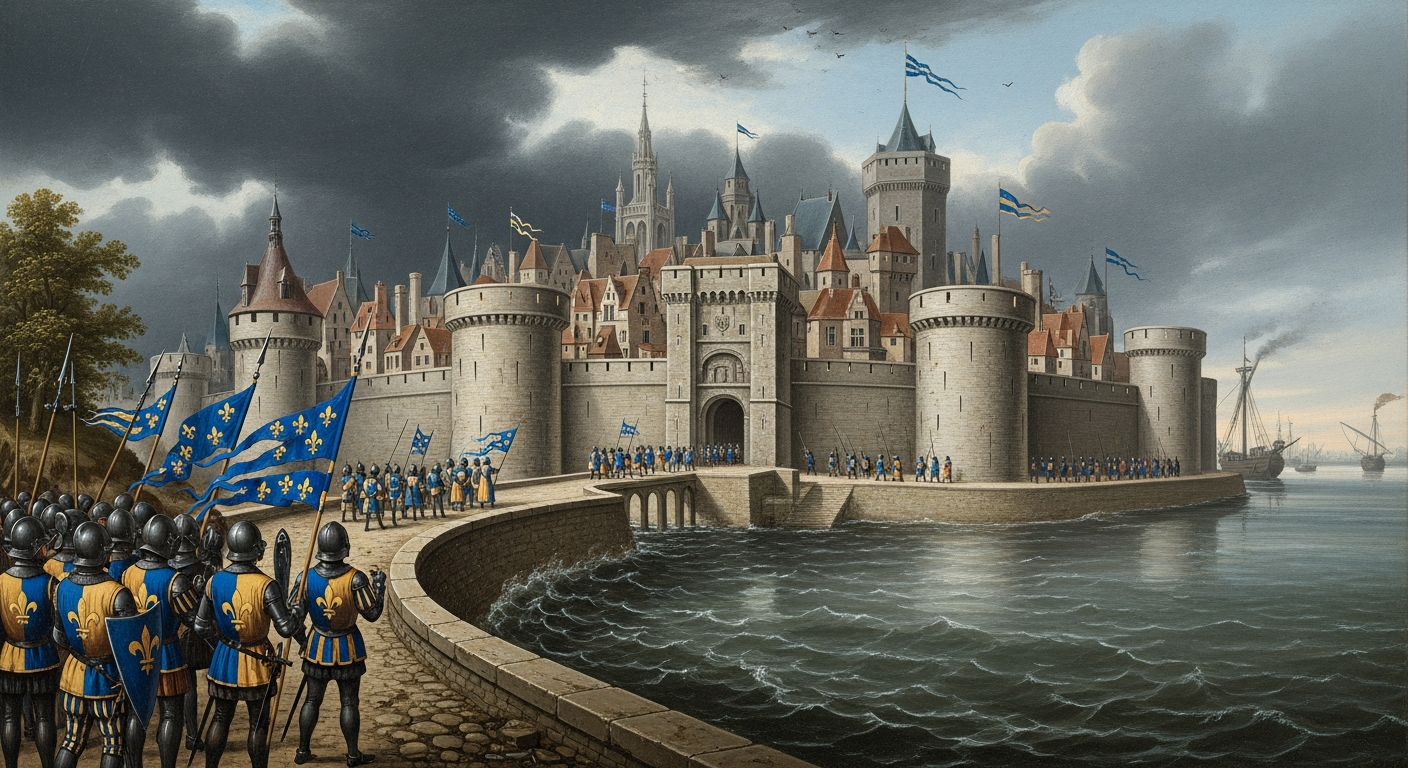
Imagine losing the last piece of your empire in just eight days. On 20 January 1558, this nightmare became reality for England when French forces under Francis, Duke of Guise, captured Calais after a swift siege that shocked Europe. The fall of this strategic port city didn’t just mark the end of a 211-year English occupation; it delivered a crushing blow to Queen Mary I that many historians believe hastened her death just eleven months later.
Calais wasn’t merely another territorial possession. Since Edward III’s conquest in 1347, this French port had served as England’s gateway to continental Europe, a vital trading hub, and a powerful symbol of English military prowess. Its loss represented the end of medieval English ambitions in France and marked a pivotal moment in Tudor history that would shape Elizabeth I’s future foreign policy.
This devastating defeat reveals the complex web of European politics, military strategy, and personal tragedy that defined Mary I’s troubled reign. From the siege tactics that overwhelmed English defences to the queen’s alleged deathbed lament that ‘Calais’ would be found written on her heart, this story illuminates how quickly centuries of history can unravel when politics, warfare, and weather conspire against a nation.
Historical Background
The siege of Calais began on 1 January 1558, when Francis, Duke of Guise, launched what would prove to be one of the most efficient military campaigns of the Tudor period. Guise, uncle to Mary Queen of Scots and a seasoned military commander, had returned from unsuccessful campaigns in Italy determined to strike a decisive blow against England. His choice of target was strategic: Calais had been fortified over two centuries but had grown complacent under prolonged English rule.
The English garrison, commanded by Lord Thomas Wentworth, found itself woefully unprepared for a winter siege. Recent military reforms had reduced the garrison’s strength, and Mary I’s government had diverted resources to support her husband Philip II of Spain’s continental wars. When French artillery began pounding the ancient walls, Wentworth discovered that promised reinforcements would not arrive in time due to severe winter weather in the English Channel.
Contemporary accounts, including the Chronicle of Queen Jane and of Two Years of Queen Mary, describe how French forces employed innovative siege techniques, including the use of gabions (earth-filled baskets) to protect advancing troops and concentrated artillery fire that quickly breached Calais’s medieval fortifications. The speed of the French advance shocked European observers who had expected a prolonged siege reminiscent of earlier English-French conflicts.
By 20 January, with supplies dwindling and no hope of relief, Wentworth made the pragmatic decision to surrender. The terms were surprisingly generous: the garrison would be allowed to depart with honour, though the civilian English population faced exile or submission to French rule. This eight-day conquest represented one of the most humiliating military defeats in Tudor history, ending over two centuries of English presence on the European mainland.
Significance and Impact
The fall of Calais struck Mary I with devastating force, both personally and politically. David Loades, in his comprehensive biography Mary Tudor: A Life, documents how the queen received news of the surrender whilst already weakened by illness and depression following her phantom pregnancies and Philip II’s prolonged absences from England. The loss of Calais represented the failure of her pro-Spanish foreign policy, which had subordinated English interests to those of the Habsburg empire.
Economically, Calais’s loss proved catastrophic for English merchants who had used the port as their primary gateway to continental markets. The Merchant Staplers, who controlled England’s lucrative wool trade, suddenly found themselves without their traditional base of operations. This commercial disruption contributed to the economic difficulties that would challenge Elizabeth I’s early reign, forcing a fundamental reassessment of England’s trading relationships with European partners.
The political ramifications extended far beyond immediate military embarrassment. Calais had served as a symbol of English power projection and medieval claims to French territory dating back to Edward III’s victories at Crécy and Poitiers. Its loss effectively ended the Hundred Years’ War mentality that had influenced English foreign policy for centuries, forcing a recognition that England’s future lay in maritime expansion rather than continental conquest.
The psychological impact on Mary I cannot be overstated. Contemporary sources suggest that news of Calais’s fall triggered the final decline in her health, contributing to the mysterious illness that would claim her life in November 1558. Her reported declaration that ‘Calais’ would be found written on her heart after death, whilst possibly apocryphal, captures the profound personal anguish this military disaster caused England’s first queen regnant.
Connections and Context
The siege of Calais occurred against the backdrop of the Italian Wars, a complex series of conflicts that had embroiled Europe for decades. Mary I’s marriage to Philip II of Spain had drawn England into this continental struggle, with disastrous consequences. English resources that might have strengthened Calais’s defences had instead been committed to Spanish campaigns in Italy, leaving England’s last continental stronghold vulnerable to French attack.
This military disaster coincided with other challenges facing Mary’s regime. The Marian persecutions, which saw approximately 300 Protestants burned at the stake, had already undermined her popularity amongst many subjects. The loss of Calais provided additional ammunition for critics who argued that the queen’s Spanish marriage had subordinated English interests to foreign powers, a charge that would influence Elizabeth I’s careful approach to marriage negotiations.
Did you know that the fall of Calais indirectly influenced the development of English naval power? The loss of this continental base forced English planners to reconsider their strategic priorities, contributing to the naval innovations that would make possible the defeat of the Spanish Armada thirty years later. Elizabeth I’s government would invest heavily in naval capabilities partly because Calais’s loss had demonstrated the vulnerability of land-based continental commitments.
Modern Relevance and Fascinating Details
The rapid fall of Calais offers striking parallels to modern military history, particularly in its demonstration of how technological innovation can overcome seemingly impregnable fortifications. French artillery techniques employed in 1558 presaged the military revolutions that would transform European warfare, making medieval castle designs obsolete within decades.
Historical fiction writers have found rich material in the Calais siege, though it remains less well-known than other Tudor military disasters. The human drama of English families forced to abandon homes their ancestors had occupied for generations provides compelling narrative possibilities, whilst the military aspects offer insights into sixteenth-century siege warfare that historians continue to study.
Modern archaeological investigations in Calais have uncovered evidence of the 1558 siege, including cannonballs and structural damage that confirm contemporary accounts of the French bombardment’s effectiveness. These discoveries have enhanced our understanding of early modern artillery techniques and the vulnerability of medieval fortifications to gunpowder weapons.
The psychological impact of territorial loss explored in this historical episode resonates with contemporary discussions about national identity and imperial decline. Mary I’s reported anguish over Calais’s fall illustrates how deeply territorial possessions could be embedded in royal and national consciousness, offering insights relevant to modern studies of political psychology and national trauma.
Fictional goldmine? What do you think?
As I write this (Jan 2026) the Predestination Series has covered John Dee’s fictional adventures, embedded within the mostly factual Tudor history, from April 1547 (Divination) to February 1554 (Insurrection). I am planning a tetralogy (4 book mini-series) to follow on from Insurrection, to take Dee through 1554, 1555, 1556… So he could certainly be free to engage in more adventures in 1558, and participate somehow in the fall of Calais.
What do you think? Tell me in the comments if you’d like to see a novel set during this siege.
Conclusion
The fall of Calais on 20 January 1558 marked more than the end of a siege; it signified the conclusion of England’s medieval continental ambitions and the beginning of a new chapter in Tudor foreign policy. This eight-day military disaster, documented in sources like the Chronicle of Queen Jane and of Two Years of Queen Mary and analysed by historians such as David Loades, reveals the complex interplay of personal tragedy, political miscalculation, and military innovation that shaped the final months of Mary I’s reign.
Understanding this pivotal moment illuminates broader themes in Tudor history: the challenges facing female monarchs, the costs of continental warfare, and the technological changes that were transforming European military affairs. As Elizabeth I would soon discover, the loss of Calais, whilst traumatic, ultimately freed England to pursue the maritime strategies that would define her glorious reign and establish the foundations of later English global dominance.