
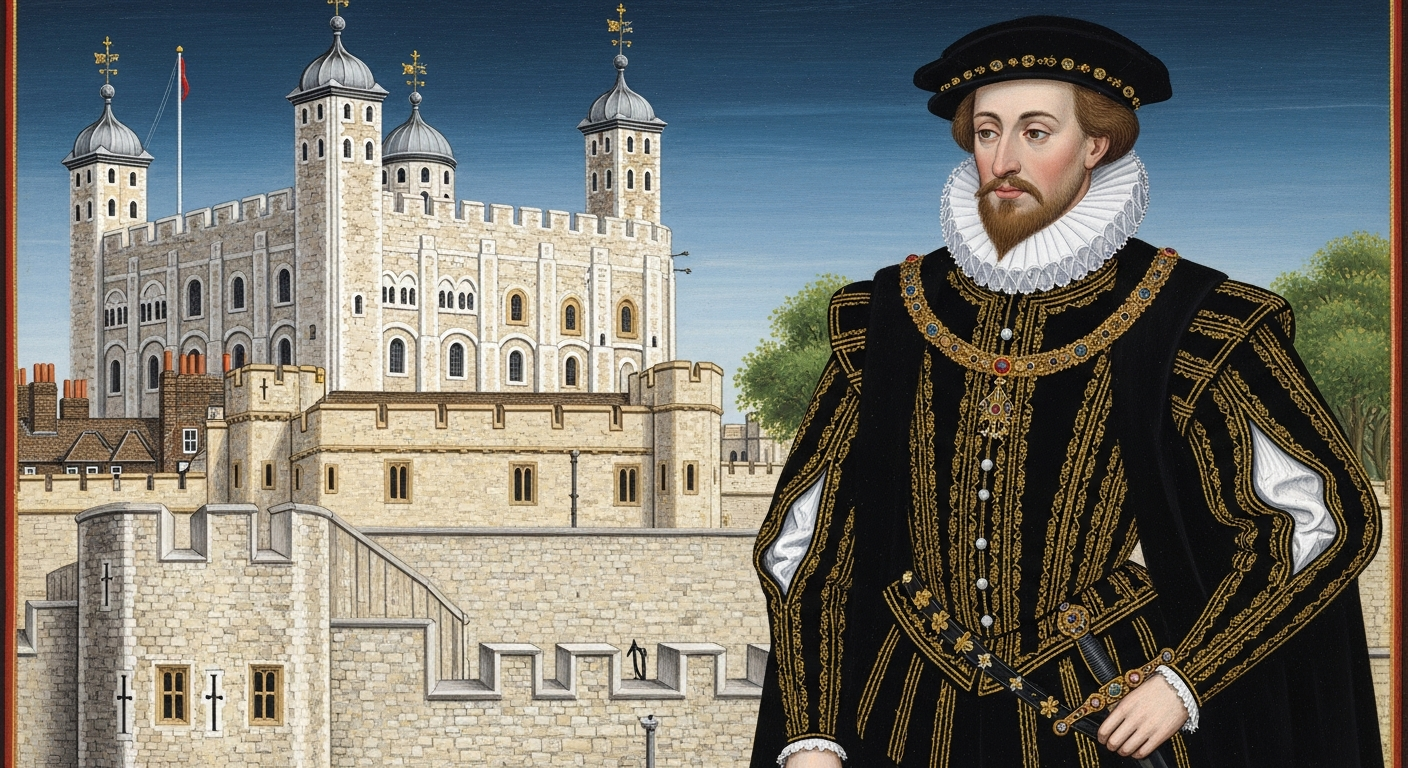
The Day a Favourite Fell: Essex’s Desperate Gamble That Shook Elizabeth I’s Throne
On a grey February morning in 1601, the streets of London witnessed one of the most dramatic political catastrophes of Elizabeth I’s reign. Robert Devereux, 2nd Earl of Essex, once the queen’s most cherished favourite, led an armed band of supporters through the City in a desperate attempt to force his way back into royal favour. Within hours, this reckless gamble would transform the golden boy of the Elizabethan court from a celebrated war hero into a condemned traitor, his head destined for the executioner’s block.
The Essex Rebellion of 8th February 1601 represents far more than a single nobleman’s fall from grace. It marked the violent climax of factional politics that had been poisoning Elizabeth’s court for years, and demonstrated how quickly royal favour could turn to fatal enmity. For a regime built on personal loyalty and careful political balance, Essex’s armed march through London struck at the very heart of Tudor authority.
This extraordinary episode reveals the dangerous intersection of personal ambition, political intrigue, and royal power in the final years of Elizabeth’s reign, offering fascinating insights into how Tudor politics could spiral from favour to treason in a matter of months.
The Rise and Fall of a Royal Favourite
Robert Devereux, 2nd Earl of Essex, had once seemed destined for greatness. Born in 1565, he inherited his title at age nine and quickly caught the attention of Elizabeth I, who was drawn to his youth, charm, and striking resemblance to her earlier favourite, his stepfather Robert Dudley, Earl of Leicester. By the 1590s, Essex had become the queen’s most prominent courtier, enjoying unprecedented access to royal favour and wielding considerable political influence.
However, as historian Paul E.J. Hammer demonstrates in his definitive study ‘The Polarisation of Elizabethan Politics’, Essex’s career was marked by increasing tension with rival court factions, particularly those led by Sir Robert Cecil and Sir Walter Ralegh. Essex’s military ambitions, volatile temperament, and expensive lifestyle created mounting pressures that would ultimately prove his undoing.
The crisis began with Essex’s disastrous campaign in Ireland between 1599 and 1600. Appointed Lord Lieutenant of Ireland with enormous resources to crush the rebellion led by Hugh O’Neill, Earl of Tyrone, Essex instead negotiated an unauthorised truce and abandoned his post to return to England without permission. This catastrophic failure infuriated Elizabeth, who placed Essex under house arrest and stripped him of his lucrative monopolies, leaving him financially ruined and politically isolated.
By early 1601, Essex found himself in a desperate position. The Calendar of State Papers Domestic records how his debts mounted whilst his access to the queen remained blocked by his enemies at court. Convinced that Sir Robert Cecil and others were poisoning Elizabeth’s mind against him, Essex began to contemplate the unthinkable: forcing his way back into favour through armed rebellion.
The Rebellion That Shook London
On the morning of 8th February 1601, Essex and approximately 200 supporters, including several disaffected nobles and military veterans from his Irish campaign, marched from Essex House on the Strand into the City of London. Their plan was audacious in its simplicity: rally public support, seize key government positions, and compel Elizabeth to dismiss his enemies from court whilst restoring him to favour.
The rebellion proved to be a spectacular miscalculation. Rather than flocking to Essex’s banner, the citizens of London remained largely indifferent to his cause. The government’s response was swift and decisive: Sir John Popham, the Lord Chief Justice, proclaimed Essex and his followers traitors, whilst loyal forces moved to contain the uprising. According to contemporary accounts, Essex found himself trapped in the City with dwindling support and no clear escape route.
The dramatic climax came when Essex attempted to return to Essex House, only to find his path blocked by government forces. In the ensuing skirmish, several men were killed, including Essex’s page, who died in his master’s arms. Faced with overwhelming opposition and the prospect of a siege, Essex surrendered that evening, bringing his rebellion to an ignominious end within a single day.
The speed of the rebellion’s collapse revealed just how thoroughly Essex had misjudged both public sentiment and the strength of Elizabeth’s government. What he had envisioned as a popular uprising against corrupt courtiers was instead perceived as an attack on the crown itself, alienating potential supporters and ensuring his swift defeat.
The Price of Treason: Consequences and Impact
The failure of Essex’s rebellion carried profound consequences that reverberated throughout the final years of Elizabeth I’s reign. Most immediately, it demonstrated the continuing strength of Tudor monarchy even in its twilight years. Despite being an ageing queen without an heir, Elizabeth’s government proved capable of crushing armed rebellion with remarkable efficiency, sending a clear message to any other potential challengers.
Essex’s swift trial and execution on 25th February 1601 marked the end of an era in Elizabethan politics. His death eliminated the last great rival to the Cecil faction, consolidating Sir Robert Cecil’s dominance over government policy and ensuring a smoother transition to James I’s accession in 1603. The rebellion’s failure also marked the final collapse of the military faction at court, ending decades of tension between civilian administrators and ambitious soldiers seeking political influence.
The broader impact on Elizabethan society was equally significant. The spectacle of a former royal favourite leading armed rebellion shocked contemporaries and highlighted the dangerous instability lurking beneath the surface of late Tudor politics. It revealed how the personalised nature of Elizabethan government, whilst generally successful, could produce catastrophic results when relationships broke down completely.
Perhaps most importantly, the Essex Rebellion demonstrated the limits of royal favour in Tudor England. Essex had pushed the boundaries of acceptable behaviour too far, believing that his past relationship with Elizabeth would protect him from the consequences of treasonous actions. His execution proved that even former favourites were not above the law, reinforcing the principle that loyalty to the crown superseded all personal relationships.
Connections to the Wider Tudor World
The Essex Rebellion cannot be understood in isolation from the broader context of late Elizabethan England. By 1601, the kingdom faced mounting pressures that created fertile ground for political instability. The war with Spain continued to drain royal finances, whilst the ongoing Irish rebellion remained unresolved despite massive military expenditure. Economic difficulties, including harvest failures and inflation, added to the general sense of uncertainty about the future.
Interestingly, the rebellion occurred just one day after a special performance of Shakespeare’s ‘Richard II’ at the Globe Theatre, commissioned by Essex’s supporters. This play, depicting the deposition of a monarch, was considered so potentially seditious that Elizabeth herself later remarked, ‘I am Richard II, know ye not that?’ The incident illustrates how cultural and political spheres intersected in Tudor England, with even theatrical performances carrying political implications.
The rebellion also connects to the broader European context of noble revolts against centralising monarchies. Similar challenges to royal authority occurred across Europe during this period, as traditional nobles struggled to maintain their influence against increasingly professional government bureaucracies. Essex’s rebellion thus represents not just an English phenomenon, but part of a continent-wide transformation in the nature of political power.
Modern Fascination and Enduring Legacy
The story of Essex’s dramatic rise and fall continues to captivate modern audiences, inspiring numerous works of historical fiction and biographical studies. As a historical fiction author, I find that Essex’s rebellion provides rich material for exploring themes that remain relevant today: the corruption of power, the dangers of political polarisation, and the tragic consequences of unchecked ambition.
Did you know that Essex was executed with the same axe that had been used to behead Mary Queen of Scots fourteen years earlier? Such macabre details, carefully recorded by contemporary observers, provide fascinating glimpses into the ritual and symbolism surrounding Tudor executions. Essex’s execution was notably attended by a small audience, reflecting Elizabeth’s desire to avoid creating a martyr figure who might inspire further rebellion.
Modern political observers often draw parallels between Essex’s rebellion and contemporary examples of political figures who overreach their authority or misjudge public sentiment. The rebellion serves as a timeless cautionary tale about the dangers of assuming personal loyalty can overcome institutional opposition, and the fatal consequences that can follow when ambition exceeds judgement.
Understanding Tudor Politics Through Essex’s Downfall
The Essex Rebellion of 1601 offers an extraordinary window into the complexities of Tudor politics and the personal nature of Elizabethan government. Essex’s transformation from beloved favourite to executed traitor within the space of two years demonstrates how quickly fortunes could change in a system built on personal relationships and royal favour. His failed rebellion marked not just the end of his own ambitious career, but the conclusion of a particular style of Elizabethan politics characterised by factional rivalry and military adventurism.
For modern students of Tudor history, Essex’s story provides valuable lessons about the intersection of personal ambition and political power, whilst his rebellion remains one of the most dramatic episodes in Elizabeth I’s long and eventful reign. The speed and decisiveness with which this crisis unfolded continues to offer insights into both the strengths and vulnerabilities of Tudor monarchy, reminding us that even in its final years, Elizabeth’s government retained the capacity to defend itself against those who would challenge royal authority through force of arms.
The Only Rebellion?
Think this was the only rebellion in Tudor times? Sorry – wildly incorrect. See a whole list of Tudor uprisings in this blog post.