
Introduction
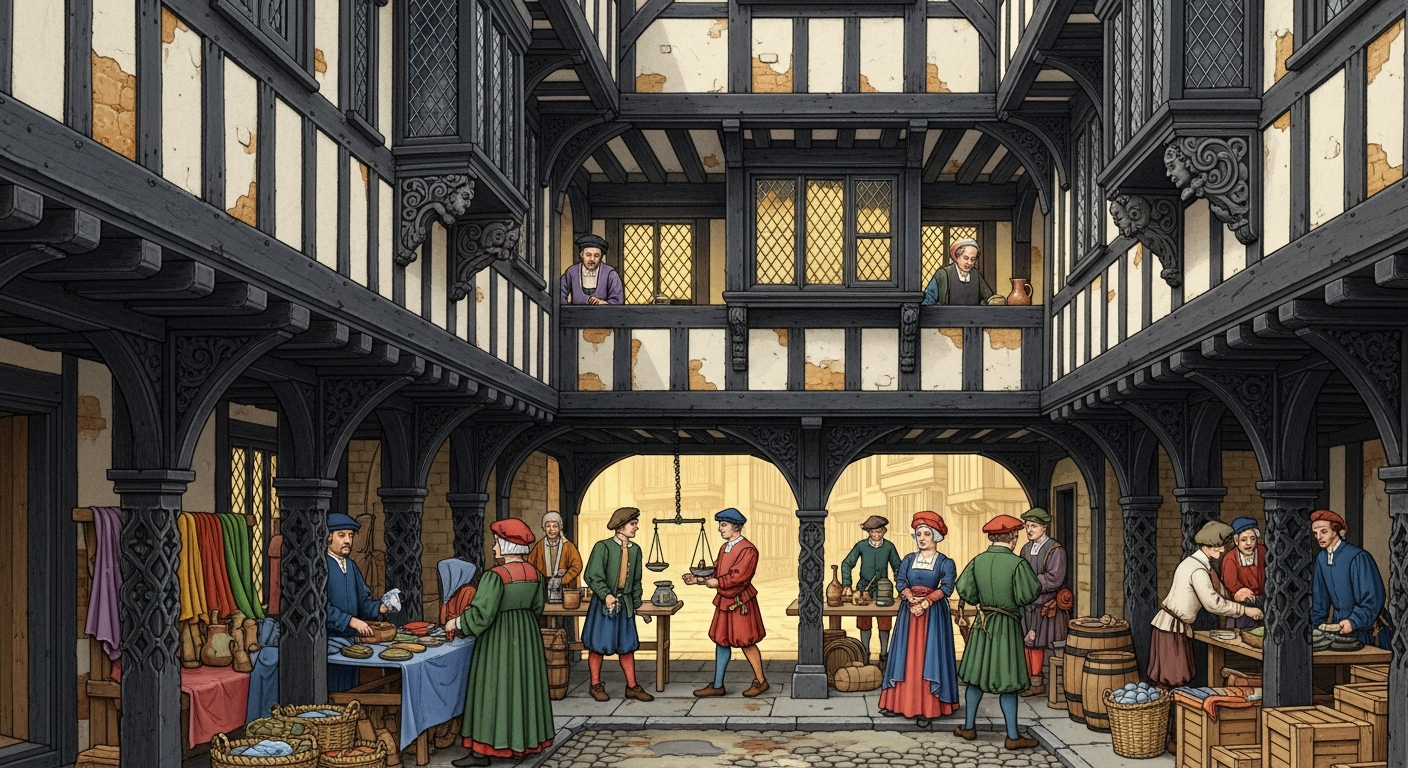
Imagine strolling through a medieval shopping centre where merchants conducted business on two separate levels, connected by covered walkways that protected both goods and customers from England’s unpredictable weather. This isn’t a modern retail innovation, but rather a 13th-century architectural marvel that thrived throughout the Tudor period in the border city of Chester. Known as ‘The Rows’, these unique covered galleries represent what historians consider England’s first two-level shopping experience, predating modern shopping centres by several centuries.
During the reigns of Henry VIII, Edward VI, Mary I, and Elizabeth I, Chester’s Rows continued to serve as a bustling commercial hub, their distinctive architecture setting them apart from any other English market town. While most Tudor-era commercial districts consisted of simple ground-level shops lining narrow streets, Chester’s merchants enjoyed the luxury of conducting trade across two tiers of covered walkways, creating a shopping experience unlike anywhere else in the kingdom.
This remarkable survival of medieval commercial architecture offers us a unique window into Tudor trading practices, urban planning, and the daily lives of merchants and customers during one of England’s most transformative periods. From their mysterious origins in the 13th century through their continued prosperity under Tudor rule, the Chester Rows tell a fascinating story of innovation, adaptation, and enduring commercial success.
Historical Background
The Rows of Chester emerged during the 13th century, well before the Tudor dynasty came to power, but their most prosperous period coincided with the economic expansion of the 16th century. According to Richard K. Morris in his work ‘Chester in the Plantagenet and Tudor Reigns’ from the Chester Archaeological Society records, these covered walkways were already well-established when Henry VII ascended the throne in 1485, having served Chester’s merchant community for over two centuries.
Chester’s strategic location near the Welsh border made it a crucial trading post throughout the medieval and Tudor periods. The city’s proximity to Wales meant that merchants dealing in Welsh wool, livestock, and other goods found Chester an ideal location for conducting business. The Rows provided these traders with weather-protected spaces where they could display their wares and negotiate deals regardless of seasonal conditions, a significant advantage in an era when most commerce occurred in open-air markets.
The architectural design of the Rows was both practical and innovative for its time. The structures featured shops at street level with additional retail spaces on the first floor, connected by covered galleries that ran along the building fronts. These first-floor walkways were accessible via stairs and allowed customers to browse shops while remaining sheltered from the elements. A.N. Brown’s research in ‘The Rows of Chester: The Chester Rows Research Project’ (1999) for English Heritage confirms that this two-tier system was virtually unique in England, making Chester’s commercial district a curious anomaly rather than a widespread medieval practice.
During the Tudor period, the Rows housed a diverse array of merchants and craftsmen. Drapers, mercers, goldsmiths, and booksellers all operated from these covered galleries, taking advantage of the prime retail locations and the steady flow of customers attracted by the novelty and convenience of the shopping experience. The city’s guild system regulated trade within the Rows, ensuring quality control and fair competition amongst the various merchants operating in this unique commercial environment.
Significance and Impact
The continued success of Chester’s Rows throughout the Tudor period demonstrates the importance of innovation in medieval and early modern commerce. While other English cities relied on traditional market squares and street-level shops, Chester’s merchants enjoyed the competitive advantages offered by their unique two-level system. This architectural innovation allowed for higher density commercial development within the city’s limited space, maximising the number of trading opportunities available to both local and visiting merchants.
The economic impact of the Rows extended far beyond individual shop sales. The distinctive shopping experience attracted visitors from across England and Wales, establishing Chester as a destination for commerce rather than merely a convenient stopping point. This influx of visitors brought additional revenue to the city through accommodation, dining, and other services, creating a multiplier effect that benefited the entire local economy throughout the Tudor era.
From a social perspective, the Rows fostered a unique urban culture during the Tudor period. The covered walkways encouraged social interaction and created a sense of community amongst merchants and customers alike. Unlike the hurried transactions typical of open-air markets, the sheltered environment of the Rows allowed for more leisurely shopping experiences and extended conversations between buyers and sellers. This social dimension of commerce was particularly important during the Tudor period, when business relationships often depended as much on personal connections as on the quality of goods or services offered.
The architectural preservation of the Rows throughout the Tudor period also reflects the economic stability and forward-thinking approach of Chester’s merchant community. Rather than demolishing these medieval structures to make way for more conventional Tudor-era buildings, Chester’s business leaders recognised the commercial value of their unique selling proposition and invested in maintaining and improving the Rows rather than replacing them.
Connections and Context
The prosperity of Chester’s Rows during the Tudor period connects to broader themes of commercial expansion and urban development that characterised 16th-century England. While cities like London were experiencing rapid growth and architectural transformation, Chester’s approach of preserving and enhancing existing medieval commercial infrastructure represents an alternative model of Tudor-era urban development that proved equally successful within its specific context.
The timing of the Rows’ continued success during the Tudor period coincides with England’s growing involvement in international trade networks. Chester’s position as a gateway to Wales and Ireland made it an important port for merchants engaged in expanding trade routes. The efficiency and capacity offered by the two-tier shopping system of the Rows enabled Chester merchants to handle increasing volumes of trade without requiring expensive expansion of the city’s commercial district.
Contemporary developments in other English cities provide interesting contrasts to Chester’s approach. While London’s merchants were establishing the Royal Exchange in the 1560s as a purpose-built trading centre, and cities like York and Norwich were modernising their market facilities, Chester continued to thrive with its centuries-old Rows system. This suggests that architectural innovation, once successful, could provide lasting commercial advantages even as other cities pursued different modernisation strategies.
Modern Relevance and Fascinating Details
Today, Chester’s Rows remain remarkably intact and continue to serve their original commercial purpose, making them one of the few surviving examples of medieval retail architecture still functioning as intended. Modern visitors can walk the same covered galleries that Tudor merchants used, browsing contemporary shops housed within structures that have facilitated commerce for over seven centuries. This continuity of use makes the Rows a living museum of commercial history rather than merely a preserved historical curiosity.
Did you know that the Rows’ design principles actually anticipate many features of modern shopping centres? The covered walkways, multi-level retail spaces, and weather protection that Tudor shoppers enjoyed in Chester wouldn’t seem out of place in a contemporary shopping mall. This historical precedent suggests that successful retail environments share certain timeless characteristics, regardless of the era in which they operate.
For historical fiction authors and Tudor history enthusiasts, the Rows provide a wealth of authentic details for depicting 16th-century commercial life. The specific architectural features, the mix of trades represented, and the social dynamics of this unique shopping environment offer rich material for bringing Tudor-era commerce to life. Unlike many aspects of Tudor daily life that must be reconstructed from fragmentary evidence, the Chester Rows provide a tangible connection to the commercial experiences of our Tudor ancestors.
The preservation of the Rows through centuries of urban development, including the Tudor period’s significant architectural changes, demonstrates the economic value of maintaining distinctive commercial environments. Modern city planners and heritage professionals study Chester’s example as a model for balancing historical preservation with continued commercial viability, a challenge that Tudor-era Chester clearly mastered.
Conclusion
Chester’s Rows represent a fascinating intersection of medieval innovation and Tudor-era commercial success, demonstrating how architectural uniqueness could provide lasting economic advantages. Their survival and prosperity throughout the Tudor period illustrates the importance of preserving distinctive commercial environments while adapting them to meet changing economic conditions. The two-tier shopping galleries that served Tudor merchants so well continue to attract visitors and commerce today, proving the enduring value of thoughtful urban design.
For anyone interested in Tudor history, medieval architecture, or the evolution of commercial practices, Chester’s Rows offer an unparalleled opportunity to experience authentic historical retail environments. Their story reminds us that innovation in commerce and architecture often emerges from practical solutions to local challenges, and that successful designs can transcend their original time periods to provide value across centuries.