
Introduction
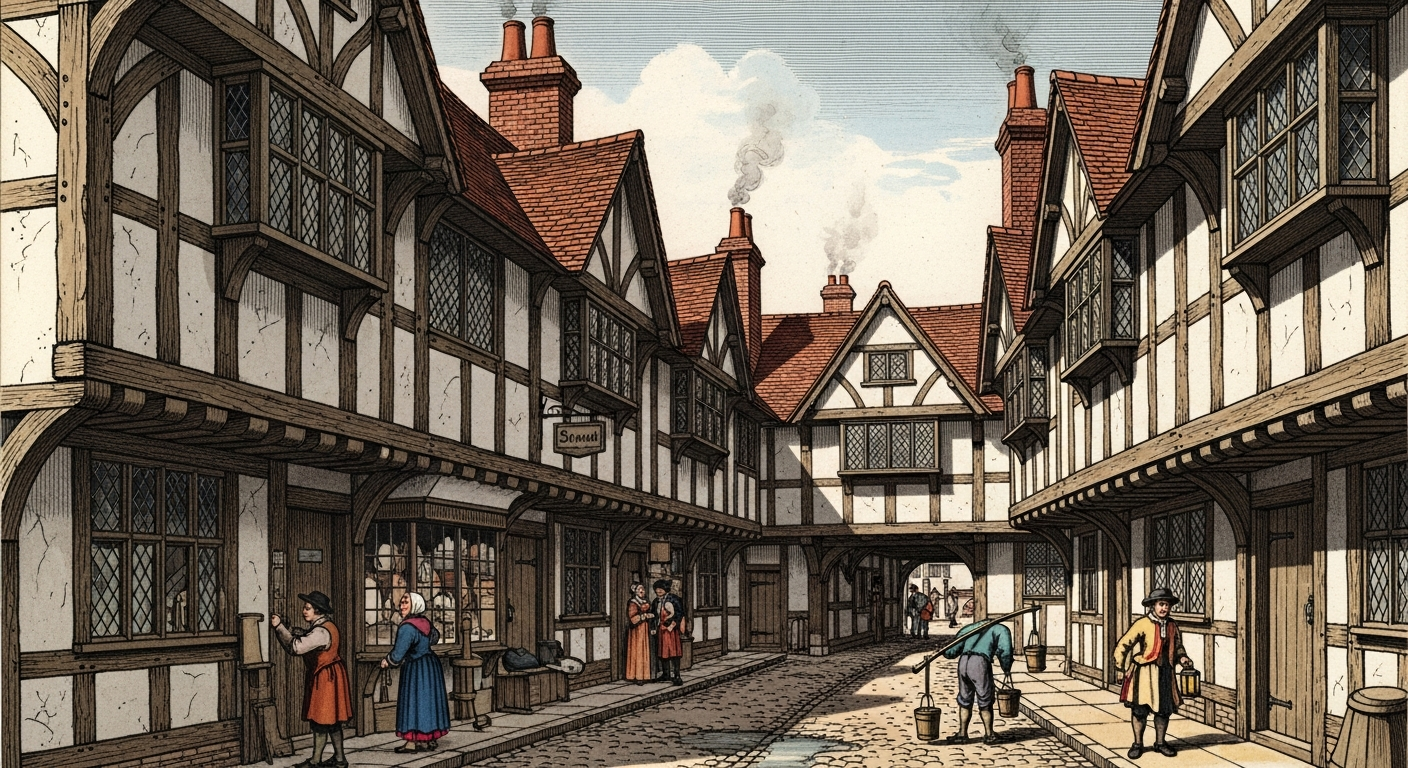
Imagine walking through London’s narrow streets in 1600, where buildings loom so precariously overhead that you can barely glimpse the sky above. The upper floors of houses jut out so dramatically that neighbours across the street could practically shake hands from their windows. This was the reality of Tudor London, a city transformed by one of the most dramatic population explosions in European history.
Between 1500 and 1600, London’s population quadrupled from approximately 50,000 souls to over 200,000, making it one of Europe’s largest urban centres alongside Paris and Naples. This extraordinary growth created a medieval city bursting at the seams, where the solution to overcrowding was to build up rather than out, creating the iconic overhanging timber-framed houses that defined Tudor streetscapes.
This remarkable transformation reveals how ordinary people adapted to extraordinary circumstances, creating architectural innovations that would define London’s character for centuries whilst simultaneously creating unprecedented urban challenges that would reshape English society forever.
Historical Background
The population explosion that transformed Tudor London began during the early decades of the 16th century, accelerating throughout the reigns of Henry VIII, Edward VI, Mary I, and reaching its peak under Elizabeth I. Contemporary observer John Stow, writing in his Survey of London in 1598, documented this dramatic change firsthand, describing streets he had known as a child now packed with towering houses and teeming with inhabitants from across England and beyond.
This growth occurred primarily within the ancient boundaries of the City of London and the rapidly expanding suburbs beyond the walls. The medieval city, originally designed for a much smaller population, simply could not accommodate the influx through horizontal expansion alone. Land within the city walls was incredibly valuable and strictly controlled by guilds and wealthy merchants, forcing builders to maximise every square foot of available space.
The solution lay in a building technique called ‘jettying’, where each successive floor of a house projected further out over the street than the one below. Master carpenters and builders developed increasingly ambitious designs, with some houses extending their upper floors up to four feet beyond their ground floor footprint. These overhanging structures, supported by elaborate timber brackets and corbels, became the defining architectural feature of Tudor London’s streetscape.
Steve Rappaport’s comprehensive study Worlds Within Worlds: Structures of Life in Sixteenth-Century London reveals that this building boom involved everyone from wealthy merchants constructing grand houses to poor labourers subdividing existing properties into ever-smaller tenements. The construction industry became one of London’s largest employers, with carpenters, masons, thatchers, and glaziers working frantically to house the growing population.
Significance and Impact
The architectural transformation of Tudor London created far more than just an interesting skyline; it fundamentally altered how people lived, worked, and interacted in England’s capital. The overhanging houses created a unique urban environment where streets became tunnel-like passages, perpetually shadowed and increasingly cramped as buildings grew taller and jutted further outward.
These structural changes had profound social consequences. The lack of sunlight in many streets created persistent dampness and poor air circulation, contributing to the spread of diseases that would periodically devastate London’s population. The 1563 plague outbreak killed approximately 20,000 people, roughly 15% of the city’s inhabitants, with the overcrowded conditions significantly accelerating the epidemic’s spread.
Fire hazards multiplied exponentially as timber-framed buildings with overhanging upper floors created continuous combustible surfaces across entire street blocks. The close proximity of jutting upper floors meant that flames could leap easily from building to building, whilst the narrow streets below made it nearly impossible for firefighting efforts to be effective. Multiple serious fires throughout the Tudor period foreshadowed the Great Fire of London that would eventually consume much of the medieval city in 1666.
Yet these challenging conditions also fostered remarkable innovations in urban living. Shop signs hanging from the overhanging floors created the world’s first comprehensive commercial advertising system, whilst the covered walkways created by projecting upper floors provided shelter for street vendors and pedestrians. The vertical expansion of housing also enabled London’s emerging middle class to afford properties that would have been impossible in a horizontally-planned city.
Connections and Context
London’s population explosion coincided with England’s transformation from a relatively isolated medieval kingdom into a major European power. The dissolution of the monasteries under Henry VIII released vast amounts of property onto the market, much of which was quickly developed to house the growing population. Simultaneously, England’s expanding trade networks and the beginnings of colonial ventures attracted merchants, craftsmen, and labourers from across the country and continent.
The architectural solutions developed in Tudor London influenced urban development throughout England. Market towns like York, Chester, and Canterbury adopted similar jettied building techniques, creating the distinctive ‘black and white’ timber-framed streetscapes that remain tourist attractions today. The guilds that controlled building standards in London also established the construction techniques and regulations that would spread throughout England’s growing urban centres.
This period of urban growth also coincided with the flowering of English Renaissance culture. The same overcrowded streets that created public health challenges also fostered the vibrant street life that inspired playwrights like William Shakespeare and Christopher Marlowe. The close quarters and mixed social classes living in jettied houses created the urban energy that fueled England’s cultural golden age, with taverns, markets, and street performances thriving in the shadowy spaces beneath the overhanging buildings.
Modern Relevance and Fascinating Details
Tudor London’s response to rapid population growth offers surprisingly relevant lessons for modern urban planning. Just as contemporary cities grapple with housing shortages and vertical development, Tudor builders pioneered intensive urban living solutions that maximised limited space whilst creating distinctive community environments. The jettied houses of Tudor London represent one of history’s most successful examples of organic urban densification.
Did you know that some Tudor houses projected so far over the street that their top floors were wider than their ground floors by more than eight feet? Archaeological evidence suggests that the most extreme examples of jettying created streets where the gap between opposing upper floors was less than six feet, requiring special municipal regulations to ensure cart traffic could still pass below.
These remarkable buildings continue to capture imaginations through historical fiction and period dramas. Films and television series set in Tudor London invariably feature the distinctive overhanging houses, from Shakespeare adaptations to historical dramas about Henry VIII’s court. As a historical fiction author, I find that readers are consistently fascinated by the practical details of how ordinary people navigated daily life in these vertical, crowded urban environments where privacy was nearly impossible and community bonds were forged by necessity.
Many original Tudor jettied houses survive today, particularly in London’s legal quarter around the Inns of Court, where visitors can still experience the distinctive atmosphere of walking beneath overhanging upper floors. These surviving examples provide tangible connections to the experiences of London’s Tudor inhabitants, reminding us that urban challenges we consider uniquely modern have deep historical precedents.
Or for a totally authentic experience, visit The Shambles, in York. York is a lovely city in Yorkshire, with a wonderful cathedral (York Minster).
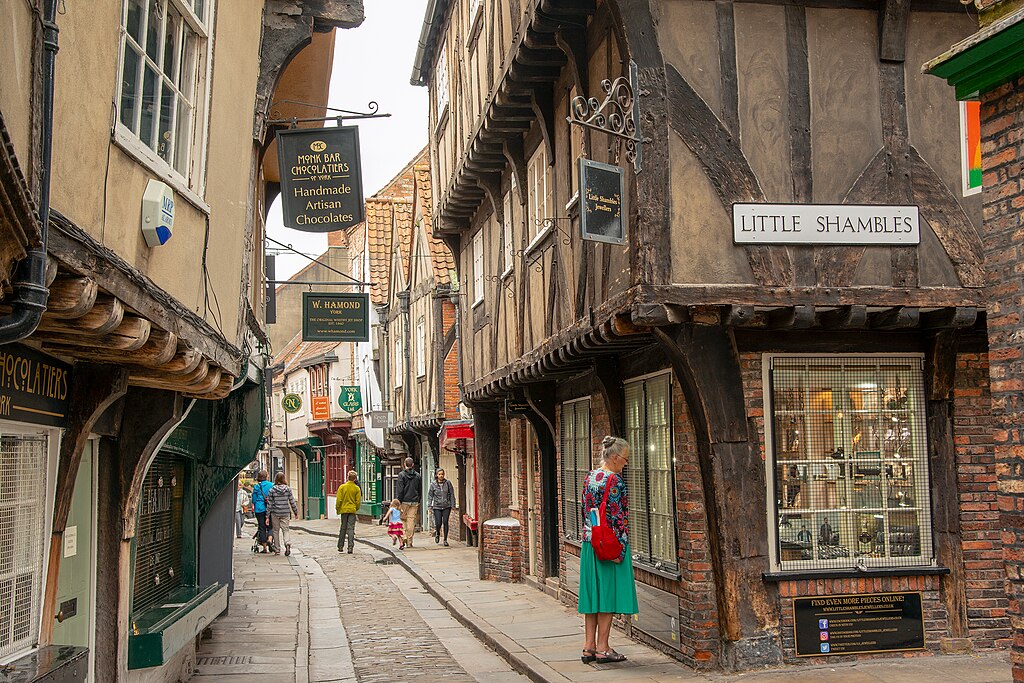
Photo copyright: Peter K Burian This file is licensed under the Creative Commons Attribution-Share Alike 4.0 International license.
Conclusion
The transformation of Tudor London from a modest medieval city to one of Europe’s largest urban centres created architectural and social innovations that would influence English urban development for centuries. The distinctive overhanging houses that lined London’s streets represented both the ingenuity and the challenges of rapid population growth, creating unique urban environments that fostered community whilst simultaneously generating unprecedented public health and safety concerns.
Understanding how Tudor Londoners adapted their built environment to accommodate quadruple population growth offers valuable insights into human adaptability and urban resilience. The next time you encounter images of Tudor London’s distinctive streetscapes, remember that those precariously overhanging buildings represent one of history’s most dramatic urban transformations, achieved by ordinary people facing extraordinary circumstances with remarkable creativity and determination.