
Introduction
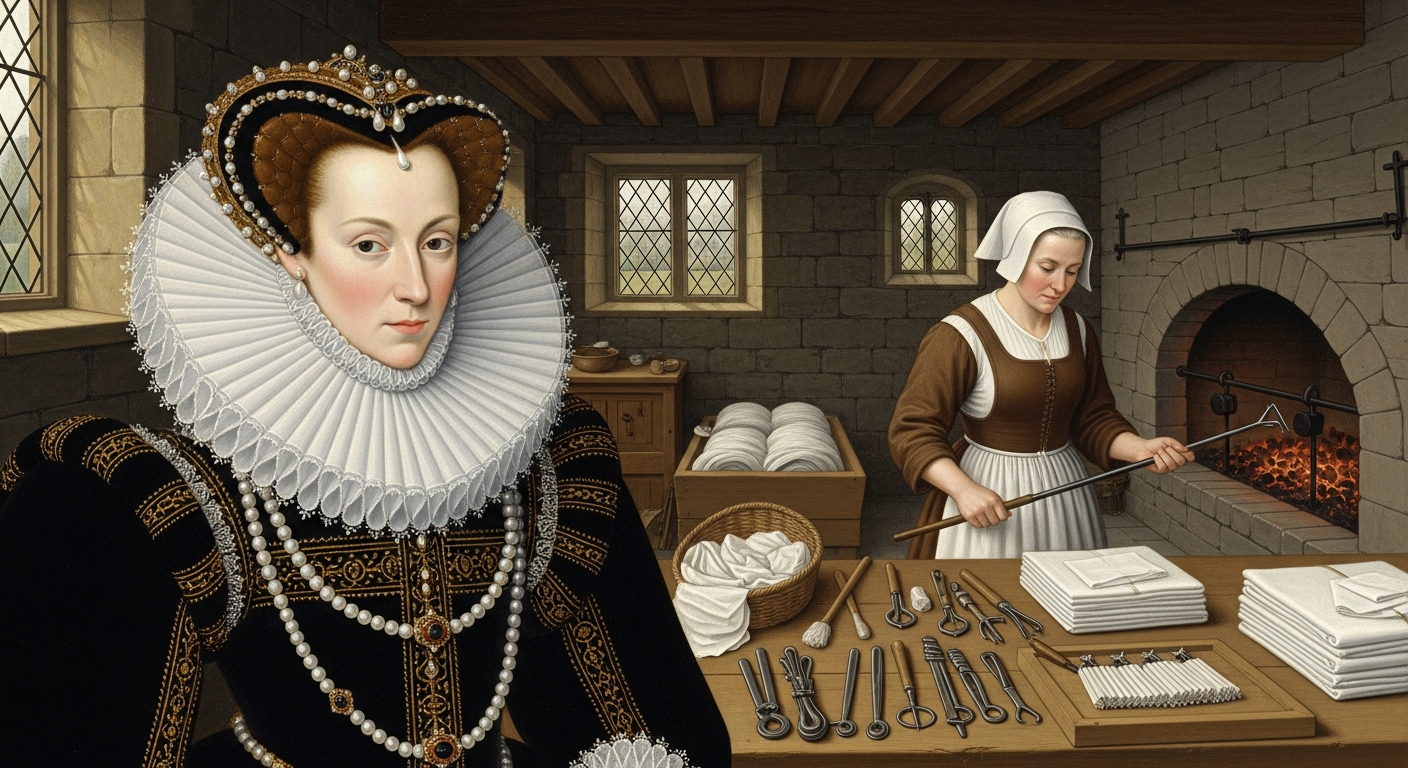
Imagine wearing a collar that jutted six inches from your neck, constructed from twelve yards of the finest linen, and required a team of skilled professionals armed with heated metal rods to maintain its perfect pleats. This was the reality of the Elizabethan ruff, perhaps the most extraordinary and impractical fashion statement in English history. By the late sixteenth century, these magnificent ‘cartwheel’ ruffs had evolved from simple neck coverings into towering symbols of wealth, status, and societal position that literally kept their wearers at arm’s length from the world around them.
The Tudor court was a theatre of power, and fashion served as both costume and script in this elaborate performance. As Elizabeth I’s reign reached its zenith between 1580 and 1603, the ruff collar became the ultimate expression of courtly magnificence, requiring not only enormous financial investment but also a dedicated infrastructure of craftspeople to create and maintain them. Understanding the complexity behind these seemingly simple accessories reveals the intricate social machinery that powered one of England’s most glittering royal courts.
From the specialised laundresses wielding their heated ‘poking sticks’ to the complex etiquette of navigating daily life whilst wearing what amounted to a textile fortress around one’s neck, the story of the Elizabethan ruff illuminates broader themes of power, gender, technology, and social mobility in Tudor England.
Historical Background
The ruff’s journey to magnificent excess began modestly in the early sixteenth century as a simple frill attached to the neckline of shirts and chemises. However, by the 1560s, during the early years of Elizabeth I’s reign, these neck frills had separated from the garment itself and evolved into standalone accessories. The transformation from practical to spectacular occurred gradually, with each decade seeing ruffs grow larger, more elaborate, and increasingly divorced from any functional purpose.
The golden age of the ruff coincided with Elizabeth’s later years, particularly from 1580 onwards, when international trade had enriched England’s merchant classes and the queen’s court had established itself as a centre of European diplomacy and culture. Wealthy courtiers, merchants, and their families competed to display their prosperity through increasingly elaborate dress, with the ruff serving as the crown jewel of this sartorial arms race. As Janet Arnold documents in her seminal work Patterns of Fashion 4: The Cut and Construction of Linen Shirts, the most impressive ruffs of this period required up to twelve yards of fine linen, representing a significant financial investment equivalent to several months’ wages for ordinary workers.
The creation of these magnificent accessories required a small army of specialists. Master tailors cut the initial fabric using carefully calculated geometric patterns that would create the perfect pleated effect. Seamstresses then spent countless hours creating the minute, regular pleats that gave ruffs their distinctive appearance. Most crucially, skilled laundresses became the unsung heroes of Elizabethan fashion, wielding heated metal implements called ‘poking sticks’ to set each pleat with mathematical precision.
The laundresses’ work was both art and science. These heated iron rods, often imported from Spain and considered precious tools of the trade, had to be maintained at precisely the right temperature to crisp the linen without scorching it. The process required such skill that experienced ruff-setters commanded high wages and developed loyal clienteles among the nobility. The complexity of maintaining these garments meant that their wearers required not just wealth to purchase them, but ongoing resources to keep them in perfect condition.
Significance and Impact
The massive Elizabethan ruff represented far more than a fashion trend; it became a powerful symbol of England’s growing confidence and prosperity during what historians now recognise as a golden age. These elaborate collars served as wearable declarations of wealth, with their impracticality being precisely the point. Only someone with sufficient resources to afford twelve yards of fine linen, plus the ongoing costs of specialist maintenance, could sport such an accessory. The ruff thus became a form of conspicuous consumption that immediately communicated the wearer’s social and economic status to everyone they encountered.
From a gender perspective, the ruff played a particularly interesting role in Elizabethan society. Both men and women wore these accessories, but they served different symbolic functions. For men, especially courtiers and merchants, ruffs demonstrated their success and sophistication. For women, the accessories became part of a complex visual language that could suggest virtue, wealth, and proper social standing simultaneously. The Virgin Queen herself used ruffs strategically in her portraits, often depicted wearing moderate versions that suggested both majesty and restraint.
The social impact of ruff-wearing extended beyond mere display. These accessories literally changed how people moved through the world, requiring wearers to hold their heads high and maintain careful posture. They made intimate conversation difficult and casual physical contact nearly impossible. In this way, ruffs enforced a certain formality and distance that reinforced social hierarchies. The wealthy literally couldn’t get too close to their social inferiors, and the elaborate ritual of maintaining these accessories created a buffer zone of servants and specialists around the upper classes.
The economic implications were equally significant. The ruff industry created employment for thousands of workers, from the linen manufacturers to the specialist laundresses. As Aileen Ribeiro notes in The Art of Dress, this fashion trend stimulated international trade, as the finest linens were imported from the Low Countries, whilst the prized Spanish poking sticks became sought-after imports. The industry also drove technological innovation, as craftspeople developed new techniques for creating ever more elaborate pleating patterns and more efficient methods for maintaining these complex garments.
Connections and Context
The rise of the elaborate ruff coincided with several other significant developments in Elizabethan England that help explain both its emergence and its eventual decline. The expansion of international trade during this period had created a newly wealthy merchant class eager to display their prosperity and gain social acceptance. Simultaneously, the relative political stability of Elizabeth’s later reign allowed court culture to flourish, creating an environment where elaborate fashion could thrive without the disruptions of war or succession crises.
The ruff phenomenon also connects to broader European fashion trends of the period. Similar accessories appeared in Spanish, French, and Dutch courts, though the English versions became particularly noted for their size and elaboration. This international dimension reflected England’s growing integration into European diplomatic and cultural networks, with fashion serving as a form of soft diplomacy that demonstrated English sophistication to foreign visitors and ambassadors.
Interestingly, the peak years of ruff-wearing coincided with England’s naval expansion and the early stirrings of colonial enterprise. The same international trade networks that brought fine linens to England and carried English wool to continental markets also facilitated the exchange of fashion ideas and luxury goods that made elaborate court dress possible. The ruff thus represents not just personal vanity, but England’s emergence as a significant player in the global economy of the late sixteenth century.
Modern Relevance and Fascinating Details
Contemporary fashion historians and costume designers continue to marvel at the technical achievement represented by these elaborate ruffs. The mathematical precision required to cut and pleat twelve yards of linen into a perfectly symmetrical collar that would stand six inches from the wearer’s neck represents a level of craftsmanship that impresses even modern textile experts. Indeed, accurate reproduction of these accessories for museum exhibitions and theatrical productions requires specialist knowledge that few contemporary seamstresses possess.
The story of the Elizabethan ruff offers fascinating parallels to modern luxury fashion and status symbols. Like today’s designer handbags or limited-edition trainers, ruffs served as immediately recognisable markers of wealth and taste that required both significant initial investment and ongoing maintenance costs. The heating and setting of ruffs with poking sticks might be compared to the regular professional maintenance required by luxury automobiles or the specialist care needed for haute couture garments.
Popular culture has embraced the visual drama of Elizabethan ruffs, with costume designers for films and television programmes often exaggerating their size for dramatic effect. However, historical accuracy reveals that reality was often more extreme than fiction. The largest surviving examples in museum collections demonstrate that the most magnificent ruffs were indeed as impractical and elaborate as contemporary accounts suggest. For historical fiction writers, these accessories provide rich material for exploring themes of social mobility, gender roles, and the intersection of personal identity with public presentation in Tudor society.
Did you know that the decline of the ruff was as dramatic as its rise? By the early seventeenth century, changing political circumstances and evolving fashion sensibilities led to their rapid abandonment. James I’s court favoured a more relaxed style, and the practical difficulties of maintaining such elaborate accessories during England’s increasing political turbulence made them seem increasingly anachronistic. The ruff’s brief but spectacular reign thus serves as a perfect encapsulation of the confident, prosperous, and slightly mad final years of the Elizabethan age.
Conclusion
The story of the Elizabethan ruff reveals how fashion can serve as a window into the broader social, economic, and cultural currents of any historical period. These magnificent accessories, requiring twelve yards of linen and teams of specialists wielding heated poking sticks, represented the peak of Tudor conspicuous consumption and the confidence of a nation discovering its place on the world stage. They embodied the complexity and contradictions of Elizabethan society: simultaneously beautiful and impractical, democratic and elitist, innovative and conservative.
Understanding the ruff helps us appreciate the sophisticated craftsmanship and complex social dynamics that characterised late Tudor England, whilst also providing insights into timeless human desires for status, beauty, and self-expression. Whether you’re interested in fashion history, social dynamics, or simply the fascinating details of daily life in Shakespeare’s England, the extraordinary tale of the Elizabethan ruff offers rich material for exploration and continues to influence our understanding of one of English history’s most remarkable periods.