
Introduction
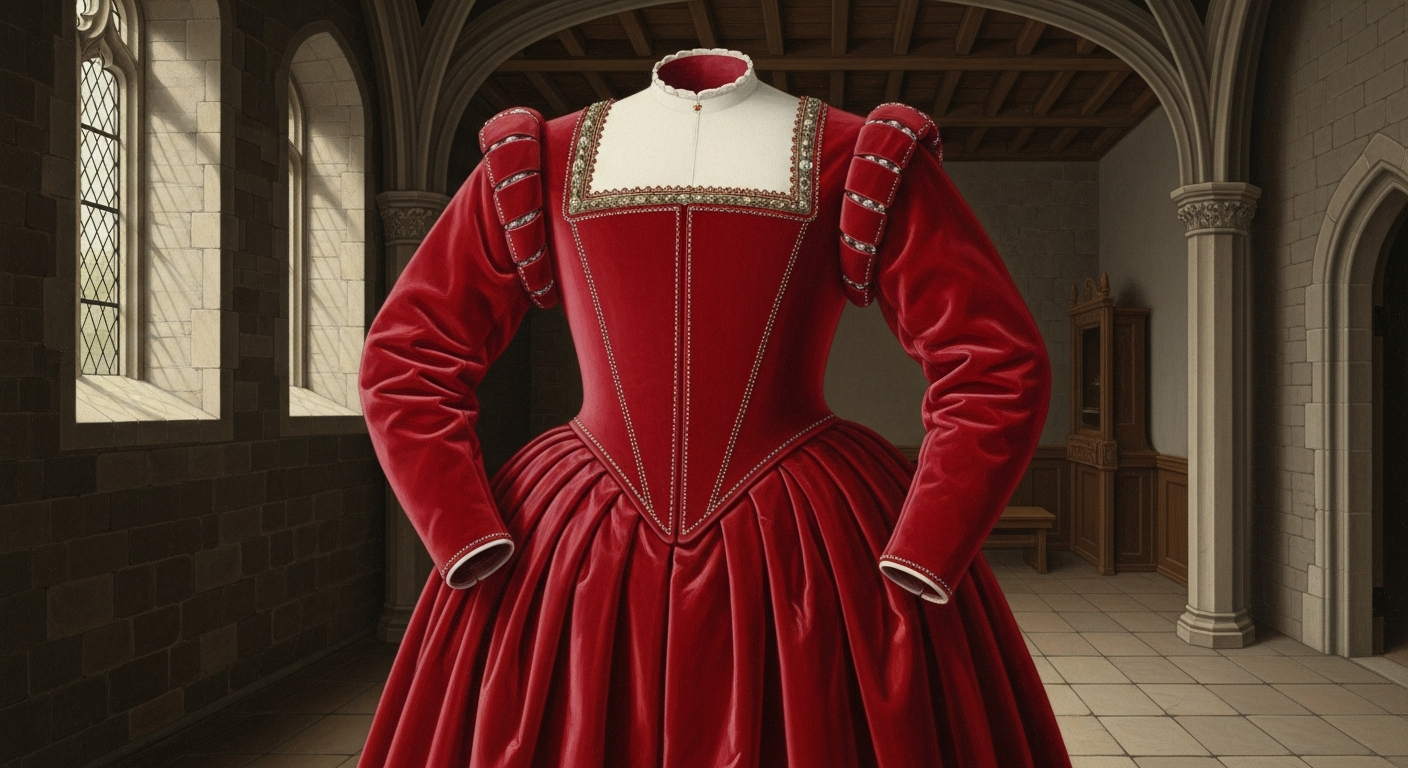
On a cold February morning in 1587, Mary Queen of Scots made her final political statement not with words, but with colour. As the executioner’s assistants stripped away her black outer garments at Fotheringay Castle, they revealed a stunning sight that would echo through history: beneath lay a crimson velvet petticoat and bodice, the liturgical red of Catholic martyrdom blazing against the austere Protestant surroundings. This wasn’t mere vanity or fashion choice, it was a calculated act of defiance that transformed Mary’s execution from a political necessity into a religious spectacle.
The choice of crimson velvet speaks to the complexity of Mary Stuart, a woman who understood the power of symbolism even in death. Having spent nearly two decades as Elizabeth I’s prisoner, she had learned to communicate through gesture and appearance when words failed her. Her final costume would ensure that history remembered her not as a traitor or failed monarch, but as a Catholic martyr dying for her faith.
This deliberate theatrical choice reveals fascinating insights into Tudor court culture, religious symbolism, and the political machinations that led to one of the most controversial executions in British history. The crimson beneath Mary’s mourning black tells us as much about 16th-century politics as any state paper or diplomatic correspondence.
Historical Background
Mary Queen of Scots arrived at her execution on 8th February 1587 as a woman who had lost everything except her faith and her flair for drama. Born in 1542, she had been Queen of Scotland from six days old, Queen consort of France as a teenager, and had laid claim to the English throne through her descent from Henry VII. By 1587, however, she was a 44-year-old prisoner whose very existence threatened Elizabeth I’s Protestant settlement.
The immediate circumstances leading to Mary’s execution stemmed from the Babington Plot of 1586, a Catholic conspiracy to assassinate Elizabeth and place Mary on the English throne. Though Mary’s direct involvement remained contentious, intercepted letters appeared to show her endorsement of the scheme. For Elizabeth’s government, this provided the long-sought justification for removing the Scottish queen permanently.
Fotheringay Castle in Northamptonshire served as both Mary’s final prison and execution site. The castle, already ancient by Tudor standards, provided the requisite isolation and security for such a momentous event. According to the Calendar of State Papers Scotland, Volume 9, the execution took place in the castle’s great hall, hastily converted into an execution chamber with a raised platform draped in black cloth.
The morning of her death, Mary appeared dressed entirely in black, a widow’s garb that spoke to her mourning for her executed husband Lord Darnley, her lost kingdoms, and perhaps her own approaching death. Only her attendants knew what lay beneath. When the executioner’s assistants began removing her outer garments (standard practice to prevent the clothes being claimed as holy relics), the crimson revelation beneath caused audible gasps from the assembled witnesses.
Significance and Impact
The symbolic power of Mary’s crimson garments cannot be overstated in the context of 16th-century religious warfare. Red had been the liturgical colour associated with martyrs since early Christianity, specifically chosen to represent the blood shed for faith. By wearing crimson to her execution, Mary deliberately cast herself in the role of religious martyr rather than political prisoner, transforming her death from a matter of English state security into a Catholic cause célèbre.
This colour choice had immediate political ramifications across Europe. Catholic monarchs, particularly Philip II of Spain, had been reluctant to intervene militarily on behalf of a woman whose claim to various thrones remained legally questionable. However, a Catholic martyr presented an entirely different proposition. Mary’s crimson-clad death provided additional justification for Philip’s already-planned invasion of England, contributing to the religious fervour that would characterise the Spanish Armada’s mission in 1588.
Within England, Mary’s final costume choice presented Elizabeth I’s government with an unexpected propaganda challenge. They had carefully orchestrated the execution to appear as just punishment for treason, complete with detailed written accounts emphasising Mary’s calm acceptance of her fate. The crimson revelation, however, provided Catholic sympathisers with powerful visual symbolism that transcended official narratives.
The impact on contemporary observers was profound and immediate. Many witnesses reported feeling unsettled by the colour revelation, as if Mary had somehow seized control of her own death narrative. Even Protestant observers acknowledged the theatrical effectiveness of her final gesture, though they interpreted it as evidence of Catholic superstition rather than genuine martyrdom.
Connections and Context
Mary’s strategic use of clothing and colour reflected broader patterns in Tudor court culture, where appearance served as political communication. Her choice echoed other instances of symbolic dressing, such as Elizabeth I’s famous appearances in white and silver as the Virgin Queen, or the rich fabrics and jewels used by Henry VIII to project royal authority. In a world where few people could read, visual symbols carried enormous communicative power.
The execution occurred during a particularly tense period in European religious conflict. The Protestant Reformation had fractured Western Christianity, creating a continental divide between Catholic and Protestant powers. Mary’s death came just months before the Spanish Armada’s attempted invasion, making her martyrdom part of the larger struggle between Catholic Spain and Protestant England for European dominance.
Interestingly, Mary’s attention to symbolic detail at her execution mirrored her lifelong relationship with fashion and ceremony. Throughout her captivity, she had maintained royal protocols in her dress and bearing, refusing to abandon the trappings of sovereignty even when reduced to prisoner status. Contemporary accounts describe her continued attention to fine fabrics and appropriate court dress, suggesting that her final costume choice represented a culmination rather than an aberration in her approach to royal performance.
Modern Relevance and Fascinating Details
Modern audiences often find Mary’s colour choice particularly compelling because it demonstrates how historical figures used available tools, in this case, clothing, to assert agency even in powerless situations. Her crimson garments represent an early example of what we might now call ‘controlling the narrative,’ showing how symbolism could transcend the immediate political context to influence historical memory.
Did you know that Mary’s execution required multiple axe blows? The elderly executioner, possibly unnerved by the proceedings, failed to achieve a clean death, requiring three attempts to complete the beheading. Witnesses reported that Mary’s lips continued moving in prayer for several minutes after the first blow, adding to the martyrdom narrative her crimson clothing had already established. Her small lapdog, hidden beneath her skirts, was discovered after the execution, covered in her blood and refusing to leave her body.
The crimson velvet garments themselves disappeared quickly after the execution, likely destroyed to prevent their use as Catholic relics. This practice was standard for high-profile executions where martyrdom was a concern, though it has meant that no physical evidence of Mary’s final costume survives today. Popular culture has seized upon this detail, with numerous films, novels, and television series featuring recreations of the crimson revelation scene, though historical accuracy in these depictions varies considerably.
As a historical fiction author, I find Mary’s final costume choice particularly fascinating because it demonstrates the intersection of personal psychology, political calculation, and religious belief that makes Tudor personalities so compelling. Her ability to plan and execute such a powerful symbolic gesture while facing death shows the remarkable composure and strategic thinking that characterised her throughout her tumultuous life.
Conclusion
Mary Queen of Scots’ decision to wear crimson velvet beneath her black execution garments represents far more than a fashion choice, it was a masterful final act of political and religious theatre. By choosing the liturgical colour of martyrdom, she transformed her death from English state business into Catholic martyrdom, influencing European politics and her own historical legacy in ways that continue to resonate today.
The crimson beneath the black serves as a perfect metaphor for Mary herself: beneath the surface of political prisoner lay a woman who never abandoned her claims to sovereignty, her Catholic faith, or her understanding of royal performance. In death, as in life, Mary Queen of Scots proved that sometimes the most powerful statements require no words at all, only the courage to reveal one’s true colours when it matters most. For those interested in exploring Tudor history further, Mary’s execution offers a fascinating window into the religious conflicts, political machinations, and personal dramas that defined one of England’s most turbulent centuries.