
Introduction
When Elizabeth I penned a diplomatic letter in flawless Italian to the Duke of Savoy, or when she casually switched from Latin to Greek during court discussions, she was demonstrating something extraordinary for any 16th-century ruler: true multilingual mastery. The Virgin Queen’s linguistic prowess extended far beyond mere royal accomplishments, encompassing six languages spoken with native fluency and a talent for translation that would impress modern scholars.
In an age when communication with foreign powers could mean the difference between war and peace, Elizabeth I wielded languages like diplomatic weapons. Her ability to correspond directly with foreign rulers in their native tongues, without relying on potentially unreliable translators, gave England a significant advantage on the European stage. From translating complex philosophical works to conducting sensitive negotiations in multiple languages, Elizabeth’s polyglot abilities shaped Tudor diplomacy in ways historians are still uncovering.
This remarkable linguistic achievement tells us not only about Elizabeth’s exceptional education but also about the changing nature of Renaissance monarchy, where intellectual prowess became as important as military might in securing a nation’s future.
Historical Background
Elizabeth Tudor’s extraordinary linguistic education began during her childhood under the tutelage of some of England’s finest scholars. Her governess Kat Ashley laid the foundation, but it was her tutor William Grindal, and later Roger Ascham, who developed her remarkable facility with classical and modern languages. By the age of eleven, Elizabeth was already impressing foreign ambassadors with her ability to converse in Latin, French, and Italian.
The young princess’s education took place primarily at Hatfield House and the various royal residences during the 1540s and early 1550s. Roger Ascham, who became her tutor in 1548, famously wrote to his friend Johann Sturm that Elizabeth’s mind had ‘no womanly weakness’ and that her perseverance in study was equal to that of a man. Under his guidance, she mastered not only grammar and vocabulary but also the nuanced art of translation, spending her mornings on Greek texts (particularly the New Testament and classical works), her afternoons on Latin composition, and additional time on modern languages.
The political circumstances of Elizabeth’s youth made these linguistic skills particularly crucial. As Henry VIII’s daughter by his second wife Anne Boleyn, Elizabeth’s legitimacy was frequently questioned, and her position in the succession remained uncertain for years. Her half-sister Mary I’s reign (1553-1558) saw England’s brief return to Catholicism, during which Elizabeth’s Protestant education and linguistic abilities helped her navigate dangerous political waters through carefully crafted correspondence with European courts.
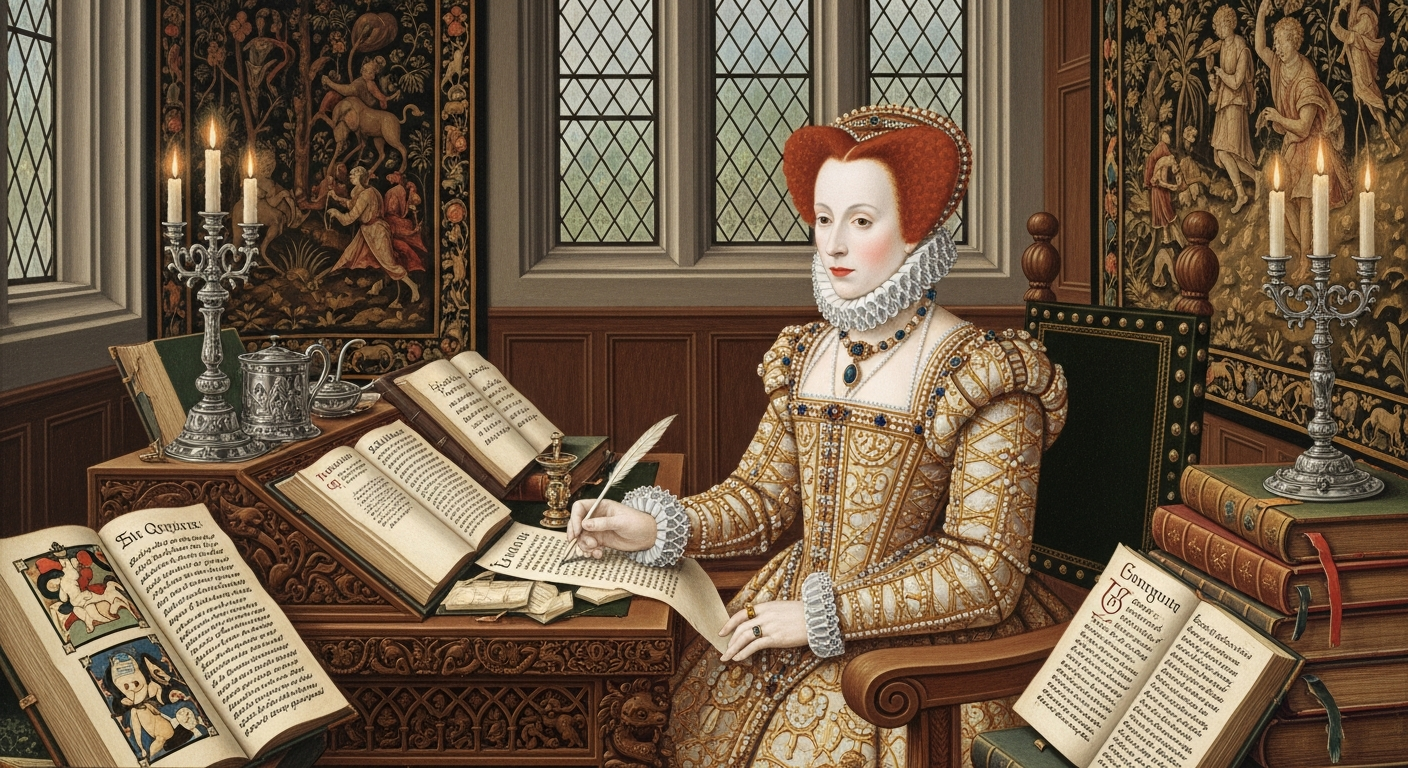
By the time Elizabeth ascended the throne in 1558 at age 25, she had achieved true fluency in English, French, Italian, Latin, Greek, and Spanish. The British Library’s Royal MS 17 A xvi contains one of her most impressive intellectual achievements: her personal translation of Boethius’s ‘Consolation of Philosophy’, completed during her early years as queen. This wasn’t merely a linguistic exercise but a philosophical engagement with one of the most important texts of medieval thought.
Significance and Impact
Elizabeth’s multilingual abilities revolutionised Tudor diplomacy in ways that extended far beyond mere convenience. When she corresponded directly with Catherine de Medici in French, or wrote to Philip II of Spain in his native tongue, she eliminated the potential for mistranslation and the delays inherent in working through interpreters. More importantly, she could read intercepted foreign correspondence in its original language, gaining intelligence advantages that proved crucial during events like the Spanish Armada crisis of 1588.
The queen’s linguistic skills also transformed the nature of court culture during the Elizabethan era. Foreign ambassadors were often startled to find themselves addressed in their native languages by the English queen, creating immediate rapport and demonstrating England’s cultural sophistication. The Venetian ambassador Giovanni Michiel reported in 1557 that Elizabeth ‘speaks Italian better than English’, whilst Spanish diplomats noted her ability to engage in complex theological discussions in Latin with visiting scholars.
Beyond diplomacy, Elizabeth’s translation work contributed to the broader Renaissance movement of making classical texts accessible to contemporary readers. Her translation of Boethius, as documented by scholar Janel Mueller in ‘Elizabeth I: Translations, 1544-1589’ (University of Chicago Press, 2009), demonstrates not only linguistic competence but sophisticated understanding of philosophical concepts. The ‘Consolation of Philosophy’ deals with questions of fortune, fate, and divine providence that were particularly relevant to a monarch facing constant political uncertainties.
The cultural impact extended to Elizabeth’s subjects as well. Her example helped establish the expectation that educated English nobles should be conversant in multiple languages, contributing to what historians call the ‘linguistic flowering’ of late Tudor England. This period saw increased translation of foreign works, greater cultural exchange with continental Europe, and the development of English as a language capable of sophisticated literary and philosophical expression.
Connections and Context
Elizabeth’s polyglot abilities must be understood within the broader context of Renaissance humanism and the Tudor dynasty’s need to establish cultural legitimacy alongside political power. Her father Henry VIII had also been well-educated in languages, though not to Elizabeth’s extent, whilst her predecessor Mary I was fluent in Latin and Spanish (partly due to her mother Catherine of Aragon’s influence). However, Elizabeth’s linguistic range exceeded that of any previous English monarch.
The timing of Elizabeth’s linguistic education coincided with several crucial developments in 16th-century Europe. The Protestant Reformation required careful negotiation between Catholic and Protestant powers, whilst the rise of Spain as a dominant European force made Spanish linguistic competency essential for English diplomacy. Simultaneously, the Renaissance emphasis on classical learning meant that Latin and Greek remained crucial for scholarly and diplomatic discourse.
Did you know that Elizabeth’s linguistic skills proved particularly valuable during the complex negotiations surrounding potential marriages to foreign princes? Her ability to correspond directly with suitors like Erik XIV of Sweden and Archduke Charles of Austria allowed her to manage these delicate diplomatic relationships without intermediaries who might have their own agendas. These marriage negotiations, which continued throughout the first two decades of her reign, required extraordinary diplomatic finesse that her language skills made possible.
Modern Relevance and Fascinating Details
Elizabeth I’s linguistic achievements continue to fascinate modern audiences, partly because they challenge contemporary assumptions about 16th-century women’s education. Recent scholarly research, including digital analysis of her surviving manuscripts, reveals the sophistication of her translation techniques and her ability to adapt classical concepts for contemporary readers. Her approach to translation was remarkably modern, focusing on conveying meaning rather than merely providing literal word-for-word renditions.
One particularly intriguing aspect of Elizabeth’s multilingual abilities was her reported tendency to swear in different languages depending on her audience and level of anger. Contemporary accounts suggest she reserved her most colourful language for Italian and Spanish, perhaps believing that fewer courtiers would understand these expressions. When particularly frustrated with Parliament, she allegedly muttered complaints in Latin, the language of her scholarly education.
Modern historical fiction has embraced Elizabeth’s linguistic prowess as a defining characteristic, with authors like Philippa Gregory and Alison Weir incorporating her translation work and diplomatic correspondence into their narratives. However, many popular depictions still underestimate the true extent of her abilities, focusing on her political acumen whilst overlooking the intellectual foundation that made her diplomatic success possible. As a historical fiction author, I find that readers are consistently surprised to learn that Elizabeth personally translated philosophical works and conducted complex theological debates in Latin with visiting scholars.
Conclusion
Elizabeth I’s mastery of six languages represents far more than royal accomplishment; it was a strategic advantage that helped secure England’s position in an increasingly complex European political landscape. Her ability to engage directly with foreign powers, understand intercepted communications, and demonstrate cultural sophistication through scholarly translation work established new standards for Renaissance monarchy.
The surviving evidence of Elizabeth’s linguistic abilities, from her translation of Boethius housed in the British Library to the numerous examples of her multilingual correspondence, offers modern readers insight into a mind that combined political shrewdness with genuine intellectual curiosity. For anyone interested in exploring Tudor history further, examining Elizabeth’s translations and foreign correspondence provides a unique window into both her personal character and the sophisticated diplomatic culture of 16th-century England.