
Introduction
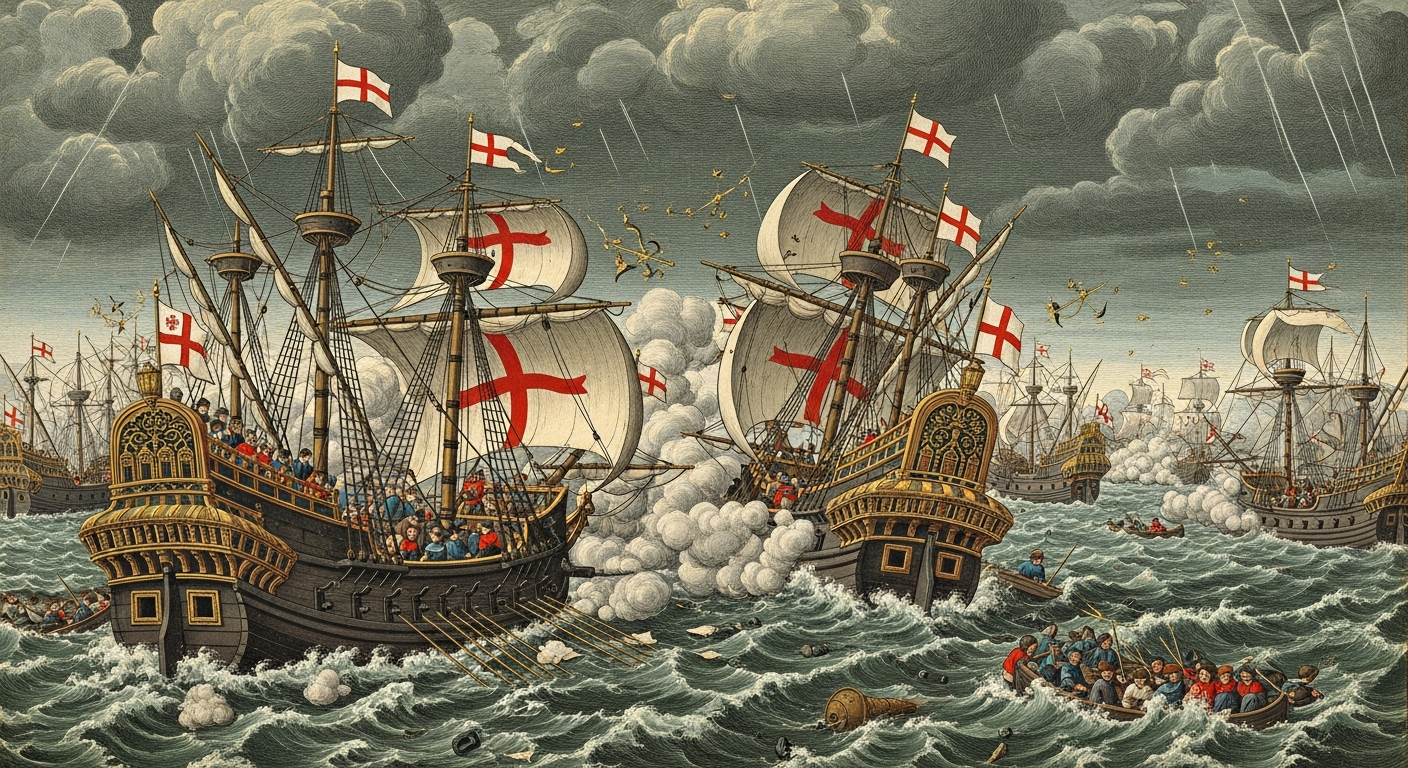
The year 1588 witnessed one of history’s most dramatic naval encounters when Philip II of Spain launched his ‘Invincible Armada’ against Elizabethan England. What began as a carefully orchestrated invasion fleet of approximately 130 ships carrying over 25,000 men would end in catastrophic failure, with only about 60 vessels limping back to Spanish ports. This wasn’t merely a military defeat; it was a pivotal moment that reshaped the balance of European power and secured England’s Protestant future.
The Spanish Armada’s destruction represents far more than a single battle won or lost. It marked the beginning of England’s rise as a naval superpower whilst simultaneously signalling the decline of Spanish dominance over European affairs. The combination of English naval innovation, strategic brilliance, and nature’s fury created a perfect storm that would echo through centuries of maritime history.
Understanding this momentous campaign reveals not only the military tactics and political machinations of the late 16th century but also the personal courage, religious conviction, and national identity that defined Tudor England’s greatest triumph.
Historical Background
The Spanish Armada crisis emerged from decades of escalating tensions between Catholic Spain and Protestant England. Philip II of Spain, the most powerful monarch in Europe, had compelling reasons for launching his grand enterprise against Elizabeth I. His motives were deeply personal and religious: Elizabeth had executed his fellow Catholic, Mary Queen of Scots, in February 1587, whilst English privateers like Sir Francis Drake had been systematically attacking Spanish treasure fleets returning from the Americas.
The invasion plan, conceived in 1587, was ambitious in scope. The Duke of Medina Sidonia commanded the vast armada, which assembled at Lisbon before departing in May 1588. According to Captain Alonso Vanegas’ contemporary account preserved in the Spanish State Archives at Simancas, the fleet comprised 130 ships of various sizes, from massive galleons to smaller support vessels. The human cost was enormous: over 25,000 men including sailors, soldiers, and officers committed to this unprecedented naval expedition.
The Spanish strategy relied on linking their fleet with the Duke of Parma’s experienced army stationed in the Netherlands. Once combined, this formidable force would cross the English Channel to establish a beachhead, overthrow Elizabeth’s government, and restore Catholic rule to England. The plan required precise coordination between two separate forces across hostile waters, a logistical challenge that would prove insurmountable.
England’s response demonstrated the effectiveness of Tudor naval reforms initiated decades earlier. Lord Admiral Charles Howard commanded the English fleet, with Drake serving as vice-admiral. Their ships, though smaller and fewer in number, possessed crucial advantages: superior manoeuvrability, longer-range cannons, and crews intimately familiar with English coastal waters. The stage was set for a confrontation that would determine not only England’s survival but the future of European politics.
Significance and Impact
The Armada’s defeat fundamentally altered the trajectory of English history and European power dynamics. Most immediately, it secured Elizabeth I’s throne and guaranteed England’s Protestant settlement. Had Philip’s invasion succeeded, the English Reformation would have been reversed, with profound implications for religious freedom, parliamentary development, and cultural identity throughout the British Isles.
The victory’s psychological impact proved equally significant. English morale soared as the nation recognised its capacity to defeat Europe’s greatest military power. This confidence would fuel England’s subsequent colonial expansion, naval innovations, and commercial ventures that ultimately established the foundations of the British Empire. The defeat of the ‘Invincible Armada’ became a defining national myth, reinforcing English exceptionalism and divine favour that would influence British identity for centuries.
From a military perspective, the campaign revolutionised naval warfare tactics. The English emphasis on long-range artillery bombardment over traditional close-quarters boarding actions proved devastatingly effective. As Colin Martin and Geoffrey Parker demonstrate in their authoritative study ‘The Spanish Armada: Revised Edition’ (Manchester University Press, 1999), this tactical shift influenced naval strategy throughout Europe, accelerating the development of purpose-built warships designed for artillery duels rather than troop transport.
The economic consequences were equally profound. Spain’s financial resources, already strained by continuous warfare in the Netherlands and the Mediterranean, suffered a crushing blow. The loss of ships, equipment, and trained personnel weakened Spanish naval capacity for decades. Conversely, England’s maritime confidence encouraged investment in exploration, trade, and colonial ventures that would generate enormous wealth throughout the following century.
Connections and Context
The Armada campaign cannot be understood in isolation from the broader context of late Tudor politics and European religious warfare. The execution of Mary Queen of Scots in February 1587 had removed the most obvious Catholic claimant to Elizabeth’s throne, but it also eliminated any remaining diplomatic solutions to Anglo-Spanish tensions. Philip II, as Mary’s chosen heir, now possessed a personal claim to the English crown that legitimised his invasion plans.
Simultaneously, the ongoing Dutch Revolt against Spanish rule had created a secondary theatre of conflict where English and Spanish interests directly collided. Elizabeth’s covert support for Dutch rebels, including the dispatch of the Earl of Leicester’s expeditionary force in 1585, had effectively declared England’s opposition to Spanish hegemony in northwestern Europe. The Armada represented Philip’s attempt to eliminate this English threat whilst securing his vulnerable flank in the Netherlands.
The campaign also intersected with broader patterns of 16th-century exploration and commerce. English privateers’ attacks on Spanish treasure fleets weren’t merely piracy; they represented a systematic challenge to Spain’s American monopoly. Drake’s circumnavigation (1577-1580) and his raid on Cadiz (1587) demonstrated England’s growing naval capabilities whilst disrupting Spanish preparations for the invasion. These interconnected maritime conflicts would continue long after 1588, ultimately leading to England’s emergence as a global naval power.
Modern Relevance and Fascinating Details
The Spanish Armada continues to captivate modern audiences partly because it represents a classic David versus Goliath narrative, but the reality was far more complex than popular mythology suggests. Did you know that weather played perhaps the decisive role in the campaign’s outcome? The famous ‘Protestant wind’ that scattered Spanish ships wasn’t a single storm but a series of gales that prevented the Armada from maintaining formation and forced many vessels onto hostile coastlines.
Modern archaeological investigations have revealed fascinating details about the campaign’s human cost. Shipwrecks discovered off Ireland and Scotland contain poignant reminders of the disaster: personal possessions, navigational instruments, and even preserved organic materials that illuminate the daily lives of ordinary sailors caught up in this grand political struggle. These discoveries remind us that behind the strategic and religious narratives lay thousands of individual tragedies.
The Armada’s legacy in popular culture reflects changing national attitudes and historical understanding. From Elizabethan propaganda celebrating divine intervention to modern historical fiction exploring Spanish perspectives, the campaign continues to inspire writers, filmmakers, and historians. As a historical fiction author, I find the human stories within this epic event particularly compelling: the reluctant Spanish commander who never wanted the job, the English captain who abandoned his post to capture a prize ship, and the Irish coastal communities who faced the impossible choice between helping shipwrecked enemies or facing English retribution.
Contemporary parallels emerge when we consider modern naval conflicts and the role of technology in warfare. Just as the English fleet’s superior artillery and tactics overcame Spanish numerical advantages, modern military history repeatedly demonstrates how technological innovation can offset traditional measures of military strength. The Armada campaign thus offers timeless lessons about adaptation, strategic thinking, and the unpredictable nature of armed conflict.
Conclusion
The defeat of the Spanish Armada stands as one of history’s most consequential naval campaigns, transforming England from a peripheral European kingdom into a emerging maritime power whilst simultaneously beginning Spain’s long decline from European hegemony. The loss of more than half Philip II’s invasion fleet to English tactics and North Sea storms represented far more than a military setback; it was a turning point that reshaped religious, political, and cultural development throughout the Atlantic world.
The campaign’s enduring significance lies not merely in its immediate strategic outcomes but in its demonstration of how individual courage, technological innovation, and sheer determination can overcome seemingly impossible odds. For modern readers seeking to understand the foundations of English-speaking civilisation, the events of 1588 offer essential insights into the forces that shaped our world. The echoes of those distant guns and the memory of those storm-tossed seas continue to resonate through the centuries, reminding us that history’s greatest turning points often emerge from the most desperate struggles.