
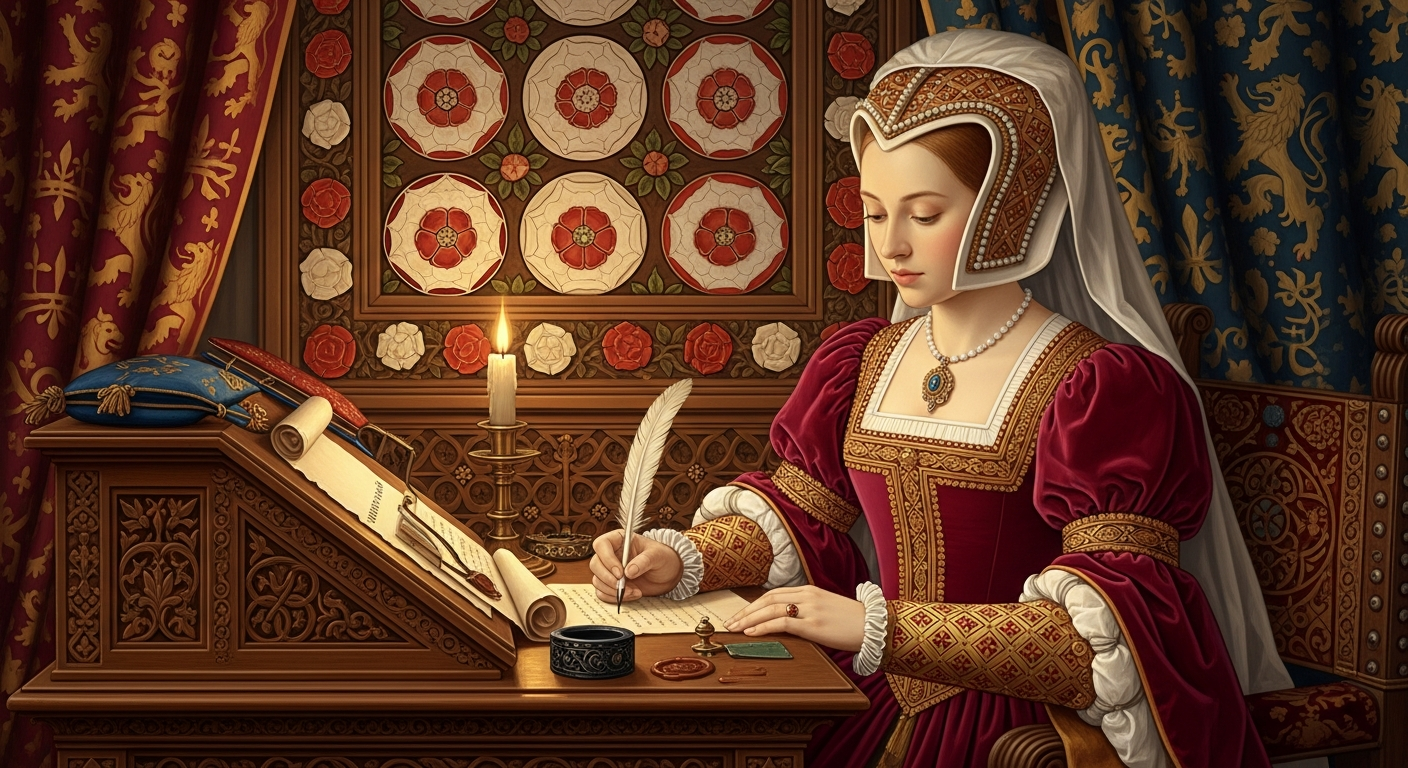
The Fatal Love Letters: Catherine Howard’s Scandalous Romance That Shook the Tudor Court
At just 19 years old, Catherine Howard faced the executioner’s block on a cold February morning in 1542, clutching what remained of her dignity after a scandal that rocked Henry VIII’s court to its very foundations. Her crime? Writing passionate love letters to a court gentleman whilst married to the most dangerous man in England. What makes Catherine’s story particularly tragic is not just her youth, but the evidence that survives today: her own desperate words, penned in secret, declaring “It makes my heart to die to think what fortune I have that I cannot be always in your company.”
Catherine Howard’s brief reign as Henry VIII’s fifth wife lasted barely eighteen months, yet her story continues to fascinate historians and the public alike. Her tale represents the deadly intersection of youthful passion and Tudor politics, where a single love letter could determine the fate of a queen. Understanding Catherine’s story provides crucial insight into the brutal realities of court life, the impossible position of Tudor women, and the paranoid final years of Henry VIII’s reign.
This examination of Catherine Howard’s downfall reveals not only the personal tragedy of a young woman caught between desire and duty, but also the broader implications for Tudor succession, court culture, and the increasingly unstable rule of an ageing king who had already disposed of two wives.
The Players in a Tudor Tragedy
Catherine Howard entered Henry VIII’s orbit around 1540, likely born between 1521 and 1523 into the powerful Howard family. As a niece of Thomas Howard, 3rd Duke of Norfolk, she possessed the noble bloodline that Henry valued, yet her upbringing in the chaotic household of her step-grandmother, Agnes Howard, Dowager Duchess of Norfolk, left her vulnerable and poorly educated in the deadly art of court survival.
Thomas Culpeper, the object of Catherine’s fatal affection, served as a Gentleman of the King’s Privy Chamber, a position that granted him intimate access to Henry VIII. Contemporary records describe Culpeper as handsome and charming, qualities that clearly appealed to the young queen but would ultimately prove his undoing. The third crucial figure in this drama was Jane Boleyn, Lady Rochford, who facilitated the secret meetings between Catherine and Culpeper. Jane’s involvement was particularly significant given her previous role in the downfall of Anne Boleyn, her own sister-in-law.
The romance between Catherine and Culpeper appears to have begun during Henry’s northern progress in the summer of 1541. According to the State Papers of Henry VIII, their correspondence began innocuously but quickly developed into passionate declarations of love. The historical record suggests that whilst their relationship may have remained technically chaste, their emotional intimacy and secret meetings constituted treasonable behaviour under Tudor law.
The discovery of their correspondence came through the testimony of Catherine’s former servant, Henry Manox, and Francis Dereham, both of whom had previous romantic entanglements with Catherine before her marriage to the king. Their revelations opened the door to a broader investigation that ultimately uncovered the Culpeper letters, sealed Catherine’s fate, and demonstrated the precarious nature of queenly power in Tudor England.
A Scandal That Shattered the Tudor Court
The implications of Catherine Howard’s affair extended far beyond a simple case of marital infidelity. Her actions struck at the very heart of Tudor concepts of royal legitimacy and succession. Henry VIII’s quest for a male heir had already led him to break with Rome, execute two wives, and destabilise the English nobility. Catherine’s betrayal represented not just personal humiliation for the ageing king, but a direct threat to the royal bloodline and the stability of the realm.
The political ramifications were immediate and severe. The Howard family, one of England’s most powerful noble houses, found themselves once again under suspicion and facing potential destruction. Thomas Howard, Duke of Norfolk, Catherine’s uncle who had orchestrated her rise to power, narrowly escaped execution only because Henry VIII died before signing his death warrant. The scandal effectively ended Howard influence at court for the remainder of Henry’s reign.
Tudor society’s reaction to Catherine’s downfall reveals the complex attitudes towards female sexuality and royal authority in the 16th century. Whilst some chroniclers expressed sympathy for Catherine’s youth and inexperience, the prevailing view held that queens must be held to the highest standards of moral conduct. The concept of the “king’s two bodies” meant that any crime against the physical person of the monarch was simultaneously an attack on the body politic of England itself.
The legal proceedings that followed established important precedents for treason trials. Parliament passed an act making it treasonable for any woman to marry the king whilst concealing a sexually unchaste past, whilst also making it treason for anyone with knowledge of such matters to remain silent. These laws demonstrated how Catherine’s case influenced English jurisprudence and reflected the crown’s determination to prevent similar scandals in future.
Connections to the Broader Tudor Narrative
Catherine Howard’s execution must be understood within the context of Henry VIII’s increasingly paranoid and tyrannical final years. By 1542, the king had already executed Thomas More, John Fisher, Anne Boleyn, and countless others who had crossed him. Catherine’s death was part of a broader pattern of violence that characterised Henry’s later reign, as the ageing monarch became increasingly suspicious of potential threats to his authority.
The timing of Catherine’s downfall proved particularly significant for English politics. Her execution came just months before Henry’s final marriage to Catherine Parr, a union that would bring stability to the royal household and ensure the survival of Henry’s children to adulthood. Had Catherine Howard lived and produced an heir, the entire course of English history might have changed, potentially preventing the eventual accession of Mary I and Elizabeth I.
Catherine’s story also connects directly to the earlier execution of Anne Boleyn, creating a disturbing pattern in Henry’s treatment of wives who failed to meet his expectations. Both women were young, both were accused of adultery, and both faced similar charges of treason. The involvement of Jane Boleyn, Lady Rochford, in both cases highlights the complex loyalties and dangerous alliances that characterised Tudor court life, where survival often depended on successfully navigating ever-shifting political currents.
Why Catherine Howard’s Story Still Captivates Us
Modern audiences continue to find Catherine Howard’s story compelling because it combines elements that resonate across centuries: young love, political intrigue, and the abuse of power. Her story has inspired numerous historical novels, television programmes, and academic studies, each attempting to understand how a teenager from a noble family could find herself facing execution for following her heart.
Recent historical scholarship has increasingly focused on Catherine’s agency and the limited choices available to Tudor women. Historians like Lacey Baldwin Smith in his seminal work “A Tudor Tragedy: The Life and Times of Catherine Howard” have emphasised how Catherine’s story illuminates the broader experiences of women in Tudor society, where marriage was primarily a political and economic transaction rather than a romantic partnership.
Did you know that Catherine Howard was never actually crowned as queen? Unlike Henry’s other wives, she never received a coronation ceremony, possibly because Henry was already becoming suspicious of her past. This detail adds another layer of tragedy to her story, as she faced all the dangers of queenship without ever receiving its full recognition and honours.
The survival of Catherine’s love letters in the British Library provides modern readers with an extraordinarily intimate glimpse into Tudor emotions and relationships. Her passionate declaration that “It makes my heart to die to think what fortune I have that I cannot be always in your company” reveals a young woman caught between genuine feeling and impossible circumstances, making her story timelessly relatable despite the vast differences between Tudor and modern society.
Understanding a Tudor Tragedy
Catherine Howard’s brief life and dramatic death encapsulate many of the central themes of Tudor history: the dangerous intersection of personal desire and political necessity, the precarious position of women in a male-dominated society, and the absolute power of monarchy in sixteenth-century England. Her love letters, preserved in the State Papers of Henry VIII, provide us with rare insight into the emotional reality behind the grand narratives of Tudor politics.
The tragedy of Catherine Howard lies not just in her youth or the brutality of her execution, but in the impossible position she occupied as both a private individual with personal desires and a public figure whose every action carried political implications. Her story continues to resonate because it reveals the human cost of absolute power and reminds us that behind the grand sweep of Tudor history were real people facing impossible choices with often fatal consequences.