
Introduction
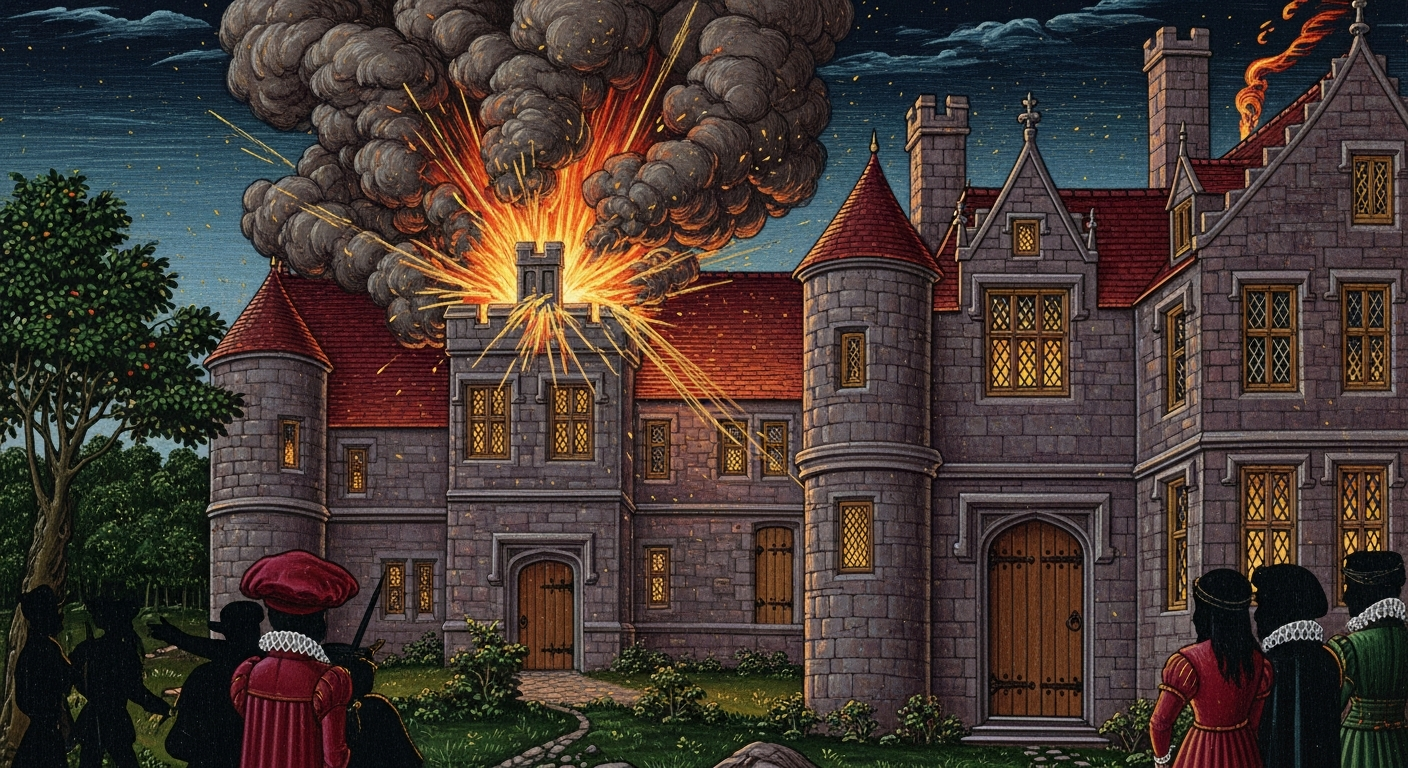
The year 1567 stands as one of the most dramatic and consequential in Scottish royal history, when a single act of violence would ultimately seal the fate of Mary Queen of Scots. The explosion that destroyed Lord Darnley’s lodging at Kirk o’ Field in Edinburgh during the early hours of 10th February 1567 was not merely a spectacular murder, but the catalyst for a chain of events that would topple a queen from her throne within mere months.
This devastating incident, followed by Mary’s scandalous marriage to the Earl of Bothwell just three months later, created such outrage amongst the Scottish nobility that they would force their anointed queen to abdicate in favour of her infant son James VI by July 1567. The speed and drama of these events represent one of the most remarkable political collapses in Tudor-era Britain, transforming Mary from a reigning monarch into a prisoner seeking refuge in England.
Understanding the Kirk o’ Field murder and its aftermath reveals not only the personal tragedy of Mary Queen of Scots, but also the volatile nature of 16th-century politics, where rumour, suspicion, and political expediency could destroy even the most seemingly secure royal position.
Historical Background
Henry Stuart, Lord Darnley, had married Mary Queen of Scots in July 1565, a union that initially seemed politically advantageous but quickly soured into mutual resentment and mistrust. Darnley, though titled and handsome, proved arrogant, dissolute, and politically inept. His involvement in the brutal murder of Mary’s secretary David Rizzio in March 1566, conducted in the queen’s presence whilst she was six months pregnant, had irreparably damaged their relationship.
By early 1567, Darnley was recovering from what was likely syphilis at a house called Kirk o’ Field, just outside Edinburgh’s city walls. The building had been chosen as a quiet retreat where the king could recuperate away from court. Mary had been visiting him regularly, maintaining the appearance of wifely concern despite their estranged relationship. On the night of 9th February, she had attended a wedding celebration at Holyrood Palace, leaving Darnley at Kirk o’ Field with only a few servants.
James Hepburn, 4th Earl of Bothwell, occupied a central position in these events. As Lord Admiral of Scotland and one of Mary’s most trusted nobles, Bothwell had significant political influence and military power. Contemporary sources, including the Calendar of State Papers relating to Scotland, reveal that suspicions about Bothwell’s involvement in what would unfold began circulating almost immediately after the explosion.
In the early hours of 10th February 1567, Kirk o’ Field was destroyed by a massive gunpowder explosion that could be heard across Edinburgh. However, when searchers found Darnley’s body, he lay in the garden, apparently strangled rather than killed by the blast. This peculiar circumstance immediately suggested premeditated murder rather than an accident, as someone had clearly removed Darnley from the building before finishing him off by other means.
Significance and Impact
The murder of Lord Darnley represented a watershed moment that would reshape not only Scottish politics but also the broader balance of power in Tudor Britain. As John Guy notes in his authoritative biography ‘Queen of Scots: The True Life of Mary Stuart’, the explosion at Kirk o’ Field “marked the beginning of the end of Mary’s effective rule in Scotland.” The incident created a crisis of legitimacy that would prove impossible for Mary to overcome.
The immediate political impact was devastating. Protestant lords who had already viewed Mary’s Catholic faith with suspicion now had concrete grounds to question her moral fitness to rule. When placards appeared around Edinburgh directly accusing Bothwell of the murder and implying Mary’s complicity, the royal authority began to crumble. The fact that no serious investigation was conducted, and that Bothwell’s subsequent trial was widely regarded as a sham, only deepened public suspicion.
Mary’s marriage to Bothwell on 15th May 1567, conducted according to Protestant rites at Holyrood Palace, proved to be the final straw for the Scottish nobility. This hasty union, occurring just three months after Darnley’s murder and shortly after Bothwell’s controversial acquittal, appeared to confirm the worst suspicions about both the murder and Mary’s character. The marriage was seen as evidence that Mary had been complicit in her husband’s death in order to marry her lover.
The consequences were swift and decisive. By June 1567, a confederation of Scottish nobles had raised an army against Mary and Bothwell. Following their defeat at the Battle of Carberry Hill on 15th June, Mary was imprisoned at Lochleven Castle. The political pressure became so intense that on 24th July 1567, Mary was forced to abdicate in favour of her thirteen-month-old son, James VI, with her half-brother the Earl of Moray appointed as regent.
Connections and Context
The Kirk o’ Field murder occurred during a particularly turbulent period in British history, when religious divisions and dynastic uncertainties created constant political instability. In England, Elizabeth I remained unmarried and without an heir, making Mary’s son James a potential claimant to the English throne. This broader context helps explain why the Scottish crisis attracted such intense interest from European courts and why Elizabeth I would eventually feel compelled to intervene.
The events of 1567 also illuminate the complex relationship between Scotland and England during this period. When Mary escaped from Lochleven Castle in May 1568 and was defeated at the Battle of Langside, her decision to flee to England rather than France reflected the changing European political landscape. The French alliance that had sustained Scottish independence for centuries was weakening, whilst the Protestant connection with England was becoming more significant.
These developments were occurring simultaneously with other major political upheavals across Europe. The Dutch Revolt against Spanish rule had begun in 1566, whilst in France, the tensions that would explode into the French Wars of Religion were intensifying. The Kirk o’ Field murder and its aftermath thus represented one element in a broader pattern of 16th-century political instability driven by religious division and dynastic uncertainty.
Modern Relevance and Fascinating Details
The mystery surrounding Lord Darnley’s murder continues to fascinate historians and the public alike, partly because it combines elements of political thriller and personal tragedy that remain compelling today. The case has parallels with modern political scandals where the appearance of impropriety can be as damaging as actual guilt, and where the speed of events can overwhelm attempts at damage control.
Did you know that the explosion at Kirk o’ Field was so powerful that pieces of the building were found scattered over a considerable area, yet Darnley’s body showed no signs of blast damage? This forensic detail, carefully recorded by contemporary investigators, continues to puzzle historians and has inspired numerous theories about exactly what happened that February night. Some historians suggest that Darnley may have discovered the gunpowder plot and attempted to escape, only to be caught and killed by the conspirators.
The case has proved enduringly popular in historical fiction and popular culture, from Friedrich Schiller’s classic play ‘Mary Stuart’ to modern novels and television dramas. As a historical fiction author, I find that the Darnley murder offers a perfect example of how personal relationships and political necessity intersected in the 16th century, creating situations where even queens could find themselves trapped by circumstances beyond their control.
Modern forensic techniques have been applied to re-examine the evidence, though the destruction of many contemporary records means that definitive answers remain elusive. What we can say with certainty is that the political handling of the crisis was disastrously inept, transforming what might have remained a matter of speculation into a public relations catastrophe that destroyed Mary’s reputation and ultimately cost her throne.
Conclusion
The murder of Lord Darnley at Kirk o’ Field stands as a pivotal moment in British history, demonstrating how a single dramatic event could reshape the political landscape of an entire nation. Within five months, the explosion that destroyed Darnley’s lodging had led directly to Mary Queen of Scots losing her throne and fleeing to England, where she would spend the remaining nineteen years of her life as Elizabeth I’s prisoner.
The speed and completeness of Mary’s fall from power offer timeless lessons about the fragility of political authority when it loses public confidence. Whether or not Mary was actually complicit in Darnley’s murder, her inability to manage the crisis effectively, combined with her disastrous marriage to Bothwell, created a perfect storm that no amount of royal authority could withstand. For anyone interested in understanding the complex interplay of personal relationships and political power in Tudor Britain, the events of 1567 provide an unparalleled case study in how quickly circumstances can transform triumph into tragedy.