
Introduction
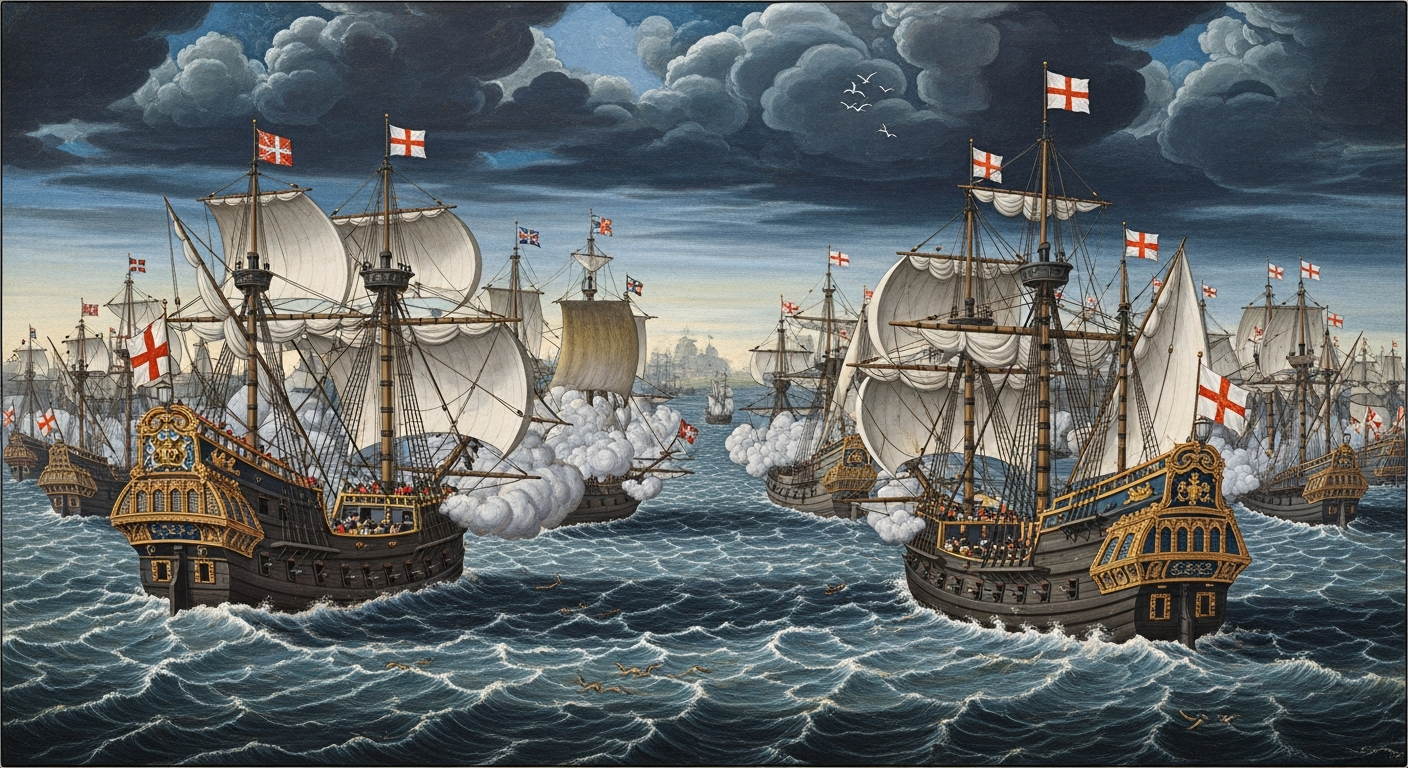
When Queen Elizabeth I declared that she had “the heart and stomach of a king, and of a king of England too,” she could hardly have imagined that within months, her realm would face its greatest existential threat since the Norman Conquest. The year 1588 witnessed one of history’s most dramatic naval confrontations, as Philip II of Spain launched his “Enterprise of England” with approximately 130 warships carrying 30,000 men. Yet by autumn’s end, fewer than 70 battered Spanish vessels limped home, marking not just a military defeat but a seismic shift in European power.
The defeat of the Spanish Armada represents far more than a single naval victory. It marked England’s transformation from a relatively minor European kingdom into an emerging maritime superpower, whilst simultaneously beginning Spain’s decline from its position as Europe’s dominant force. This pivotal moment in Tudor history would reshape international relations, boost Protestant confidence across Europe, and establish the foundations for England’s later colonial empire.
Understanding the Armada’s defeat requires examining not only the tactical brilliance of English naval commanders and the ferocity of North Sea storms, but also the complex web of religious, political, and economic factors that made this confrontation inevitable. From the meticulous planning in Spanish archives to the desperate battles in the English Channel, this is the story of how England’s destiny was forged in saltwater and cannon smoke.
Historical Background
The Spanish Armada crisis emerged from decades of escalating tension between Catholic Spain and Protestant England. Philip II, the most powerful monarch in Europe, had multiple grievances against Elizabeth I: her support for Protestant rebels in the Spanish Netherlands, English privateering attacks on Spanish treasure ships, and most personally, the execution of his fellow Catholic monarch Mary, Queen of Scots, in February 1587.
Philip’s “Enterprise of England” was conceived as both a religious crusade and a strategic necessity. The Spanish king believed that removing the Protestant Elizabeth and installing a Catholic monarch would secure Spain’s Atlantic trade routes, eliminate English support for Dutch rebels, and restore Catholic unity to northern Europe. Pope Sixtus V had even promised to contribute one million gold ducats to the venture, though only after English soil was actually occupied.
The Armada that assembled in Lisbon during early 1588 represented the largest naval force ever assembled. Under the command of the Duke of Medina Sidonia, approximately 130 ships carried 8,000 sailors and 18,000 soldiers, supported by 2,500 pieces of artillery. The strategy was ambitious: sail up the English Channel, rendezvous with the Duke of Parma’s veteran army of 17,000 men in the Spanish Netherlands, then transport these forces across the narrow seas to invade England.
Elizabeth’s England, by contrast, possessed a smaller but more manoeuvrable fleet of approximately 200 vessels, though many were smaller merchant ships pressed into service. However, the English ships were generally faster, more heavily armed with long-range cannon, and commanded by experienced sea captains like Sir Francis Drake, Lord Howard of Effingham, and John Hawkins. These men had spent years perfecting new naval tactics that prioritised mobility and firepower over the traditional approach of grappling and boarding enemy vessels.
Significance and Impact
The Armada’s defeat fundamentally altered the balance of European power in ways that would echo for centuries. Most immediately, it preserved Protestant England’s independence and demonstrated that Philip II’s Spain, despite its vast wealth and military reputation, was not invincible. According to the Calendar of State Papers Relating to English Affairs in the Archives of Simancas, Spanish officials struggled to comprehend how their seemingly overwhelming force had been so comprehensively defeated.
For Tudor England, victory brought unprecedented international prestige and confidence. Elizabeth’s subjects, who had watched beacon fires blaze across the realm’s hills as the Armada approached, now celebrated their queen as a deliverer appointed by Providence. The victory medal struck afterwards bore the inscription “Flavit Jehovah et Dissipati Sunt” (“Jehovah blew and they were scattered”), reflecting the widespread belief that God himself had intervened to protect Protestant England.
The defeat’s economic consequences proved equally significant. Spain’s naval losses, combined with the ongoing costs of fighting in the Netherlands, France, and the Mediterranean, strained even Philip II’s seemingly inexhaustible treasury. Meanwhile, England’s enhanced naval reputation attracted increased foreign investment and emboldened English merchants to expand their trading ventures. The psychological impact of victory encouraged the risk-taking mentality that would later drive English colonial expansion.
Perhaps most importantly, the Armada’s destruction established new principles of naval warfare that would define maritime conflict for generations. The English tactics of maintaining distance whilst delivering concentrated cannon fire proved far more effective than traditional close-quarters combat. As Colin Martin and Geoffrey Parker demonstrate in their authoritative study ‘The Spanish Armada: Revised Edition’, this tactical revolution represented a fundamental shift in how naval power would be projected and contested.
Connections and Context
The Armada crisis cannot be understood in isolation from other pivotal events of Elizabeth’s reign. The execution of Mary, Queen of Scots, in February 1587 had provided Philip II with the final justification he needed for invasion, whilst also removing the most obvious Catholic claimant to the English throne. This timing was crucial, as it meant Philip would need to govern England directly rather than through a puppet monarch, making the invasion far more complex logistically.
Simultaneously, England’s ongoing support for Protestant rebels in the Netherlands had created an intolerable situation for Spanish strategic interests. The Earl of Leicester’s expedition to aid the Dutch rebels in 1585-1587, though militarily unsuccessful, had demonstrated Elizabeth’s commitment to opposing Spanish expansion. This intervention made peaceful coexistence between England and Spain increasingly impossible.
The international context also favoured England’s cause. France, traditionally Spain’s rival, was embroiled in religious civil wars and could offer Philip no assistance. The Ottoman Empire’s continued pressure in the Mediterranean meant Spain could not concentrate its full naval strength against England. These circumstances created a brief window of opportunity that English commanders exploited brilliantly.
Did you know that the Armada crisis coincided with the height of English Renaissance culture? Even as Spanish ships sailed up the Channel, Christopher Marlowe was writing ‘Doctor Faustus’, whilst William Shakespeare was likely composing some of his earliest plays. This cultural flowering reflected the confidence and energy that would be dramatically boosted by the Armada’s defeat.
Modern Relevance and Fascinating Details
The Spanish Armada continues to fascinate modern audiences partly because it represents a classic David versus Goliath story, but also because new archaeological and documentary evidence keeps reshaping our understanding of these events. Underwater archaeology has revealed that many Spanish ships were lost not to English cannon fire but to the fierce storms that battered the fleet as it attempted to return home via Scotland and Ireland.
Recent research has also highlighted the crucial role of intelligence gathering in England’s victory. Sir Francis Walsingham’s spy network provided Elizabeth’s government with remarkably detailed information about Spanish preparations, allowing English commanders to position their forces optimally. This early example of intelligence-led strategy offers fascinating parallels with modern military planning.
The human stories behind the Armada remain equally compelling. Many Spanish sailors and soldiers who survived shipwrecks on Irish coasts were executed by English officials, whilst others were sheltered by Irish families despite the religious and political risks involved. These individual tales of survival, betrayal, and unexpected kindness illuminate the human cost of grand strategic confrontations.
As a historical fiction author, I’m continually struck by how the Armada campaign demonstrates the role of contingency in history. Had the Duke of Parma’s barges been ready when the Armada reached Calais, had the weather been calmer, or had Spanish gunnery been more effective, the entire course of world history might have changed. These ‘what if’ scenarios continue to inspire novelists and filmmakers, from Rafael Sabatini’s sea stories to more recent productions like ‘Elizabeth: The Golden Age’.
Conclusion
The defeat of the Spanish Armada in 1588 stands as one of history’s most decisive naval victories, transforming England from a peripheral European kingdom into an emerging global power whilst beginning Spain’s long decline from imperial dominance. The stark statistics tell part of the story: approximately 130 Spanish ships departed, but fewer than 70 returned home, carrying the survivors of what had been intended as an unstoppable invasion force.
Yet beyond the military details lies a deeper significance that continues to resonate today. The Armada’s defeat demonstrated how innovative tactics, superior intelligence, and favourable circumstances could overcome seemingly overwhelming odds. It marked a turning point in European history, establishing the foundations for England’s later maritime empire whilst proving that even the mightiest powers remain vulnerable to determined and well-prepared opponents. For anyone seeking to understand how Tudor England evolved into a global force, the summer of 1588 provides the essential starting point for that remarkable transformation.