
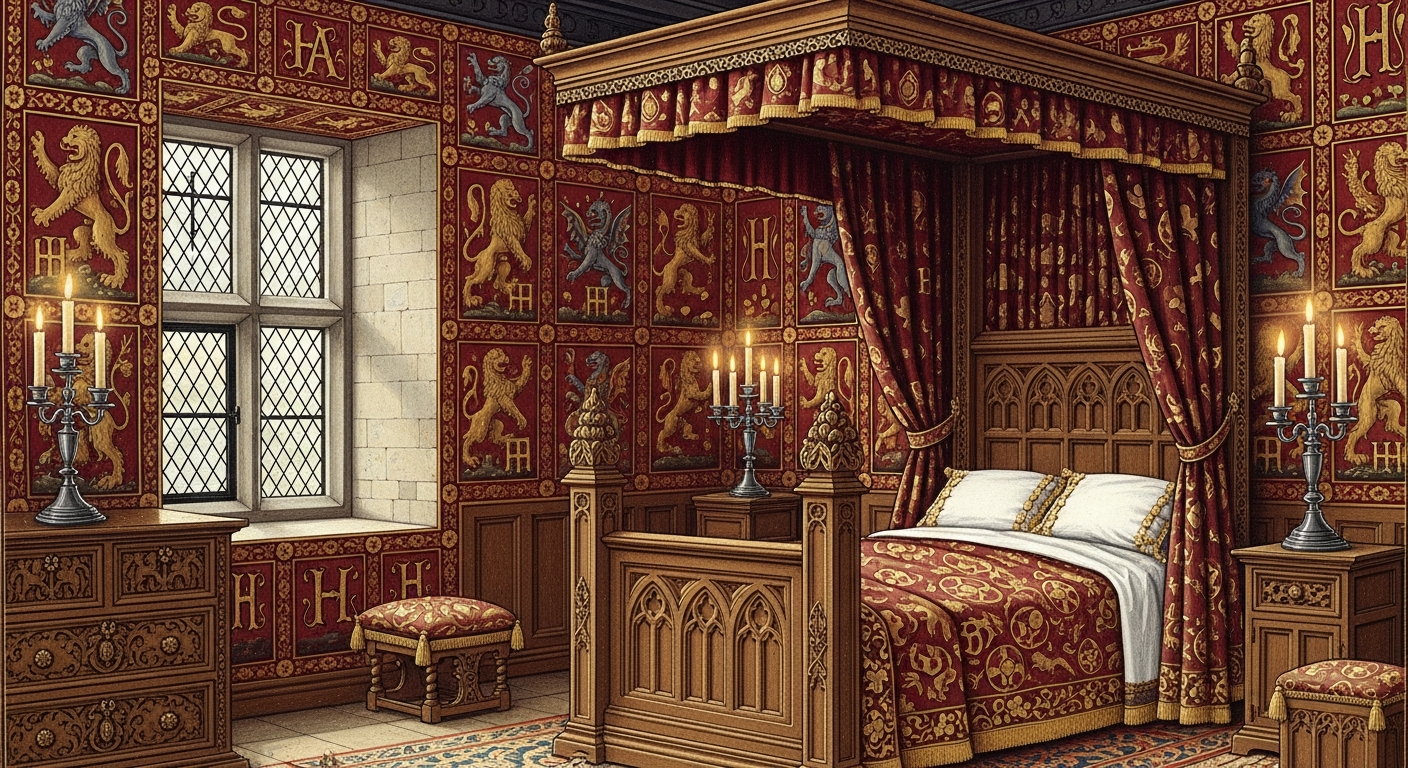
In the treacherous world of Tudor politics, few figures embodied ambition and recklessness quite like Thomas Seymour, Baron Seymour of Sudeley. This charismatic nobleman, who rose to power through his sister Jane Seymour’s marriage to Henry VIII, would ultimately meet his end on the executioner’s block in 1549. His downfall stemmed from a shocking series of events that began with a secret marriage to the dowager queen Catherine Parr and culminated in allegations of attempted seduction of the teenage Princess Elizabeth, including the infamous incident where he allegedly entered her bedchamber in his nightgown and cut her dress to pieces whilst she wore it.
The story of Thomas Seymour’s spectacular rise and fall offers a compelling glimpse into the dangerous game of Tudor court politics, where ambition often trumped common sense and where proximity to power could prove as deadly as it was alluring. His actions not only sealed his own fate but also cast a shadow over the young Princess Elizabeth that would follow her for years to come, shaping her attitudes towards marriage and trust in ways that would echo throughout her eventual reign.
This extraordinary tale reveals the complex web of relationships, power struggles, and personal desires that characterised the early years of Edward VI’s reign, when England was ruled by a child king and ambitious men vied for control behind the scenes.
Historical Background
Thomas Seymour was born around 1508 into a Wiltshire gentry family that would achieve unprecedented prominence through his sister Jane’s marriage to Henry VIII in 1536. Following Jane’s death in 1537 after giving birth to the future Edward VI, the Seymour family maintained their influential position at court. Thomas served as a naval commander and diplomat, gaining a reputation as a dashing and ambitious courtier with considerable charm but questionable judgement.
When Henry VIII died in January 1547, the political landscape shifted dramatically. Nine-year-old Edward VI ascended the throne, with his uncle Edward Seymour, Thomas’s elder brother, becoming Lord Protector and Duke of Somerset. Thomas Seymour was created Baron Seymour of Sudeley and appointed Lord High Admiral of England, positions that placed him at the heart of the new regime. However, sibling rivalry and Thomas’s restless ambition would soon create dangerous tensions within the ruling circle.
The most shocking development came in the spring of 1547, when Thomas Seymour secretly married Catherine Parr, Henry VIII’s sixth and surviving wife. According to Susan James’s research in Catherine Parr: Henry VIII’s Last Love, this clandestine union took place sometime between April and June 1547, likely at Catherine’s residence of Chelsea Palace. The marriage was kept secret initially because it violated both protocol and law for a queen dowager to marry without the king’s consent, even when that king was a nine-year-old child.
The situation became even more complex because Princess Elizabeth, then aged thirteen, was living in Catherine Parr’s household at Chelsea. It was here that the most disturbing allegations against Thomas Seymour would emerge. Contemporary accounts, preserved in the Calendar of State Papers Domestic for Edward VI’s reign, detail accusations that Seymour engaged in highly inappropriate behaviour towards the teenage princess, including entering her bedchamber whilst she was still abed, sometimes wearing only his nightgown, and on at least one occasion allegedly cutting her black dress into pieces whilst she wore it.
Significance and Impact
The Thomas Seymour affair represented far more than a single nobleman’s fall from grace; it highlighted the inherent instability of a system where a child occupied the throne and adults competed for power and influence. Seymour’s actions threatened the delicate balance of the early Edwardian regime and posed serious questions about the safety and reputation of Princess Elizabeth, who remained second in line to the throne under Henry VIII’s succession arrangements.
The allegations against Seymour had profound implications for Elizabeth personally. The Calendar of State Papers records show that she was questioned extensively about her relationship with Seymour following his arrest in January 1549. These interrogations were clearly traumatic for the fifteen-year-old princess, who had already endured the execution of her mother, Anne Boleyn, when she was just two years old. The experience taught Elizabeth hard lessons about the dangers of romantic entanglements and the way her enemies could use even innocent relationships against her.
Catherine Parr’s position in this scandal reveals the complex dynamics facing Tudor women, even those of the highest rank. Despite being a queen dowager and one of the most educated women of her time, she found herself caught between her new husband’s increasingly erratic behaviour and her responsibilities towards Elizabeth. Catherine’s death in September 1548, shortly after giving birth to Seymour’s daughter, removed the one person who might have restrained his worst impulses and protected Elizabeth from further inappropriate attention.
The political ramifications extended throughout the court and government. Thomas Seymour’s behaviour created a rift with his brother Edward, the Lord Protector, weakening the Seymour family’s grip on power at a crucial time. His attempts to curry favour with the young King Edward VI by providing him with pocket money and encouraging him to assert his independence undermined the carefully constructed regency arrangements that were meant to ensure stable government during the king’s minority.
Connections and Context
Thomas Seymour’s downfall occurred against the backdrop of significant religious and social upheaval in England. Edward VI’s reign marked the acceleration of Protestant reforms begun under Henry VIII, and the country faced economic difficulties, social unrest, and external threats from Catholic powers. In this context, Seymour’s reckless behaviour represented not just personal misconduct but a dangerous distraction from the serious business of governing the realm.
The broader pattern of ambitious men overreaching themselves was well-established in Tudor England by 1549. Thomas Seymour’s fate echoed that of other royal favourites who had fallen spectacularly from grace, including Thomas Wolsey, Thomas Cromwell, and indeed Thomas Seymore’s own brother-in-law, Henry VIII, who had ordered the execution of numerous courtiers who had displeased him. The Tudor court was a place where fortunes could change overnight, and Seymour’s story serves as a classic example of how quickly power could turn to peril.
Interestingly, Thomas Seymour’s execution in March 1549 preceded his brother Edward’s own fall from power by just over a year. The Lord Protector was overthrown in October 1549 and eventually executed in 1552, demonstrating that even the highest positions offered no guarantee of security. The Seymour brothers’ successive downfalls marked the end of their family’s brief dominance over English politics and paved the way for John Dudley, later Duke of Northumberland, to assume control of Edward VI’s government.
Modern Relevance and Fascinating Details
The Thomas Seymour scandal continues to fascinate modern audiences because it combines elements that remain compelling today: political intrigue, family dysfunction, inappropriate relationships, and the abuse of power. The story has been explored extensively in historical fiction, from Jean Plaidy’s Tudor novels to more recent works that examine the psychological impact of these events on Elizabeth I’s later life and attitudes towards marriage and sexuality.
Contemporary feminists and historians have increasingly focused on the Elizabeth angle of the story, recognising that what happened to her at Chelsea Palace would today be clearly identified as sexual harassment or abuse by a trusted adult. This modern perspective adds layers of understanding to Elizabeth’s later declaration that she would never marry, her famous statement that she was ‘married to England’, and her general wariness of male courtiers who sought to get too close to her person.
One particularly fascinating detail that often surprises people is that Thomas Seymour’s daughter by Catherine Parr, Mary Seymour, disappeared from historical records after her father’s execution. Born in late August 1548, she was left orphaned at just six months old. Despite being the child of a former queen of England, her fate remains unknown, highlighting how quickly families could fall from the heights of power to obscurity in Tudor England.
The dress-cutting incident, whilst shocking by any standards, also reveals interesting details about Tudor clothing and domestic arrangements. The fact that Seymour could access Elizabeth’s private chambers and that she was wearing a black dress suggests the formal yet vulnerable position of even high-ranking women in Tudor households, where privacy was limited and male authority figures could exercise considerable power over female dependents.
Conclusion
The extraordinary story of Thomas Seymour’s rise and fall encapsulates many of the key themes of Tudor history: the dangerous game of court politics, the vulnerability of women in a male-dominated society, and the way personal ambitions could collide catastrophically with political realities. His execution in 1549 marked not just the end of one man’s life but a crucial moment in the development of Princess Elizabeth’s character and her understanding of power dynamics.
For modern readers seeking to understand the complexities of Tudor England, Thomas Seymour’s story offers a compelling case study in how individual actions could have far-reaching consequences for the realm’s stability and the lives of those caught up in the machinations of ambitious men. His legacy serves as a reminder that in the treacherous waters of Tudor politics, those who swam too close to the crown often found themselves drowning in their own ambitions.