
Introduction
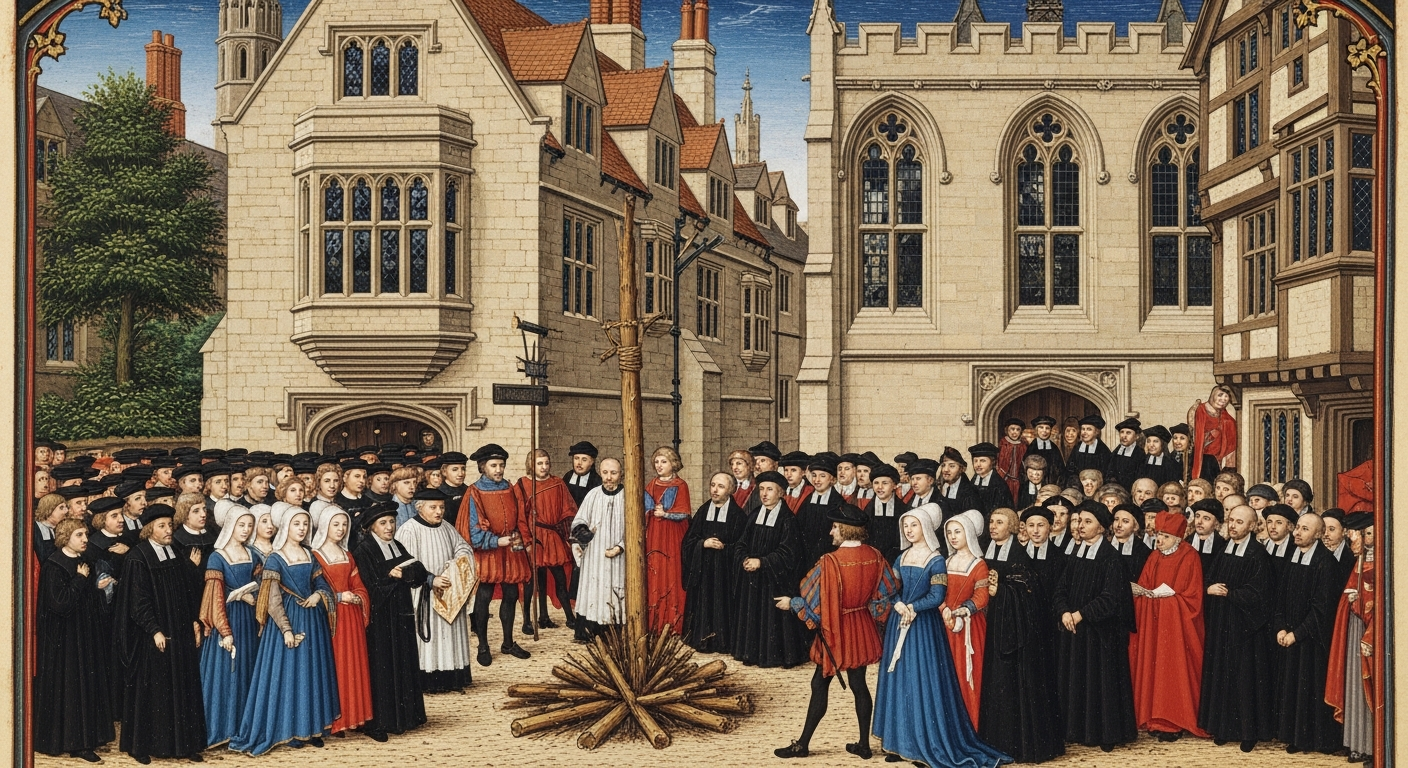
The acrid smoke rising from Oxford’s town ditch on 21st March 1556 carried with it the screams of a man whose final act would become one of the most dramatic moments in English religious history. Thomas Cranmer, former Archbishop of Canterbury and architect of English Protestant reform, thrust his right hand into the flames that were consuming him, crying out ‘this unworthy right hand’ as punishment for signing his recantation of Protestant beliefs. This extraordinary scene epitomised the religious terror that gripped England during Mary I’s five-year reign, when approximately 280 Protestants were burned alive for heresy.
Mary Tudor’s brutal campaign to restore Catholic orthodoxy earned her the enduring nickname ‘Bloody Mary’, yet her motivations were far more complex than mere cruelty. Understanding the Marian persecutions requires examining the fractured religious landscape of 16th-century England, where theological differences literally meant the difference between life and death. From humble weavers to learned bishops, men and women from all walks of life faced the ultimate test of faith during these dark years.
This exploration of the Marian martyrs reveals not only the human cost of religious reformation but also how these deaths shaped English Protestant identity for centuries to come, influencing everything from popular literature to national consciousness in ways that resonate even today.
Historical Background
When Mary I ascended the throne in July 1553, she inherited a kingdom transformed by her father Henry VIII’s break with Rome and her half-brother Edward VI’s radical Protestant reforms. Mary, a devout Catholic who had suffered persecution under Protestant regimes, was determined to restore England to papal obedience and eradicate what she viewed as dangerous heresy. The stage was set for a religious confrontation of unprecedented violence.
The persecution began in earnest in February 1555 with the burning of John Rogers, a Bible translator and former chaplain to English merchants in Antwerp. Rogers’ execution at Smithfield marked the beginning of a systematic campaign that would claim lives across England, from London’s Smithfield Market to the cathedral cities of Oxford and Canterbury. The majority of victims were ordinary people: weavers, labourers, and small tradespeople who had embraced Protestant teachings during Edward VI’s reign.
Mary’s government, advised by Cardinal Reginald Pole and supported by her husband Philip II of Spain, employed the medieval heresy laws with ruthless efficiency. Suspects were tried before ecclesiastical courts, offered opportunities to recant their beliefs, and if they refused, handed over to secular authorities for execution. The legal process, whilst following established precedent, was applied with a thoroughness that shocked contemporaries and created an atmosphere of terror throughout Protestant communities.
The geographic distribution of the burnings reveals the pattern of Protestant strength in England. London and the south-east, where reformed ideas had taken deepest root, saw the highest concentration of executions. Canterbury witnessed 45 burnings, whilst Essex, with its tradition of religious dissent, became a particular focus of persecution. Even small market towns found themselves hosting these grim spectacles, as Mary’s government sought to demonstrate that no corner of the realm would be safe for heretics.
Significance and Impact
The psychological impact of the Marian persecutions on English society cannot be overstated. For the first time since the Lollard persecutions of the early 15th century, ordinary English men and women were being burned alive for their religious beliefs on a systematic scale. The sight of neighbours and fellow parishioners meeting such horrific deaths created lasting trauma that would influence English attitudes towards Catholicism for generations.
Mary’s campaign achieved the opposite of its intended effect. Rather than intimidating Protestants into submission, the executions created martyrs whose stories spread rapidly through underground networks. John Foxe’s meticulous documentation in his Acts and Monuments, first published in 1563, preserved these accounts for posterity and transformed the Marian martyrs into powerful symbols of Protestant resistance. Foxe’s work, known as the ‘Book of Martyrs’, became one of the most influential books in English history, second only to the Bible in many Protestant households.
The social composition of the martyrs also proved significant in shaping English Protestant identity. Unlike the scholarly reformers of the early Reformation, many of Mary’s victims were ordinary working people whose simple faith and courage in the face of death demonstrated that Protestant truth was not confined to educated elites. This democratisation of martyrdom helped embed Protestant beliefs deep within English popular culture, making the reformed faith a truly national religion.
The international dimension of Mary’s policy also had lasting consequences. The involvement of Spanish advisors and the presence of papal legates reinforced Protestant propaganda that portrayed Catholicism as a foreign threat to English independence. The association between Catholic restoration and foreign influence would become a persistent theme in English political discourse, contributing to the development of a distinctly anti-Catholic national identity that persisted well into the modern era.
Connections and Context
The Marian persecutions occurred during a broader European context of religious violence that characterised the 16th century. Whilst Mary’s government was burning Protestants in England, the Roman Inquisition was intensifying its activities across Catholic Europe, and Protestant authorities in cities like Geneva were executing Catholics and radicals deemed heretical. The difference lay not in the use of violence itself, but in its scale and the particular circumstances of English religious development.
The timing of the persecutions proved crucial to their long-term impact. Beginning just as printing technology was revolutionising the spread of information, accounts of the martyrs’ sufferings could be documented and disseminated with unprecedented speed and accuracy. Protestant exiles in cities like Strasbourg and Geneva maintained extensive correspondence networks, ensuring that news of the persecutions reached international audiences and generated sympathy for the English Protestant cause.
Mary’s marriage to Philip II of Spain, celebrated just months before the burnings began, provided additional context that English Protestants exploited in their propaganda. The coincidence of foreign influence and religious persecution created a powerful narrative linking Catholic restoration with national subjugation, a theme that would resurface during subsequent invasion scares and political crises involving Catholic powers.
Modern Relevance and Fascinating Details
The story of the Marian martyrs continues to fascinate modern audiences, not least because of the extraordinary courage displayed by ordinary people facing unimaginable horror. Archaeological investigations at former execution sites have uncovered poignant evidence of these events, including remnants of the stakes and chains used to secure victims to the burning posts. At Lewes in Sussex, a memorial cross marks the spot where 17 Protestants died, whilst Oxford’s Martyrs’ Memorial commemorates Cranmer, Hugh Latimer, and Nicholas Ridley.
Perhaps most remarkably, recent historical research has revealed the extent of popular resistance to the persecutions. Despite the risks, many townspeople refused to provide fuel for the fires, forcing authorities to requisite wood and coal from neighbouring areas. In some cases, sympathetic spectators threw additional combustible material onto the fires to hasten death and reduce suffering, acts of mercy that required considerable courage given the presence of government officials.
The psychological dimension of martyrdom has also attracted modern scholarly attention. Contemporary accounts reveal the elaborate mental preparations undertaken by condemned Protestants, including memorisation of scripture verses and development of personal theological justifications for their approaching deaths. These preparations, often conducted in prison with the support of fellow believers, demonstrate the sophisticated networks of spiritual support that sustained Protestant communities during the persecution.
In popular culture, the Marian martyrs have appeared in everything from Victorian historical novels to modern television dramas, though often with varying degrees of historical accuracy. The enduring power of these stories lies in their combination of religious conviction and human vulnerability, creating narratives that transcend specific theological debates to address universal themes of conscience, courage, and resistance to oppression.
Conclusion
The approximately 280 Protestants who died during Mary I’s reign represent far more than statistics in the annals of religious persecution. Their individual stories of faith, fear, and ultimate courage created a Protestant martyrology that fundamentally shaped English national identity and religious consciousness. From Thomas Cranmer’s dramatic final gesture to the quiet dignity of unknown weavers and labourers, these deaths demonstrated that religious conviction could overcome even the most terrifying threats.
The legacy of the Marian martyrs extended far beyond their immediate historical moment, influencing English attitudes towards religious freedom, foreign intervention, and the relationship between church and state for centuries to come. Their stories, preserved in Foxe’s Acts and Monuments and other contemporary sources, remind us that the abstract theological debates of the Reformation had very real and often tragic human consequences. Understanding this dark chapter in Tudor history provides essential context for comprehending how England became the Protestant nation that would eventually challenge Catholic Europe and export reformed Christianity across the globe.