
Introduction
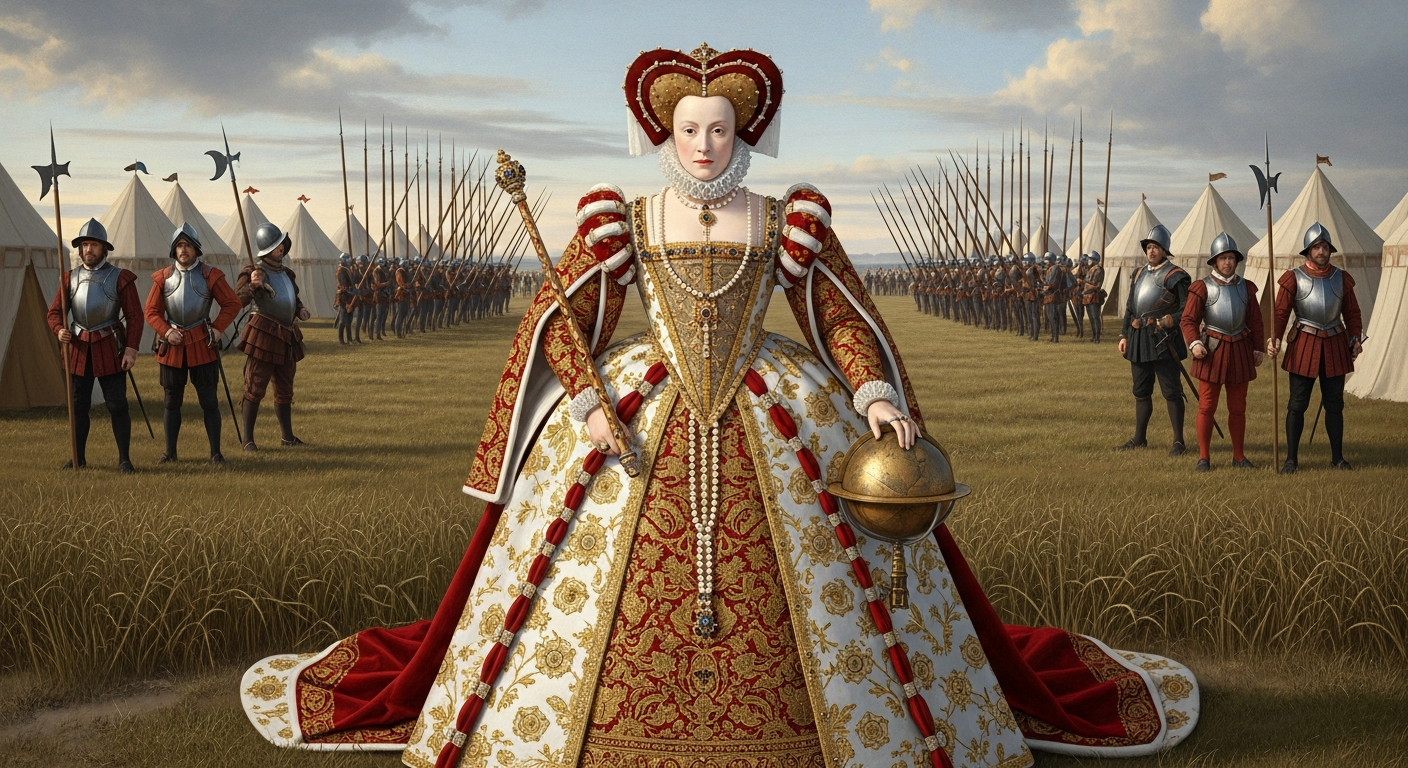
Picture Elizabeth I in gleaming silver armour, astride her white charger at Tilbury, declaring to her troops: ‘I know I have the body but of a weak and feeble woman; but I have the heart and stomach of a king!’ This iconic image has captivated historians, novelists, and filmmakers for centuries. Yet what if this legendary moment, burned into our collective memory of Tudor England, never actually happened as we imagine it?
The truth behind Elizabeth I’s famous Tilbury speech reveals a fascinating glimpse into how historical narratives are shaped, reshaped, and sometimes entirely reinvented over time. Whilst the Virgin Queen certainly addressed her troops during the Spanish Armada crisis of 1588, the stirring words and dramatic imagery we associate with this moment were only recorded decades later, raising intriguing questions about the reliability of historical memory.
Understanding the real story behind Tilbury offers us insight not only into Elizabeth’s reign during England’s greatest military crisis, but also into how Tudor propaganda worked, how historical legends are born, and why separating fact from fiction in the sixteenth century can be surprisingly challenging.
Historical Background
The summer of 1588 found England facing its gravest threat since the Norman Conquest. Philip II of Spain had assembled the largest naval force Europe had ever seen: the Spanish Armada, comprising 130 ships carrying over 30,000 men. This ‘Enterprise of England’ aimed to restore Catholic rule to Elizabeth’s Protestant realm and revenge England’s interference in Spanish territories.
As Spanish ships massed in the Channel, Elizabeth’s government established a military camp at Tilbury in Essex, strategically positioned to defend London should Spanish forces land and march inland. The Earl of Leicester commanded approximately 4,000 troops at this riverside location, though the camp’s defensive capabilities remained largely untested.
On 9th August 1588, with the Armada’s fate still uncertain (though in reality already sealed by the English fireships at Calais), Elizabeth I made her way to Tilbury to inspect the troops and boost morale. Contemporary accounts confirm she did address her soldiers, but the specific details of what she said and how she appeared remain remarkably sparse in immediate records.
The most detailed contemporary source, a letter from one ‘L.S.’ preserved in the British Library’s Harley manuscripts, provides some account of the proceedings at Tilbury, but notably lacks the dramatic flourishes that would later define the event. This absence of contemporary detail becomes crucial when examining how the Tilbury legend developed over subsequent decades.
Significance and Impact
The genuine historical significance of Elizabeth’s Tilbury appearance lies not in the specific words she may or may not have spoken, but in the unprecedented nature of her actions. Never before had an English monarch appeared before troops in such circumstances, presenting herself as both feminine ruler and military leader during a national crisis.
Elizabeth’s presence at Tilbury represented a masterful piece of political theatre, regardless of the exact performance. By appearing amongst her soldiers rather than remaining safely in London, she demonstrated personal courage whilst reinforcing the legitimacy of her rule. This was particularly important for a female monarch whose authority faced constant challenges, both from foreign Catholic powers and potential domestic rivals.
The impact of her appearance rippled through Tudor society in multiple ways. For her immediate audience, the Queen’s presence undoubtedly boosted morale during an uncertain time. More broadly, reports of her courage (however embellished) strengthened public support for her reign and reinforced the narrative of England as a chosen Protestant nation under divine protection.
Perhaps most significantly, the Tilbury episode contributed to the evolving mythology of Elizabeth I herself. Whether delivered in 1588 or invented in 1623, the famous speech articulated a compelling vision of female rule that balanced acknowledgement of physical limitation with claims to spiritual and emotional strength. This rhetoric would influence how subsequent female rulers presented themselves to their subjects.
Connections and Context
Elizabeth’s appearance at Tilbury cannot be understood in isolation from the broader context of her reign’s propaganda efforts. Throughout the 1580s, her government had increasingly portrayed England as a Protestant fortress under siege from Catholic Europe, with Elizabeth cast as both vulnerable virgin and defiant queen regnant.
The timing of the Tilbury visit also connected to other significant Tudor military moments. Henry VIII had similarly appeared before his troops at Dover in 1539 during an earlier invasion scare, whilst Elizabeth’s later successor, James I, would conspicuously avoid such martial displays. Elizabeth’s willingness to appear amongst her soldiers thus represented a distinctly Tudor approach to crisis management.
Remarkably, Elizabeth’s Tilbury appearance occurred whilst the Spanish Armada was already retreating northward, battered by English attacks and Channel storms. This timing suggests the visit served more as political reinforcement than immediate military necessity, demonstrating how Tudor monarchs used symbolic gestures to strengthen their authority even after immediate threats had passed.
Modern Relevance and Fascinating Details
The Tilbury speech mystery offers modern readers a perfect case study in how historical narratives evolve over time. The fact that our most vivid image of this event derives from sources written 35 years later reminds us to question even our most cherished historical ‘facts’. This process of historical myth-making continues to fascinate scholars studying how societies remember their past.
Did you know that the famous silver armour Elizabeth supposedly wore exists only in later accounts? Contemporary sources make no mention of such dramatic costume choices, suggesting this detail may have been added to enhance the story’s visual impact. Similarly, descriptions of Elizabeth mounted on a white charger appear to be later romantic additions rather than eyewitness testimony.
Popular culture has embraced the mythologised version of Tilbury with enthusiasm. From film adaptations to historical novels, creators typically choose the stirring 1623 version over the more mundane 1588 reality. This preference reveals something important about how we want our historical figures to behave: we crave drama, inspiration, and memorable quotes, even when the truth may have been more prosaic.
The speech continues to resonate in discussions of female leadership, with modern politicians and commentators frequently referencing Elizabeth’s supposed words about having ‘the heart and stomach of a king’. Ironically, this enduring influence means the potentially fictional speech has achieved real historical significance through its cultural impact over subsequent centuries.
Conclusion
The mystery surrounding Elizabeth I’s Tilbury speech ultimately enriches rather than diminishes our understanding of Tudor England. Whether she spoke those immortal words in 1588 or whether they were crafted by later admirers, the legend reveals important truths about how Elizabeth’s contemporaries and successors wanted to remember her reign.
As historical fiction authors and Tudor enthusiasts, we might feel disappointed to learn that one of the period’s most dramatic moments may be largely fictional. However, this discovery opens up equally fascinating questions about the nature of historical truth, the power of political mythology, and the ways in which each generation reshapes the past to serve its own needs. Perhaps the real story of Tilbury is not what Elizabeth I said in 1588, but why later writers felt compelled to put such stirring words in her mouth.