
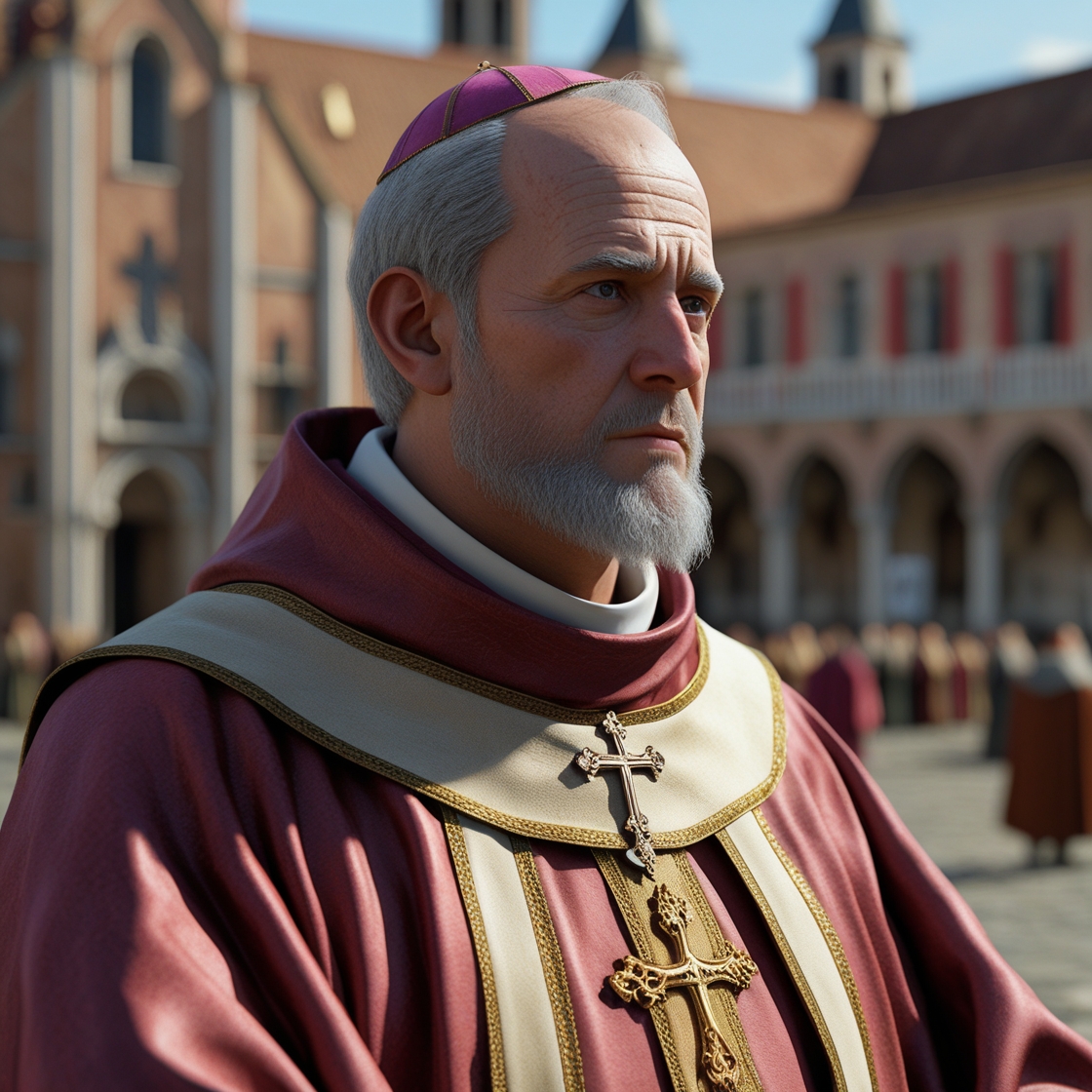
We meet the Bishop in his office overlooking the Seine, where scattered manuscript pages and an overturned inkwell hint at recent writing frustrations
Renaissance Weekly: Your Grace, thank you for receiving us during what must be an incredibly busy time. The recent Faber affair has certainly kept the Inquisition occupied.
He gestures wearily at a stack of reports on his desk, then carefully moves a salvaged manuscript away from our view. His fingers are stained with ink, and there’s a haunted look in his eyes.
Bishop Tramazzo:
Busy is… one way to put it. When I took this position, I thought I understood the depths of human folly. But Francis Faber?
[He shakes his head slowly]
That man managed to combine heresy, murder, grave robbing, and attempted necromancy into a single catastrophic enterprise. Even by Inquisition standards, it was remarkably comprehensive in its blasphemy.
RW: You’ve mentioned that you had suspicions about Faber long before these events came to light. What first drew your attention to him?
The Bishop rises and moves to his window, hands clasped behind his back as he gazes out at the city.
Bishop Tramazzo:
Instinct, primarily. Twenty years in this position teaches you to recognise certain… patterns. Faber claimed Jesuit authority but operated like a man building his own kingdom. The constant trips to Montmartre, the recruitment of questionable followers, the mysterious funding…
[He turns back, expression grim]
And there was something in his eyes when he spoke of his “mission.” The fervour was wrong – too personal, too desperate. True faith has a different quality entirely.
RW: Speaking of faith, how do you balance the Church’s need for order with your own… scholarly pursuits? We understand you’re working on a treatise?
His face flushes slightly, and he glances toward the damaged manuscript with obvious frustration.
Bishop Tramazzo: [Sighing heavily]
“The Nine Gifts of the Holy Spirit” – or it was meant to be. A comprehensive guide for my fellow clergy on recognising and combating heresy through proper examples and moral instruction.
[His voice grows bitter]
But every time I find my rhythm, some crisis erupts; my secretary bursting in with “urgent reports,” explosions echoing from Notre Dame, young English scholars turning my carefully planned operations upside down…
[He laughs ruefully]
Perhaps God is telling me I’m better suited to investigation than inspiration.
RW: That’s fascinating. Do you find that your investigative work informs your writing, or does it distract from it?
He returns to his chair, picking up a quill and turning it thoughtfully in his fingers.
Bishop Tramazzo:
Both, I’m afraid. The cases provide excellent material – real examples of how people fall into heretical thinking, what drives them to desperate acts. Faber’s obsession with resurrection, for instance, would make a perfect cautionary tale about the dangers of grief unchecked by proper faith.
[His expression darkens]
But the emotional toll… watching what people do to each other in God’s name, or in defiance of it… some nights I sit here staring at blank parchment, wondering if there’s any wisdom worth sharing that hasn’t already been written in blood.
RW: You’ve worked with some rather unconventional allies recently – young Dee and his companions. How did that collaboration come about?
A slight smile crosses his features for the first time during our interview.
Bishop Tramazzo:
Desperation breeds strange partnerships.
When my traditional methods failed to locate Faber’s new base, I needed… fresher perspectives. Young minds, unencumbered by institutional thinking.
[He chuckles]
Though I must admit, I expected surveillance and reporting, not underground explosions and rooftop confrontations. That boy has a talent for theatrical solutions that would make the ancient Romans envious.
RW: Some critics suggest the Inquisition’s methods are becoming outdated. How do you respond to such concerns?
His expression grows carefully neutral, but tension creeps into his voice.
Bishop Tramazzo:
The Church’s mission remains constant – protecting the faithful from spiritual corruption. However, the methods… [He pauses, choosing his words carefully]
I’ve found that understanding often serves better than intimidation. A heretic who truly comprehends their error is less likely to repeat it than one who simply fears punishment.
[His voice drops]
Not all my colleagues share this view, naturally. But results speak for themselves.
RW: Looking back on the Faber case, what lessons do you think the Church should take from it?
He stands again, moving to straighten some books on a shelf – clearly a nervous habit.
Bishop Tramazzo:
Pride, ultimately. Faber’s downfall began with pride – believing he could command powers beyond mortal reach, that his personal grief justified any transgression. It’s a cautionary tale as old as Lucifer himself.
[He turns back, expression thoughtful]
But perhaps we in the Church are not immune to similar temptations. When we become so focused on our authority that we forget our purpose is service… well, that way lies corruption of a different sort.
RW: Any advice for young clergy who might be struggling with similar challenges?
He returns to his desk, touching the damaged manuscript with evident sadness.
Bishop Tramazzo:
Remember that doubt is not heresy – it’s honesty. Question your methods, examine your motives, but never doubt the fundamental mission of bringing souls to God through love rather than fear.
[His voice grows firm]
And if you feel called to write, to teach, to share wisdom – do it. Don’t wait for the perfect moment or the ideal circumstances. The world needs voices of reason more than it needs perfect prose.
[He smiles wryly]
Though perhaps invest in better inkwells than I have.
As our interview concludes, Bishop Tramazzo returns to his desk, already reaching for a fresh quill despite the late hour. There’s something almost poignant about this powerful man’s literary struggles – a reminder that even those who judge others’ souls wrestle with their own demons of doubt and frustration. Through his window, the lights of Paris twinkle like earthbound stars, each representing souls under his spiritual care. One senses that for all his authority, he feels the weight of that responsibility keenly, seeking truth through both investigation and ink-stained inspiration.