
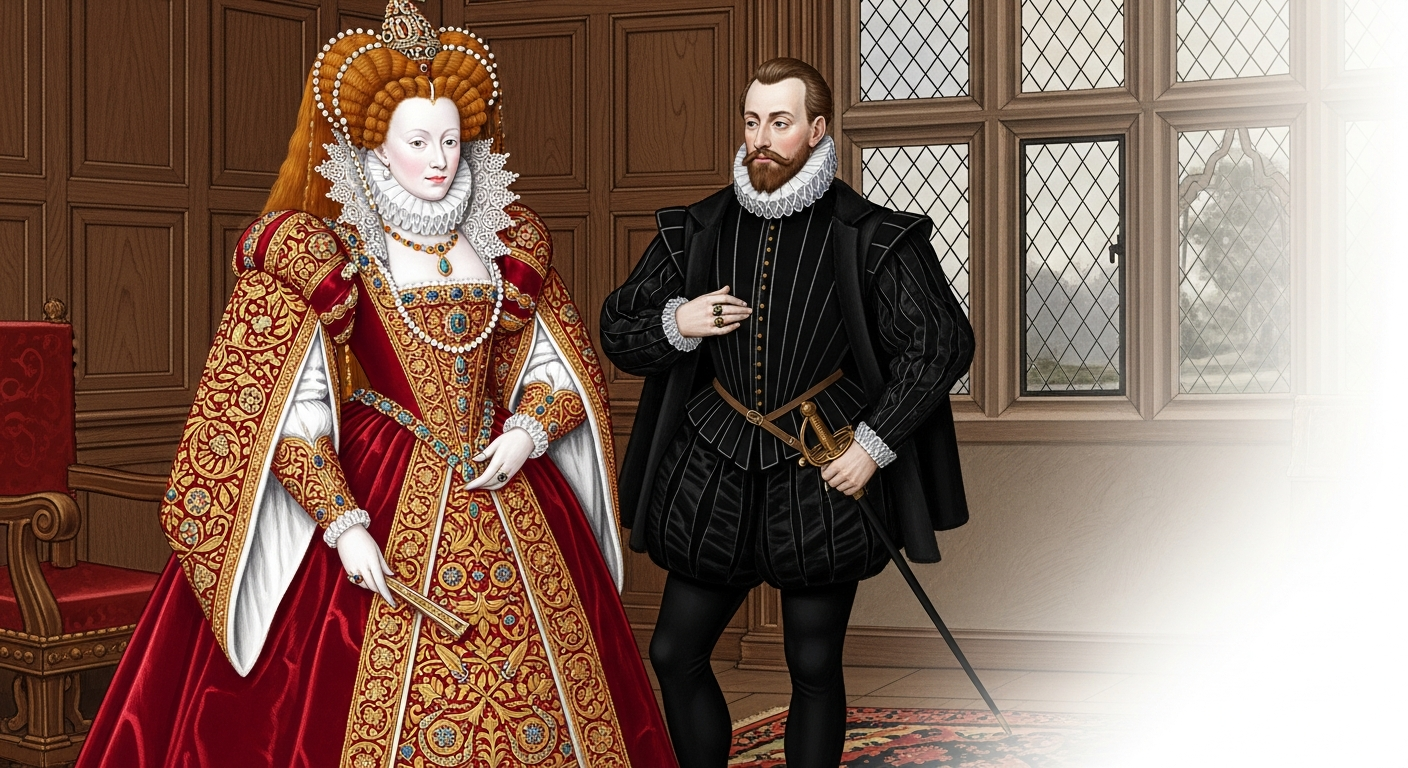
The Greatest Love Affair That Nearly Toppled a Kingdom
Picture this: the most powerful woman in 16th-century Europe tells a foreign ambassador she would marry her beloved ‘if she had been a private person.’ Yet the man she adored was forever marked by scandal, his wife’s mysterious death casting a shadow over what might have been the greatest royal romance in English history. This is the extraordinary tale of Elizabeth I and Robert Dudley, a passionate relationship that lasted three decades and threatened to destabilise the very foundations of Tudor England.
When Elizabeth Tudor ascended the throne in 1558 at just 25 years old, she inherited not only a kingdom but also the weight of unprecedented expectations. As England’s second queen regnant, every decision she made was scrutinised, particularly regarding marriage. Yet from the very beginning of her reign, one man captured her heart so completely that she was willing to risk everything for him: Robert Dudley, soon to become Earl of Leicester.
Their story reveals the profound tension between personal desire and royal duty, showing us how even the most powerful monarchs were constrained by the political realities of their age. What unfolds is a tale of passion, mystery, and ultimately, sacrifice that would shape Elizabeth’s reign and leave an indelible mark on English history.
The Players in History’s Greatest Royal Romance
Robert Dudley was no ordinary courtier when he caught Elizabeth’s eye. Born around 1532, he was the son of John Dudley, Duke of Northumberland, a man whose political machinations would ultimately lead to his execution in 1553. This family connection might have destroyed Robert’s prospects, but it actually strengthened his bond with Elizabeth. Both had experienced the Tower of London as prisoners during the tumultuous reign of Mary I, and both understood the precarious nature of political fortune.
The relationship between Elizabeth and Robert began in earnest when she appointed him Master of the Horse immediately upon her accession in November 1558. This prestigious position placed him in constant proximity to the queen, and their closeness soon became the talk of European courts. By 1559, ambassadors were reporting that Elizabeth showed him such favour that many believed she would marry him, despite one seemingly insurmountable obstacle: Robert Dudley was already married.
Amy Robsart had married Robert Dudley in 1550, when both were young and he had not yet caught the queen’s attention. By 1559, however, Amy had become an inconvenient reminder of the impossibility of Elizabeth’s romantic dreams. Living quietly in the countryside, often alone while her husband attended court, Amy Robsart occupied a uniquely tragic position in this historical drama.
The situation reached its climax in 1560. Amy was reportedly suffering from what modern historians believe may have been breast cancer, and she was living in increasing isolation. On 8th September 1560, at Cumnor Place in Oxfordshire, Amy Robsart was found dead at the bottom of a staircase, her neck broken. The timing was so convenient for Robert Dudley that suspicions of murder immediately arose, casting a shadow that would follow him for the rest of his life.
The Scandal That Shook Europe
The death of Amy Robsart created a political earthquake whose tremors reached every European court. If Elizabeth married Dudley now, she would be seen as complicit in murder, destroying her reputation and potentially her throne. The Spanish ambassador immediately reported the scandalous possibilities to Philip II, while the French court watched with fascination as England’s young queen navigated this unprecedented crisis.
What makes this situation particularly significant is how it reveals the constraints faced even by absolute monarchs. Elizabeth famously declared that she had ‘the heart and stomach of a king,’ yet when it came to matters of love, she found herself as trapped as any woman of her era. The political implications of marrying Dudley extended far beyond personal scandal. Foreign princes who had been considered as potential husbands would be insulted, diplomatic alliances would crumble, and her own nobility might rebel against a queen who elevated a man they considered beneath her station.
The impact on Elizabeth personally was profound and lasting. According to the Calendar of State Papers, she confided to the French ambassador in 1566 that she would indeed have married Dudley ‘if she had been a private person.’ This remarkable admission, recorded in official diplomatic correspondence, reveals the depth of her feelings and the sacrifice she made for her crown. Modern historian Chris Skidmore, in his detailed analysis ‘Death and the Virgin,’ argues that this moment represented the true beginning of Elizabeth’s transformation into the ‘Virgin Queen’ of legend.
The scandal also fundamentally altered how Elizabeth approached the question of marriage throughout her reign. Every subsequent courtship, from the Archduke Charles to François, Duke of Anjou, was measured against her feelings for Dudley. Her subjects and foreign observers alike recognised that no other suitor could compete with the man who had captured her heart so completely, yet whom she could never safely marry.
A Love Story Intertwined with Tudor Politics
Understanding the Elizabeth-Dudley relationship requires placing it within the broader context of Tudor dynastic politics. Elizabeth’s father, Henry VIII, had turned England upside down for love, breaking with Rome and executing two wives in his pursuit of romantic and dynastic satisfaction. Elizabeth had witnessed firsthand how personal passion could destabilise a kingdom, making her own romantic dilemma even more poignant.
The timing of Amy Robsart’s death also coincided with crucial negotiations regarding Elizabeth’s marriage to foreign princes. In 1560, serious discussions were underway regarding potential matches with European royalty, all of which would have been jeopardised by scandal. The mystery surrounding Amy’s death effectively ended these negotiations and began Elizabeth’s long game of using the possibility of marriage as a diplomatic tool rather than a personal reality.
Interestingly, the Dudley affair occurred during the same period as Mary Queen of Scots’ own romantic entanglements. While Elizabeth agonised over marrying her beloved but controversial favourite, her cousin Mary was pursuing her own disastrous romantic choices, including her scandalous marriage to the Earl of Bothwell following the mysterious death of Lord Darnley. The contrast between the two queens’ responses to similar situations highlights Elizabeth’s political wisdom, even at such personal cost.
The Enduring Mystery and Modern Fascination
The death of Amy Robsart remains one of Tudor history’s greatest unsolved mysteries, continuing to fascinate historians and popular culture alike. Modern forensic analysis of the historical evidence suggests several possibilities: suicide brought on by depression and illness, accidental death, or indeed murder. What seems certain is that Amy was suffering from what contemporary sources describe as ‘a malady in one of her breasts,’ quite possibly cancer, which might explain both her isolation and her state of mind.
Did you know that Elizabeth continued to show favour to Robert Dudley for nearly thirty more years after Amy’s death? She made him Earl of Leicester in 1564, granted him extensive lands and honours, and maintained an intimate friendship with him until his death in 1588. Their correspondence, much of which survives, reveals a relationship of extraordinary depth and affection. Elizabeth kept Dudley’s final letter to her in her private treasure chest, inscribed in her own hand as ‘his last letter.’
The story has inspired countless works of historical fiction, from Sir Walter Scott’s ‘Kenilworth’ to modern novels by authors such as Philippa Gregory and Robin Maxwell. Each interpretation grapples with the same fundamental questions: Was Amy murdered? Could Elizabeth have married for love? How different might English history have been if she had chosen passion over politics? As a historical fiction author, I find these questions endlessly compelling because they reveal the very human struggles behind the grand sweep of history.
The Elizabeth-Dudley romance also resonates with modern audiences because it represents the ultimate sacrifice of personal happiness for professional duty. In our contemporary world, where work-life balance is constantly debated, Elizabeth’s choice to prioritise her role as queen over her desires as a woman feels remarkably relevant. She truly was married to England, as she so often proclaimed, but the cost of that marriage was the love of her life.
Legacy of a Love That Could Never Be
The passionate relationship between Elizabeth I and Robert Dudley offers us one of history’s most poignant examples of duty triumphing over desire. Their 30-year romance, forever shadowed by the mysterious death of Amy Robsart, shaped not only Elizabeth’s personal life but the entire trajectory of her reign. It transformed her from a young woman in love into the Virgin Queen of legend, showing us how personal sacrifice often lies at the heart of great leadership.
This story continues to captivate us because it reveals the human heart behind the crown, reminding us that even the most powerful rulers face impossible choices between love and duty. Whether Amy Robsart died by accident, suicide, or murder, her death changed the course of English history, ensuring that Elizabeth would rule alone and that the Tudor dynasty would end with her. In choosing her kingdom over her heart, Elizabeth gave us one of history’s greatest love stories, one made all the more powerful by its tragic impossibility.
Proclamation: Poetry will be the death of me
In the Predestination series’ sequel ‘Proclamation‘, the early love between Elizabeth and Robert is depicted as a love poem that also mocks the ‘to be Queen’ Mary. With Robert roaming Norfolk on his father’s orders trying to proclaim Lady Jane as Queen, and Mary’s forces intent on capturing him, the poem could be a death sentence for Princess Elizabeth. Enter John Dee, and Jack Delauris: another day, another tense investigation. Will they find the poem and save Elizabeth’s bacon? Or will the written word condemn Elizabeth to the Tower?