
Introduction
When Queen Elizabeth I died in 1603, officials at Richmond Palace faced an extraordinary task that would consume months of their time: cataloguing the monarch’s staggering collection of over 3,000 dresses. This wasn’t simply a matter of royal extravagance gone unchecked, but rather a carefully orchestrated display of power, diplomacy, and statecraft woven into silk and gold. The resulting Stowe Inventory, now preserved in the British Library, reveals a wardrobe so vast and varied that it included 102 French gowns, 100 loose gowns, and 67 round gowns, alongside countless other garments that collectively tell the story of a queen who understood that clothing was her greatest weapon.
For Elizabeth I, every thread, every jewel, and every carefully chosen colour served a political purpose far beyond personal vanity. Her wardrobe represented the wealth and sophistication of England itself, designed to dazzle foreign ambassadors, intimidate rivals, and project an image of divine authority that few dared challenge. The sheer scale of her collection, documented in meticulous detail by court officials, offers us an unprecedented glimpse into how the Virgin Queen wielded fashion as an instrument of power.
Through examining this remarkable inventory, we can uncover not only the extraordinary craftsmanship and luxury of Tudor court dress, but also the complex political and social mechanisms that made such opulence both necessary and effective in maintaining Elizabeth’s grip on power for over four decades.
Historical Background
The Stowe Inventory of 1600, catalogued just three years before Elizabeth’s death, was compiled by court officials as part of the regular administrative duties required to manage the royal wardrobe. Stored primarily at the Wardrobe of Robes at the Tower of London and various royal residences, this collection represented the accumulation of garments acquired throughout Elizabeth’s 45-year reign, beginning in 1558. The inventory process itself was overseen by senior court officials, including the Keeper of the Queen’s Wardrobe, and required months of careful documentation due to the collection’s extraordinary size.
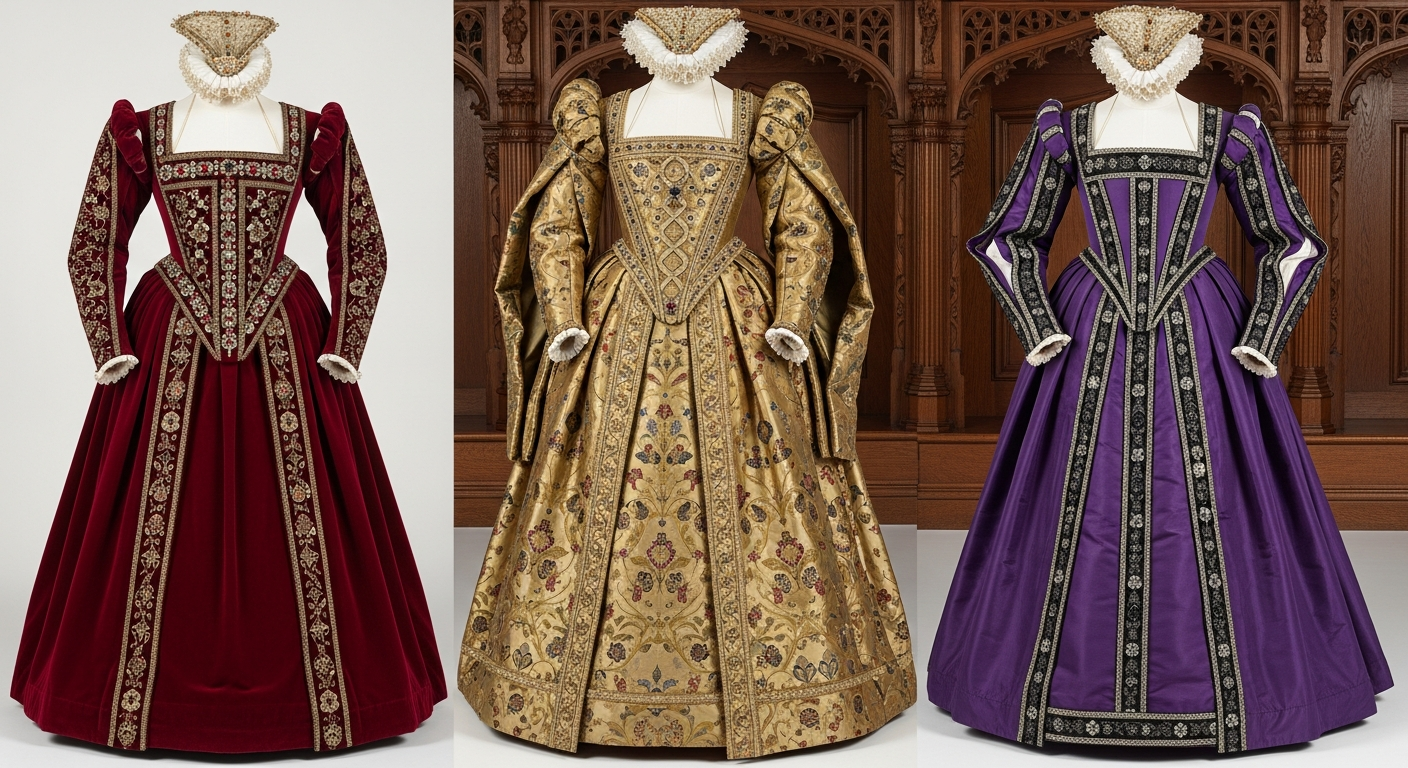
The diversity of Elizabeth’s wardrobe reflected both her personal taste and the complex demands of Tudor court life. The 102 French gowns documented in the inventory speak to the international nature of royal fashion and diplomatic gift-giving, whilst the 100 ‘loose gowns’ reference a particular style of informal court dress that allowed for greater comfort during long ceremonial occasions. The 67 ’round gowns’ represented yet another distinct style, characterised by their full, circular skirts that created an imposing silhouette when the queen held court.
Each garment in Elizabeth’s collection served specific ceremonial, diplomatic, or seasonal purposes. Court records indicate that the queen often changed her outfit multiple times during important state occasions, using different ensembles to signal various political messages to the assembled courtiers and foreign dignitaries. The inventory reveals gowns crafted from the finest materials available: cloth of gold, cloth of silver, rich velvets from Italy, and silks imported from across Europe and beyond.
The physical management of such an enormous wardrobe required a dedicated staff of dozens, including specialist seamstresses, embroiderers, and wardrobe keepers. Janet Arnold’s groundbreaking research in ‘Queen Elizabeth’s Wardrobe Unlock’d’ demonstrates how this collection represented not just personal luxury, but a significant economic enterprise that employed countless artisans and merchants throughout England and Europe.
Significance and Impact
Elizabeth’s vast wardrobe collection served as a crucial tool of statecraft in an era when visual display directly translated to political authority. In the 16th century, a monarch’s ability to dress magnificently was interpreted as evidence of their kingdom’s prosperity and divine favour. Foreign ambassadors regularly reported back to their courts about the queen’s attire, understanding that her clothing choices conveyed important diplomatic messages about England’s wealth, stability, and international relationships.
The economic impact of maintaining such an extensive wardrobe was substantial, supporting entire industries across England and Europe. The purchase of materials, commissioning of new garments, and maintenance of existing pieces created employment for silk merchants, goldsmiths, embroiderers, jewellers, and countless other skilled craftspeople. This expenditure, whilst seemingly extravagant, functioned as an early form of economic stimulus that strengthened England’s position in international luxury trades.
From a cultural perspective, Elizabeth’s wardrobe choices influenced fashion throughout her realm and beyond. Portrait painters travelled across Europe carrying visual records of her distinctive style, spreading trends that were copied by noble ladies from Madrid to Moscow. The queen’s preference for elaborate ruffs, intricate embroidery, and symbolic jewellery established aesthetic standards that defined late Tudor fashion and continued to influence court dress for generations.
The inventory also reveals the sophisticated understanding Elizabeth possessed regarding the psychology of power. By maintaining such an extensive collection, she ensured that she could always appear in fresh, magnificent attire, creating an impression of inexhaustible wealth and resources that discouraged potential challengers and impressed potential allies. This strategy proved particularly effective in managing her court, where nobles competed constantly for royal favour and were continually reminded of their monarch’s superior status through her unparalleled magnificence.
Connections and Context
Elizabeth’s enormous wardrobe collection must be understood within the broader context of Tudor court culture, where conspicuous consumption served essential political functions. Her father, Henry VIII, had similarly used clothing as a political tool, though surviving records suggest his collection, whilst impressive, never approached the scale achieved by his daughter. The queen’s wardrobe strategy also connected directly to her decision to remain unmarried, as she needed to project sufficient majesty to compensate for lacking a king consort who might otherwise have enhanced her political standing.
The timing of the Stowe Inventory’s compilation in 1600 coincided with the final years of Elizabeth’s reign, a period when questions about succession were becoming increasingly urgent. Maintaining such visible wealth and magnificence during these uncertain times served to project continued strength and stability, reassuring both subjects and foreign observers that England remained prosperous and well-governed despite concerns about the future.
Contemporary European courts were simultaneously engaged in similar displays of sartorial magnificence, creating an international competition in royal fashion. The French court under Catherine de Medici, the Spanish court of Philip II, and various Italian Renaissance courts all maintained extensive royal wardrobes, though surviving records suggest none matched the scale of Elizabeth’s collection. This gave England a distinct advantage in diplomatic ceremonies, where the queen’s ability to appear in unprecedented splendour reinforced perceptions of English power and sophistication.
Modern Relevance and Fascinating Details
The story of Elizabeth I’s 3,000 dresses continues to fascinate modern audiences because it reveals the sophisticated understanding of image management possessed by one of history’s most successful female rulers. In an age of social media and carefully curated public personas, Elizabeth’s strategic use of fashion feels remarkably contemporary, demonstrating how visual presentation has always been central to political success.
Did you know that some of Elizabeth’s gowns were so heavily decorated with gold thread and precious gems that they could literally stand upright without a wearer? The inventory records garments so elaborate that they required special storage techniques to prevent damage from their own weight. Modern fashion historians have calculated that recreating just one of Elizabeth’s most elaborate state gowns using period-accurate materials and techniques would cost well over £100,000 today.
The queen’s wardrobe has inspired countless historical fiction novels, films, and television series, though most significantly underestimate the true scale of her collection. Popular portrayals typically show Elizabeth wearing perhaps a dozen different outfits throughout an entire dramatic narrative, when historical reality suggests she possessed enough clothing to wear a different ensemble every day for over eight years without repetition. This extraordinary abundance speaks to a level of royal luxury that even modern audiences struggle to fully comprehend.
Conclusion
Elizabeth I’s collection of over 3,000 dresses, meticulously documented in the Stowe Inventory, represents far more than royal extravagance or personal vanity. This extraordinary wardrobe served as a sophisticated instrument of political power, economic policy, and cultural influence that helped secure England’s position as a major European power during the late Tudor period. The months required to catalogue this collection after the queen’s death in 1603 testified to the remarkable scale of an enterprise that employed hundreds of people and influenced fashion across the known world.
Understanding Elizabeth’s wardrobe strategy offers valuable insights into the complex relationship between personal presentation and political authority, lessons that remain relevant in our contemporary world of image-conscious leadership. The Stowe Inventory, preserved in the British Library as Stowe MS 557, continues to provide historians and fashion experts with unparalleled documentation of Tudor court life, ensuring that the story of the Virgin Queen’s magnificent wardrobe will continue to inform and inspire future generations of scholars and admirers.