
Introduction
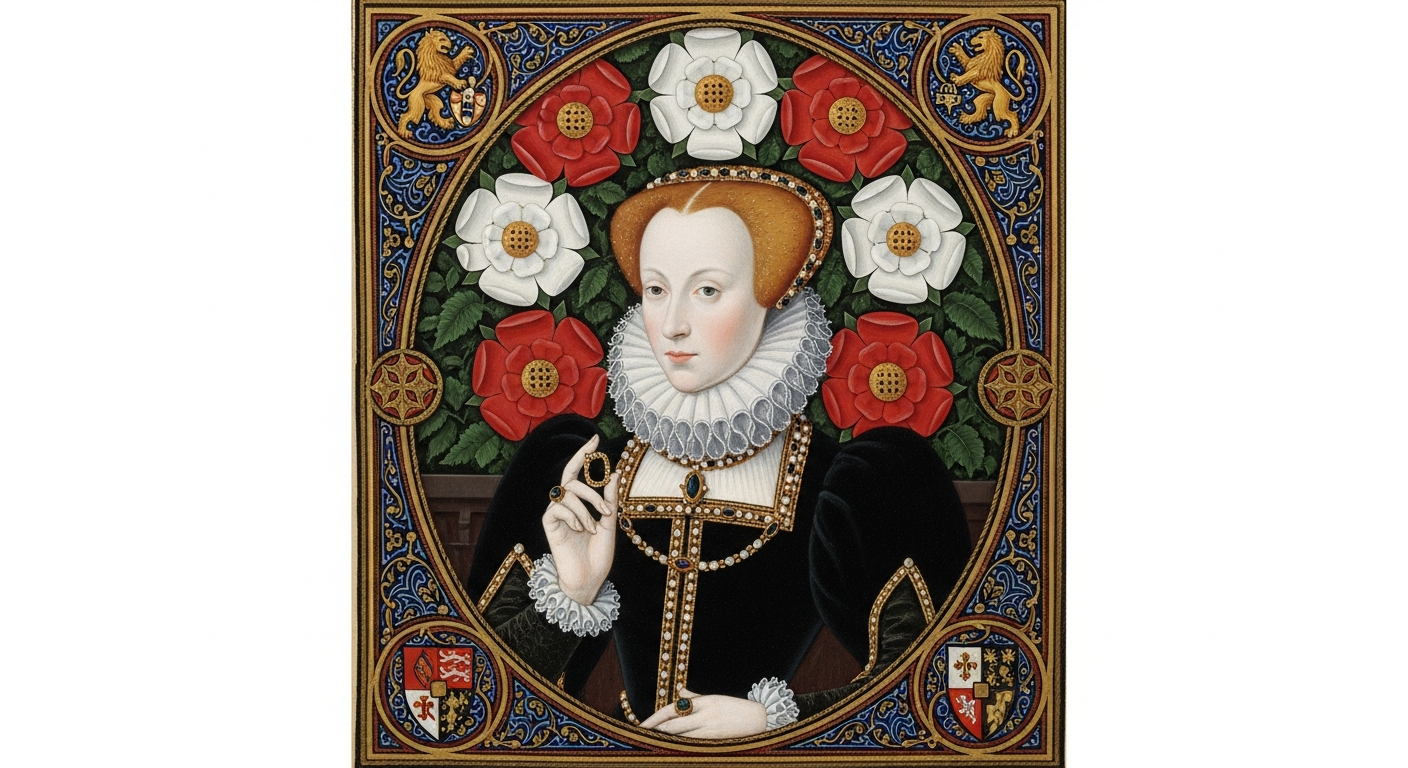
Few declarations in Tudor history resonate as powerfully as Elizabeth I’s bold statement: ‘I am already bound unto a husband, which is the kingdom of England.’ This iconic pronouncement, delivered with theatrical flair as she gestured to her coronation ring, has captivated historians and the public imagination for centuries. Yet many people assume these words were spoken during her coronation ceremony, when in fact they formed part of a carefully crafted political response to parliamentary pressure nearly a year into her reign.
On 10th February 1559, the 25-year-old Queen Elizabeth stood before the House of Commons, facing intense scrutiny about her marital intentions. The question of royal marriage wasn’t merely personal; it was a matter of national security, dynastic succession, and international diplomacy. Elizabeth’s response would set the tone for decades of masterful political manoeuvring that would define her reign as the ‘Virgin Queen.’
This moment reveals not only Elizabeth’s remarkable political acumen but also the complex pressures facing England’s second queen regnant. Understanding the true context of these famous words illuminates how Elizabeth transformed potential weakness into her greatest strength, creating a new model of female monarchy that would influence royal history for generations.
Historical Background
Elizabeth Tudor ascended to the throne on 17th November 1558, following the death of her Catholic half-sister Mary I. At just 25, she inherited a nation divided by religious upheaval, financial difficulties, and uncertain international standing. The question of marriage immediately became paramount, as contemporary political thought deemed it virtually impossible for a woman to rule alone successfully.
The parliamentary session of 1559 marked Elizabeth’s first major confrontation with this expectation. According to John Neale’s meticulous research in ‘Elizabeth I and Her Parliaments 1559-1581’, Members of Parliament had been discussing the succession question with increasing urgency. The Commons prepared a formal petition urging the Queen to marry swiftly, emphasising their concerns about dynastic stability and national security.
When Elizabeth received this petition on 10th February 1559 at Whitehall Palace, she was prepared with a response that would become legendary. The setting was formal and ceremonial, with the full weight of parliamentary authority behind the request. Did you know that Elizabeth likely rehearsed this speech carefully? Her response demonstrated the rhetorical skills that would serve her throughout her 45-year reign.
The political context cannot be understated. England faced potential threats from Catholic powers abroad, particularly France and Spain, who questioned Elizabeth’s legitimacy. A strategic marriage could provide military alliances and secure the Protestant succession, whilst remaining unmarried left England vulnerable. Parliament’s petition reflected genuine fears about the kingdom’s future, making Elizabeth’s response all the more remarkable for its audacity.
Significance and Impact
Elizabeth’s declaration to Parliament represented a revolutionary approach to female monarchy. By claiming marriage to England itself, she reframed the traditional expectation that queens required male guidance and protection. This metaphorical marriage allowed her to fulfil societal expectations of wifely devotion whilst maintaining absolute political independence.
The immediate impact was profound. Rather than simply refusing to marry, Elizabeth had transformed her unmarried state into a virtue, suggesting that her devotion to England surpassed any personal romantic attachment. This response simultaneously acknowledged Parliament’s concerns whilst firmly establishing her autonomy. As Susan Doran notes in ‘Monarchy and Matrimony: The Courtships of Elizabeth I’, this speech marked the beginning of Elizabeth’s sophisticated strategy of using marriage negotiations as diplomatic tools without ever committing to any suitor.
The long-term consequences shaped Elizabeth’s entire reign. Her ‘marriage to England’ became a central theme of Elizabethan propaganda, appearing in portraits, poetry, and public ceremonies. The coronation ring she referenced became a powerful symbol, frequently mentioned in diplomatic correspondence and court ceremonies. This symbolic marriage also allowed Elizabeth to maintain the fiction that she might marry whilst pursuing her own political agenda.
Perhaps most significantly, Elizabeth’s approach influenced how subsequent female rulers would navigate marriage and power. Her success in remaining unmarried whilst maintaining political authority challenged fundamental assumptions about gender and governance that had persisted for centuries. The speech of February 1559 thus represents a pivotal moment in the evolution of royal authority and women’s political power.
Connections and Context
Elizabeth’s parliamentary declaration occurred during a critical period of religious and political settlement. Just months earlier, she had begun implementing the Elizabethan Religious Settlement, attempting to find a middle way between Catholic and Protestant extremes. Her marriage policy complemented this broader strategy of maintaining flexibility whilst appearing decisive.
The timing also coincided with complex international negotiations. France and Scotland were closely allied through the marriage of Mary, Queen of Scots to the Dauphin Francis, creating a Catholic encirclement of Protestant England. Elizabeth’s unmarried state initially appeared to weaken England’s diplomatic position, but her parliamentary speech began the transformation of this perceived weakness into a strategic advantage.
Interestingly, Elizabeth’s speech occurred just as several potential suitors were being seriously considered. Philip II of Spain, her late sister’s widower, had already been diplomatically rejected. Erik XIV of Sweden was actively pursuing her through ambassadors. Most intriguingly, her future great love, Robert Dudley, was beginning to emerge as a significant figure at court, though his wife Amy Robsart was still alive. The Queen’s declaration thus served to establish her independence whilst various romantic and political possibilities remained open.
Modern Relevance and Fascinating Details
Elizabeth’s declaration continues to resonate in contemporary discussions about women in leadership and the balance between personal choices and professional responsibilities. Modern politicians and businesswomen often face similar, if less extreme, pressures to justify their personal decisions in relation to their public roles. Elizabeth’s solution of reframing dedication to duty as a form of marriage remains remarkably sophisticated.
Popular culture has embraced the romantic notion of Elizabeth’s ‘marriage to England,’ though often misplacing the quotation at her coronation. Films like ‘Elizabeth’ (1998) and countless historical novels have dramatised this concept, usually emphasising the personal sacrifice involved. However, the historical reality suggests Elizabeth viewed this symbolic marriage as empowering rather than limiting, a crucial distinction that reveals her political genius.
Did you know that Elizabeth continued to reference her coronation ring and marriage to England throughout her reign? In her famous Golden Speech to Parliament in 1601, she again mentioned her devotion to England using matrimonial language. The consistency of this metaphor across four decades demonstrates how central it became to her royal identity. As a historical fiction author, I find this sustained symbolic marriage one of the most compelling aspects of Elizabeth’s self-presentation, offering rich material for exploring the intersection of personal identity and political necessity.
Conclusion
Elizabeth I’s declaration that she was ‘already bound unto a husband, which is the kingdom of England’ represents far more than a clever deflection of parliamentary pressure. Delivered on 10th February 1559, these words established a new paradigm for female monarchy that would sustain her through 45 years of successful rule. By transforming her unmarried state from a political liability into a virtue, Elizabeth demonstrated the rhetorical brilliance that would define her reign.
Understanding the true context of this famous quotation illuminates Elizabeth’s sophisticated approach to the greatest challenge facing any Tudor monarch: balancing personal desires with political necessity. Her symbolic marriage to England became one of history’s most successful political metaphors, enabling her to navigate the complex demands of 16th-century queenship whilst maintaining unprecedented independence. For anyone seeking to understand how Elizabeth became one of England’s greatest monarchs, this moment in the House of Commons provides essential insight into the political genius that would make her legendary.