
Introduction
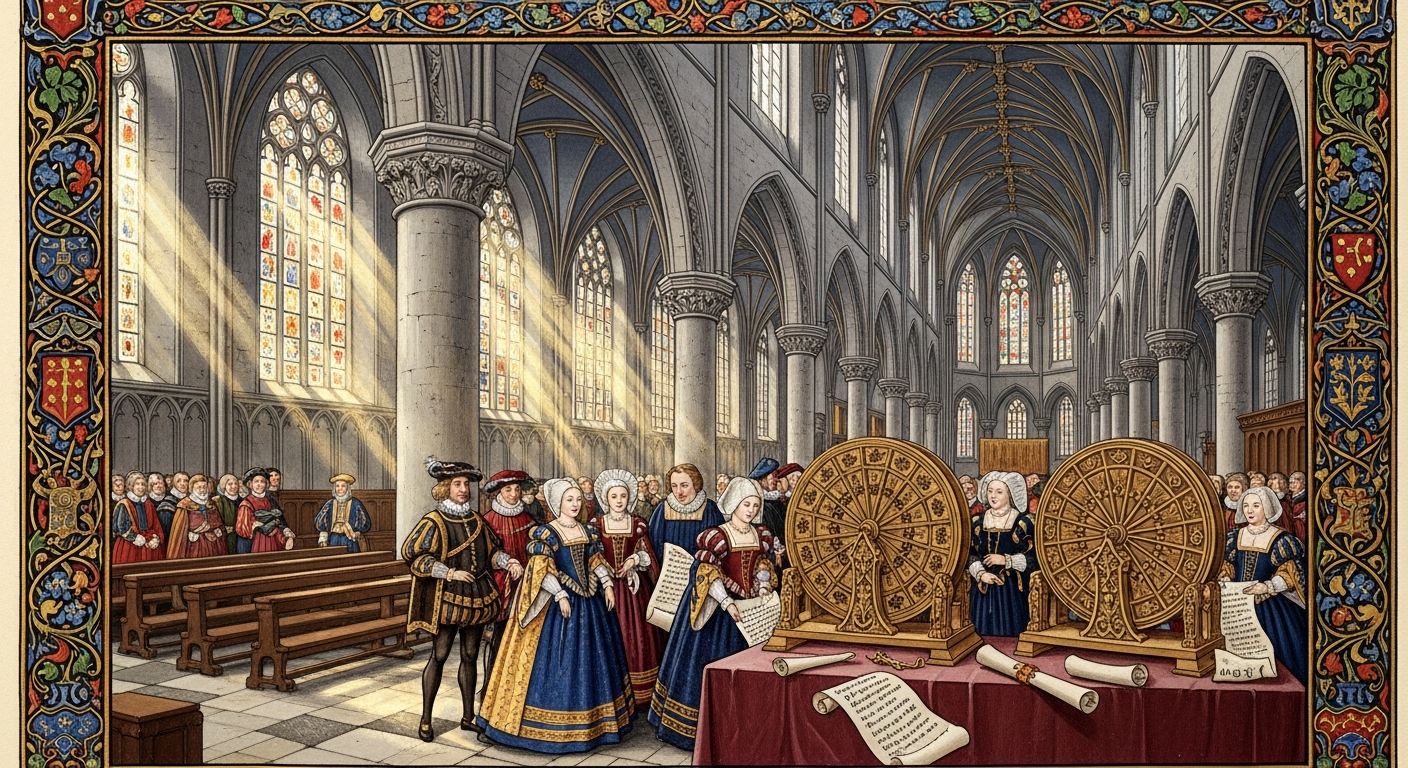
Picture this: on a crisp May morning in 1569, crowds gathered at the steps of St Paul’s Cathedral in London, not for worship, but to witness the conclusion of England’s very first state lottery. The great lottery wheel had been turning since January, and now, after nearly four months of anticipation, the final draws were about to take place. What made this moment particularly extraordinary was not just the spectacle itself, but the royal signature that had made it all possible, that of Queen Elizabeth I herself.
This wasn’t merely a game of chance; it was a revolutionary approach to public financing that would echo through centuries. The lottery of 1569 represented Elizabeth’s innovative solution to a pressing national crisis: England’s harbours were crumbling, trade was suffering, and the royal coffers couldn’t stretch to cover the massive repair costs. In typical Elizabethan fashion, the Queen turned to her subjects’ entrepreneurial spirit and love of risk-taking to solve a problem that traditional taxation couldn’t address.
From its grand opening draws in January to its dramatic conclusion at England’s most famous cathedral, this lottery captured the imagination of Tudor England and established precedents that continue to influence how governments raise funds for public works today. But how did a 16th-century queen convince her subjects to gamble for the good of the realm?
Historical Background
Queen Elizabeth I authorised England’s first state lottery through letters patent, demonstrating the careful legal framework she established around this novel fundraising method. The lottery officially commenced on 11th January 1569, with the final draws taking place on 6th May 1569 at St Paul’s Cathedral. According to John Ashton’s comprehensive study in A History of English Lotteries (1893), the choice of St Paul’s as the venue was deliberate—the cathedral represented the heart of London’s commercial and spiritual life, lending gravitas and legitimacy to the proceedings.
The lottery was organised with remarkable sophistication for its time. Tickets were priced at ten shillings each, a considerable sum that limited participation largely to merchants, craftsmen, and the emerging middle classes. The Calendar of State Papers Domestic for Elizabeth’s reign reveals that the government took great care to publicise the lottery widely, with announcements made in market towns across England and detailed explanations of the prize structure.
The timing of this lottery was no coincidence. By 1569, Elizabeth had been on the throne for over a decade, and England’s maritime trade was expanding rapidly. However, the harbours that facilitated this crucial commerce were in a deplorable state. Many had been neglected since the reign of Henry VIII, and the increasing size of merchant vessels meant that harbour improvements weren’t just desirable, they were essential for England’s economic survival.
Contemporary records show that the lottery garnered significant public interest across England’s counties. The government appointed official lottery agents in major towns, and special provisions were made for collecting tickets from remote areas. This represented one of the earliest examples of a coordinated national campaign, requiring administrative innovation that would influence how the Tudor state communicated with its subjects for generations to come.
Significance and Impact
The 1569 lottery marked a pivotal moment in the relationship between the English crown and its subjects. Unlike traditional taxation, which often met with resistance and required parliamentary approval, the lottery offered a voluntary method of raising funds whilst providing participants with the excitement of potential rewards. This psychological shift was profound, subjects were no longer simply paying money to the state; they were investing in both national infrastructure and their own dreams of fortune.
From an economic perspective, the lottery’s success demonstrated the growing wealth and commercial confidence of Elizabethan England. The fact that enough people possessed both the disposable income and the willingness to risk ten shillings on a lottery ticket revealed a society undergoing significant economic transformation. The merchant classes, in particular, embraced this new form of speculation, viewing it as another type of commercial venture rather than mere gambling.
The lottery also established important precedents for public accountability and transparency. The decision to hold the final draws at St Paul’s Cathedral, with public oversight and official witnesses, created expectations about how government should conduct such enterprises. This emphasis on public visibility and procedural fairness would influence English administrative practices well beyond the Tudor period.
Perhaps most significantly, the lottery’s success encouraged Elizabeth and her successors to view creative financing as a legitimate tool of statecraft. This shift in royal thinking would prove crucial during the later years of Elizabeth’s reign, when the costs of defending England against Spanish invasion and supporting Protestant allies across Europe strained traditional revenue sources beyond their limits.
Connections and Context
The timing of the lottery coincided with several major developments in Elizabethan England that help explain both its necessity and its success. In 1569, the Northern Rebellion was brewing, led by the Catholic Earls of Northumberland and Westmorland, which would drain royal resources and underscore the importance of secure communications and supply lines, dependent, of course, on functional harbours.
Meanwhile, Elizabeth’s religious settlement was still consolidating, and public works projects like harbour repairs served a dual purpose: they provided practical benefits whilst demonstrating the Protestant monarchy’s commitment to England’s prosperity. The lottery thus became part of Elizabeth’s broader strategy of legitimising her rule through visible improvements to national infrastructure.
The lottery also reflects the broader European context of the 1560s. Continental lotteries had already proven successful in funding public works, particularly in the Low Countries and Italian city-states. Elizabeth’s decision to adopt this innovation demonstrates her government’s willingness to learn from foreign examples, a pragmatism that characterised much of her domestic policy. However, the English version included distinctively Protestant elements, such as the prominent role of cathedral clergy in overseeing the draws.
Modern Relevance and Fascinating Details
What makes the 1569 lottery particularly fascinating to modern readers is how recognisable many of its features remain today. The careful regulation, public oversight, and use of religious venues to enhance credibility all echo in contemporary lottery operations. The government’s detailed record-keeping, preserved in the State Papers, reveals a level of administrative sophistication that challenges common assumptions about Tudor bureaucratic capabilities.
One particularly intriguing aspect was the prize structure, which included not just monetary rewards but also valuable goods such as tapestries, silverware, and even property. This approach reflected both the limited availability of cash in the 16th-century economy and a shrewd understanding of what would appeal to different social groups. Wealthy merchants might prefer silver plate for its prestige value, whilst craftsmen might favour cash prizes they could invest in their businesses.
The lottery’s four-month duration also tells us something important about Tudor society’s relationship with time and anticipation. In an era without mass media, the extended period allowed news of the lottery to spread throughout England via traditional networks of communication: market days, travelling merchants, and correspondence between friends and family. This slow build of anticipation created a shared national experience that transcended regional boundaries.
For historical fiction authors, the 1569 lottery provides a perfect lens through which to explore the social dynamics of Elizabethan England. The lottery brought together people from different social classes in a shared enterprise, creating opportunities for interactions that would have been impossible in other contexts. A merchant’s wife might find herself queuing alongside a minor nobleman to purchase tickets, both united in their hopes for fortune and their contribution to national infrastructure.
What do you think? Should the lottery feature in a future John Dee Predestination Series novel? Comment below!
Conclusion
The conclusion of England’s first state lottery on 6th May 1569 at St Paul’s Cathedral represents far more than simply the end of a fundraising campaign. It marked the successful completion of an innovative experiment in public finance that demonstrated both Elizabeth I’s political acumen and her subjects’ growing commercial sophistication. The lottery’s success in raising funds for harbour repairs whilst maintaining public enthusiasm showed that creative governance could achieve practical results without resorting to unpopular taxation.
This Tudor innovation established patterns of public engagement, administrative transparency, and creative financing that continue to influence how governments approach major infrastructure projects today. For anyone interested in understanding how Elizabethan England navigated the challenges of modernisation whilst maintaining social stability, the lottery of 1569 provides a perfect case study in pragmatic statecraft and public psychology. The echoes of those lottery draws at St Paul’s Cathedral can still be heard today, every time governments turn to voluntary participation to fund public works, a testament to Elizabeth I’s enduring influence on the relationship between rulers and the ruled.