
Introduction
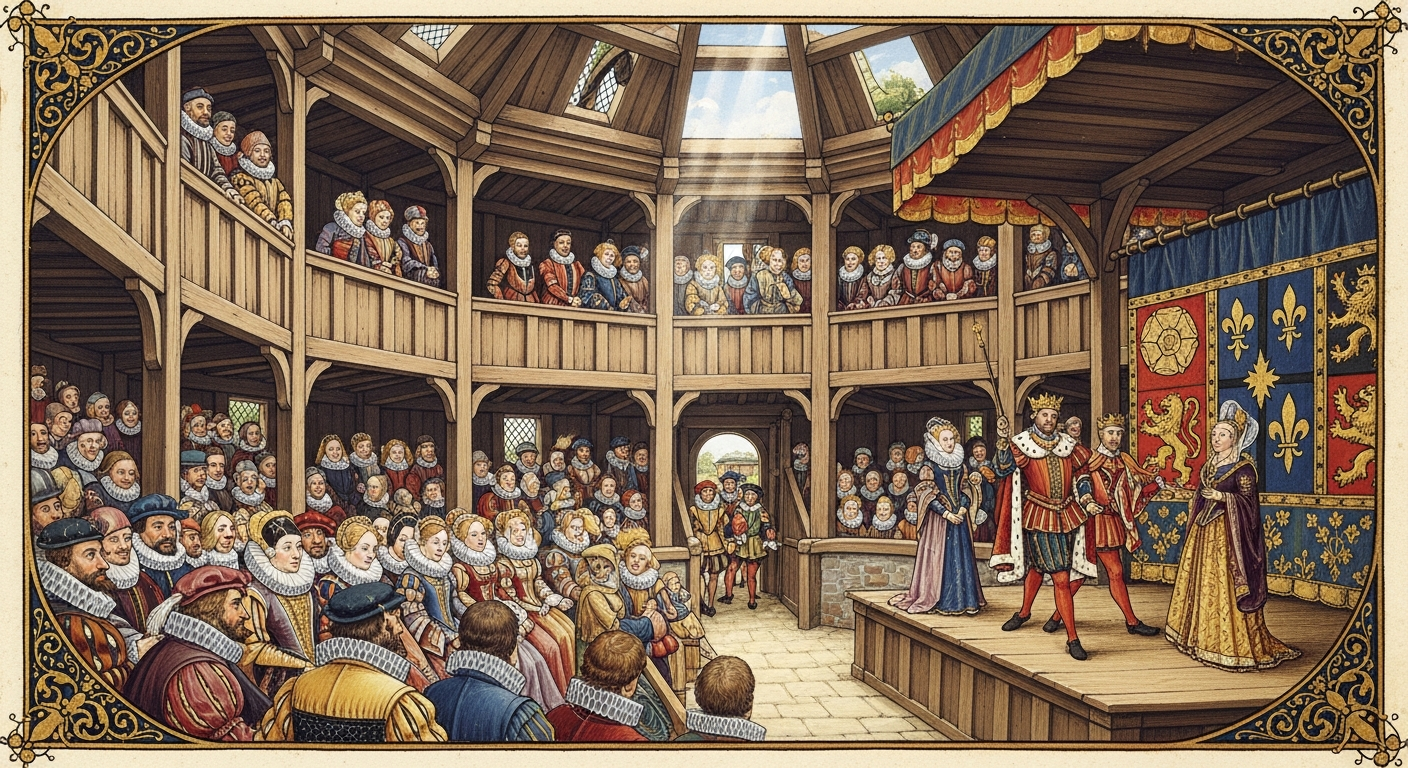
Imagine commissioning Shakespeare to stage a play about overthrowing a monarch the night before you attempt to overthrow one yourself. This extraordinary intersection of theatre and treason occurred on 7th February 1601, when supporters of Robert Devereux, 2nd Earl of Essex, paid for a special performance of Richard II at the Globe Theatre. The following day, Essex would lead an armed rebellion through the streets of London against Elizabeth I, making this perhaps the most dramatic example of propaganda theatre in English history.
The story of Essex’s rebellion reveals the dangerous final years of Elizabeth I’s reign, when the ageing queen’s court had become a powder keg of ambition, paranoia, and political desperation. As England’s last Tudor monarch faced questions about succession and struggled to maintain control over her increasingly fractious nobles, one man’s fall from grace would culminate in an audacious attempt to seize power through the streets of London.
This remarkable episode demonstrates how theatre, politics, and rebellion intersected in Tudor England, whilst revealing the complex relationship between Elizabeth I and her final favourite, whose spectacular rise and fall would help define the closing chapter of one of England’s most famous reigns.
Historical Background
Robert Devereux, 2nd Earl of Essex, had once been the golden boy of Elizabeth I’s court. Born in 1565, he inherited his title at age ten and quickly became one of the most prominent figures in Elizabethan England. Tall, charismatic, and possessed of considerable military ambition, Essex captured the queen’s attention in the late 1580s, becoming her last great favourite after the execution of his stepfather, Robert Dudley, Earl of Leicester.
For over a decade, Essex enjoyed unprecedented royal favour. Elizabeth showered him with titles, lands, and privileges, whilst he commanded military expeditions to France, Spain, and Ireland. However, this golden relationship began to sour dramatically in the late 1590s. Essex’s disastrous campaign in Ireland, where he failed to suppress the rebellion led by Hugh O’Neill, Earl of Tyrone, marked the beginning of his downfall. Against explicit royal orders, he abandoned his post and returned to England in September 1599, bursting into the queen’s private chambers at Nonsuch Palace whilst she was still in her nightgown and wig.
This shocking breach of protocol proved to be Essex’s undoing. Elizabeth, now 66 and increasingly conscious of her dignity and authority, was furious at his presumption. She placed him under house arrest, stripped him of his offices, and refused to renew his monopoly on sweet wines, effectively bankrupting him. By 1600, Essex found himself financially ruined, politically isolated, and desperately seeking a way back into royal favour.
As recorded in the Calendar of State Papers Domestic, by early 1601, Essex had gathered around him a group of disaffected nobles and gentlemen, including the Earl of Southampton (Shakespeare’s patron), Sir Charles Danvers, and Sir Gelly Meyrick. These men, facing their own financial and political difficulties, began plotting what they hoped would be a swift coup to remove Elizabeth’s advisers and restore Essex to power. Their plan was audacious in its simplicity: march through London, gather popular support, and force the queen to dismiss her current councillors, particularly Robert Cecil, Essex’s greatest rival.
Significance and Impact
The performance of Richard II on 7th February 1601 represents a pivotal moment in the relationship between theatre and politics in Tudor England. According to testimony given during Essex’s subsequent trial, Sir Gelly Meyrick paid the Lord Chamberlain’s Men forty shillings above their usual fee to perform the play, despite their initial reluctance due to its age and unpopularity. The choice of Richard II was far from coincidental; the play depicts the deposition and murder of a monarch by his nobles, making it explosive political material in an age when Elizabeth had no clear heir.
The rebellion itself, launched on 8th February 1601, proved to be a catastrophic miscalculation. Essex and approximately 200 supporters marched through London, expecting the citizens to rise in support of their cause. Instead, they found the streets largely indifferent or hostile. The government, forewarned of trouble, had already taken precautions. When Essex reached the city, he found his way blocked and his support melting away. By evening, he was trapped in Essex House, his London residence, where he surrendered after a brief siege.
The swift collapse of Essex’s rebellion had profound consequences for the final years of Elizabeth’s reign. As historian Paul E.J. Hammer notes in his comprehensive study of Essex’s career, the revolt represented the last serious challenge to Tudor royal authority and marked the end of the era of court favourites who could rival the monarch’s power. Elizabeth, shaken by the betrayal of someone she had loved and trusted, became increasingly isolated and suspicious in her final years.
The aftermath also demonstrated the efficiency of the Tudor state’s response to internal threats. Within weeks, Essex and his key supporters had been tried, convicted, and executed. The speed and thoroughness of the government’s reaction sent a clear message to any other potential rebels whilst reinforcing the absolute nature of royal authority.
Connections and Context
Essex’s rebellion occurred during one of the most anxious periods of Elizabeth’s reign. By 1601, the queen was 67, had never married, and refused to name her successor, creating uncertainty about England’s future. The country was also in the final stages of the costly Nine Years’ War in Ireland, whilst ongoing tensions with Spain continued to drain the royal treasury. These pressures created a volatile atmosphere at court, where ambitious nobles jockeyed for position in anticipation of a new reign.
The use of Shakespeare’s play as propaganda also highlights the broader cultural significance of theatre in Tudor England. Richard II was particularly sensitive because it dealt with deposition; Elizabeth herself reportedly said, ‘I am Richard II, know ye not that?’ The play had been performed during the period leading up to the rebellion, and the government was clearly aware of its potential for stirring seditious thoughts. This incident contributed to increased government scrutiny of theatrical performances and their political implications.
Furthermore, Essex’s rebellion can be seen as the culmination of factional struggles that had dominated Elizabeth’s later reign. The rivalry between Essex and Robert Cecil represented broader tensions between the old military nobility and the new bureaucratic class that was increasingly running Tudor government. Essex’s fall marked the triumph of Cecil’s more cautious, administrative approach to governance over the aggressive, military-focused policies favoured by Essex and his supporters.
Modern Relevance and Fascinating Details
The story of Essex’s rebellion continues to fascinate historians and fiction writers because it perfectly encapsulates the dramatic tensions of Elizabeth’s final years. The image of Shakespeare’s company reluctantly performing Richard II whilst knowing it might be used to justify treason adds a layer of moral complexity that resonates with modern audiences concerned about the relationship between art and politics.
Did you know that Essex wore black at his execution on 25th February 1601, and that Elizabeth reportedly kept his ring until her own death two years later? The personal tragedy underlying this political crisis adds human dimensions that have inspired countless novels, films, and television dramas. The relationship between the ageing queen and her charismatic but ultimately treacherous favourite has become a staple of historical fiction, appearing in works from Lytton Strachey’s Elizabeth and Essex to recent television series about the Tudor court.
The rebellion also raises intriguing questions about popular opinion in Tudor England. Essex clearly believed he could count on London’s citizens for support, yet they remained largely indifferent to his cause. This suggests that despite economic hardships and war weariness, Elizabeth retained considerable popular loyalty even in her final years. The failure of Essex’s appeal to ‘the people’ demonstrates the continued strength of Tudor royal mystique and the effectiveness of Elizabethan propaganda in maintaining public order.
Modern parallels with the use of media for political purposes make Essex’s theatrical propaganda particularly relevant. The idea of using popular entertainment to shape political opinion feels remarkably contemporary, whilst the government’s swift response to what we might now call ‘fake news’ or seditious media offers insights into how authority has always sought to control dangerous narratives.
Conclusion
The Essex rebellion of February 1601 represents a perfect storm of personal ambition, political desperation, and cultural manipulation that illuminates the final chapter of Elizabeth I’s remarkable reign. The decision to use Shakespeare’s Richard II as propaganda reveals both the power of theatre in Tudor society and the lengths to which desperate men would go to justify their treasonous ambitions. Essex’s spectacular fall from favourite to traitor demonstrates how quickly fortunes could change in the hothouse atmosphere of the Elizabethan court.
This episode reminds us that even the most successful reigns face moments of crisis, and that the relationship between art, politics, and power remains as complex today as it was over 400 years ago. For anyone seeking to understand the final years of England’s greatest queen, or the dangerous intersection of culture and politics in any era, the story of Essex’s rebellion offers compelling insights into human ambition, loyalty, and the ultimate price of treason.