
Introduction
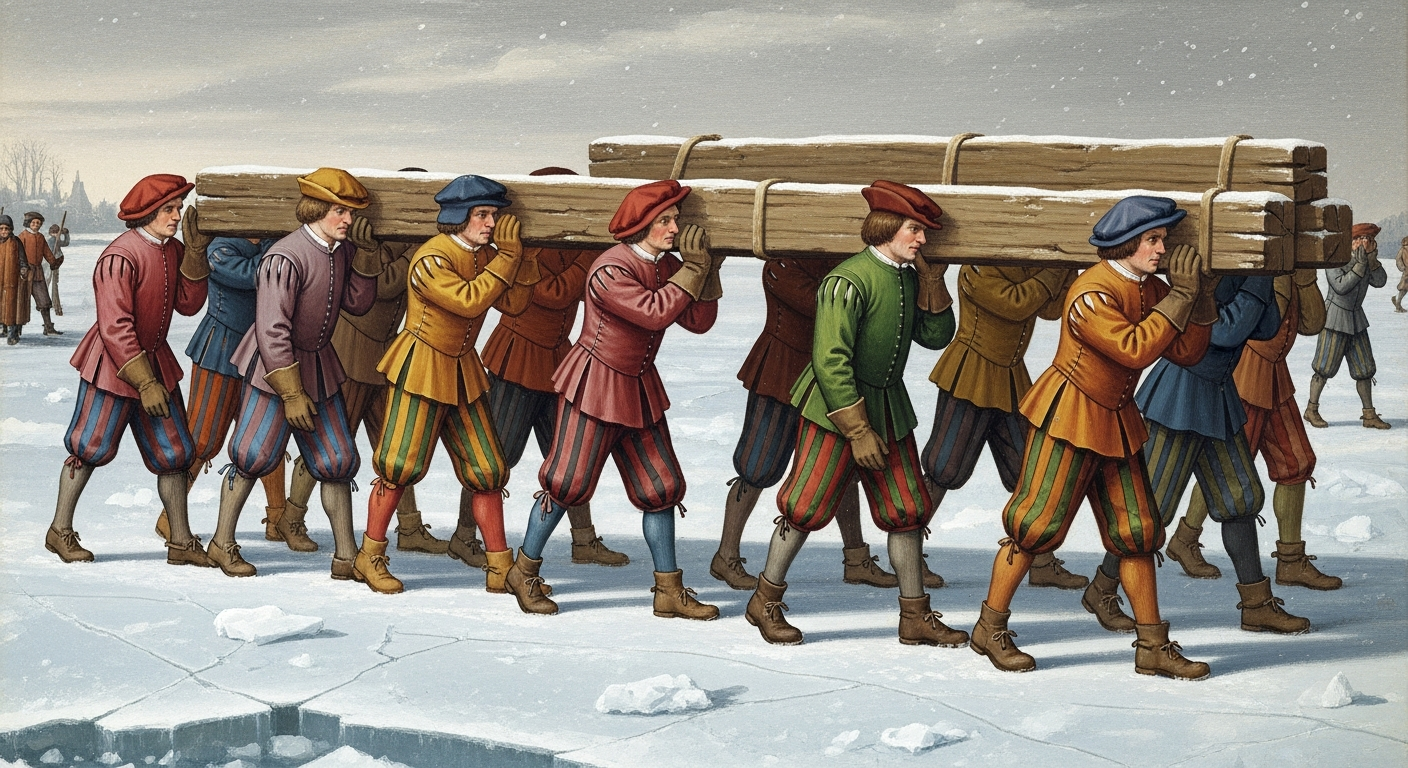
Imagine Tudor builders dismantling an entire playhouse, carrying massive timber beams across the frozen Thames, and reassembling them into what would become the most famous theatre in English history. This extraordinary feat occurred during the bitter winter of 1598-1599, when Shakespeare’s acting company, the Lord Chamberlain’s Men, literally moved their theatre piece by piece to create the Globe Theatre. What emerged was not merely a new playhouse, but a cultural phenomenon that could pack 3,000 spectators into performances of Hamlet, King Lear, and Macbeth for the price of a penny.
The story of the Globe’s construction represents one of the most audacious acts of theatrical entrepreneurship in Tudor England. Built during the final years of Elizabeth I’s reign, when London’s theatre scene was flourishing despite Puritan opposition, the Globe became the beating heart of Elizabethan drama. Its creation involved legal disputes, midnight construction work, and the remarkable vision of transforming recycled timber into a venue that would host the premieres of Shakespeare’s greatest works.
This tale reveals not only the practicalities of Tudor theatre construction but also the determination of England’s premier acting company to secure their artistic and financial future. From the original dispute over The Theatre’s lease to the Globe’s eventual destruction by fire in 1613, this story illuminates the precarious yet vibrant world of Elizabethan entertainment.
Historical Background
The Globe Theatre’s story begins with a property dispute in Shoreditch, where The Theatre had operated since 1576 as London’s first purpose-built playhouse. Constructed by James Burbage, The Theatre had served as home to the Lord Chamberlain’s Men, the acting company that included William Shakespeare as both playwright and shareholder. However, when Burbage died in 1597, his sons Richard and Cuthbert inherited a theatre but not the land beneath it, which belonged to Giles Allen.
Allen, who disapproved of theatrical entertainment on moral grounds, refused to renew The Theatre’s lease and demanded the building’s demolition. The Burbage brothers faced losing their livelihood, as did their fellow shareholders in the Lord Chamberlain’s Men, including Shakespeare, John Heminges, Augustine Phillips, Thomas Pope, and Will Kemp. Their solution was as bold as it was legally questionable: they would reclaim their property by force.
On the night of 28th December 1598, whilst Allen was away from London celebrating Christmas at his country estate, the company enacted their plan. Led by master carpenter Peter Street, a team of workers began systematically dismantling The Theatre. According to their interpretation of property law, whilst Allen owned the land, they owned the building materials. As recorded in Philip Henslowe’s diary and later court documents, this midnight operation required tremendous organisation and courage.
The dismantled timber, including the massive oak frame that formed The Theatre’s structure, was transported across the frozen Thames to Bankside in Southwark. This area, lying outside the City of London’s jurisdiction, had become the entertainment district of Tudor London, already home to bear-baiting arenas, brothels, and the rival Rose Theatre. Here, on a plot of land leased from Nicholas Brend, the Lord Chamberlain’s Men would rebuild their theatre as the Globe, with construction completed by the summer of 1599.
Significance and Impact
The Globe Theatre’s creation marked a pivotal moment in English theatrical history, establishing what Andrew Gurr describes in The Shakespearean Stage 1574-1642 as the most significant playhouse of the early modern period. Its impact extended far beyond architecture to reshape how drama reached Tudor audiences. With capacity for up to 3,000 spectators, the Globe could accommodate roughly two percent of London’s population in a single performance, making theatre a truly mass entertainment medium.
The theatre’s pricing structure democratised dramatic entertainment in unprecedented ways. For just one penny, equivalent to a day’s wages for an unskilled labourer, groundlings could stand in the yard surrounding the stage. Wealthier patrons paid two pence for gallery seats or six pence for the exclusive lords’ rooms. This accessible pricing meant that Shakespeare’s plays reached everyone from apprentices and serving maids to merchants and nobility, creating a shared cultural experience that transcended social boundaries.
The Globe’s design innovations profoundly influenced dramatic writing and performance. Its thrust stage, projecting into the yard and surrounded by spectators on three sides, created an intimate relationship between actors and audience impossible in modern proscenium theatres. Shakespeare wrote many of his greatest plays specifically for this space, including Julius Caesar, As You Like It, Hamlet, Othello, King Lear, and Macbeth. The theatre’s acoustics and sightlines shaped how these works were conceived, from soliloquies delivered directly to the groundlings to spectacular scenes utilising the gallery above the stage.
Economically, the Globe represented a new model of theatrical enterprise. Unlike earlier playhouses owned by single proprietors, the Globe was jointly owned by the Burbage brothers and five members of the Lord Chamberlain’s Men, including Shakespeare. This partnership structure, where leading actors held financial stakes in both the company and the theatre, provided unprecedented stability and creative control. It enabled long-term planning, repertory development, and the nurturing of talent that produced the golden age of English drama.
Connections and Context
The Globe’s construction occurred during a particularly fertile period in Tudor cultural history. Elizabeth I’s reign was entering its final phase, marked by military victory over the Spanish Armada in 1588 and growing confidence in English artistic achievement. The 1590s saw London’s theatre scene expand rapidly, with multiple playhouses competing for audiences and playwrights like Christopher Marlowe, Ben Jonson, and Shakespeare pushing dramatic boundaries.
Contemporary with the Globe’s construction, other significant cultural developments were reshaping Elizabethan England. The publication of Edmund Spenser’s The Faerie Queene in 1590 had established English epic poetry, whilst composers like William Byrd and Thomas Tallis were creating sophisticated musical works. The Globe’s opening coincided with the Earl of Essex’s campaigns in Ireland and growing speculation about Elizabeth’s succession, political tensions that influenced the content of contemporary plays.
The theatre’s location in Southwark connected it to London’s broader entertainment economy. Situated near the Rose Theatre, managed by Philip Henslowe whose detailed diary provides crucial evidence about Tudor theatrical practices, the Globe was part of a thriving district that included taverns, gaming houses, and other recreational venues. This concentration created a theatrical ecosystem where playwrights, actors, and audiences mingled, fostering the collaborative creativity that characterised Elizabethan drama.
Modern Relevance and Fascinating Details
The Globe’s story continues to fascinate modern audiences, as evidenced by the reconstruction of Shakespeare’s Globe near the original site, opened in 1997. This modern project, led by American actor Sam Wanamaker, used Tudor building techniques and materials to recreate the theatre experience, demonstrating enduring interest in authentic Shakespearean performance conditions. Today’s Globe attracts over 800,000 visitors annually, proving the lasting appeal of the original’s democratic approach to theatre.
Archaeological investigations have revealed intriguing details about the original Globe’s construction and use. Excavations in the 1980s and 1990s uncovered foundations showing the theatre’s polygonal shape and confirmed historical accounts of its dimensions. Artefacts discovered include clay pipes, suggesting that smoking was common among audience members, and hazelnuts shells, indicating that Tudor theatregoers enjoyed snacks during performances much like modern cinema audiences.
Did you know that the Globe’s famous motto, Totus mundus agit histrionem (‘All the world’s a stage’), directly inspired one of Shakespeare’s most famous speeches in As You Like It? This connection between the theatre’s identity and its plays demonstrates how deeply intertwined the physical space was with the dramatic works performed there. The Globe’s flag, flown on performance days to advertise shows, used different colours to indicate genre: white for comedy, black for tragedy, and red for history plays.
Conclusion
The Globe Theatre’s remarkable origin story, from midnight dismantling to triumphant reconstruction, embodies the entrepreneurial spirit and cultural dynamism of Tudor England. This extraordinary feat of theatrical logistics created more than just a playhouse; it established a cultural institution that democratised dramatic entertainment and provided the perfect venue for Shakespeare’s greatest works. The collaboration between practical necessity and artistic vision that built the Globe offers enduring lessons about creative problem-solving and the power of shared cultural experiences.
Understanding the Globe’s construction illuminates the broader context of Elizabethan theatre and society, revealing how determined individuals could reshape cultural landscapes despite legal obstacles and social prejudices. For modern readers interested in Tudor history, Shakespeare studies, or the evolution of entertainment, the Globe’s story provides a fascinating window into a pivotal moment when English drama achieved unprecedented artistic heights whilst reaching unprecedented popular audiences.