
Introduction
When we think of the Great Fire of London in 1666, we often focus on Christopher Wren’s magnificent churches rising from the ashes or the birth of modern city planning. However, the fire’s most profound impact may have been something far more subtle: the final destruction of Tudor England’s architectural legacy. In four devastating days, the flames consumed over 13,000 medieval and Tudor houses within the old Roman walls, effectively erasing the last physical remnants of a bygone era.
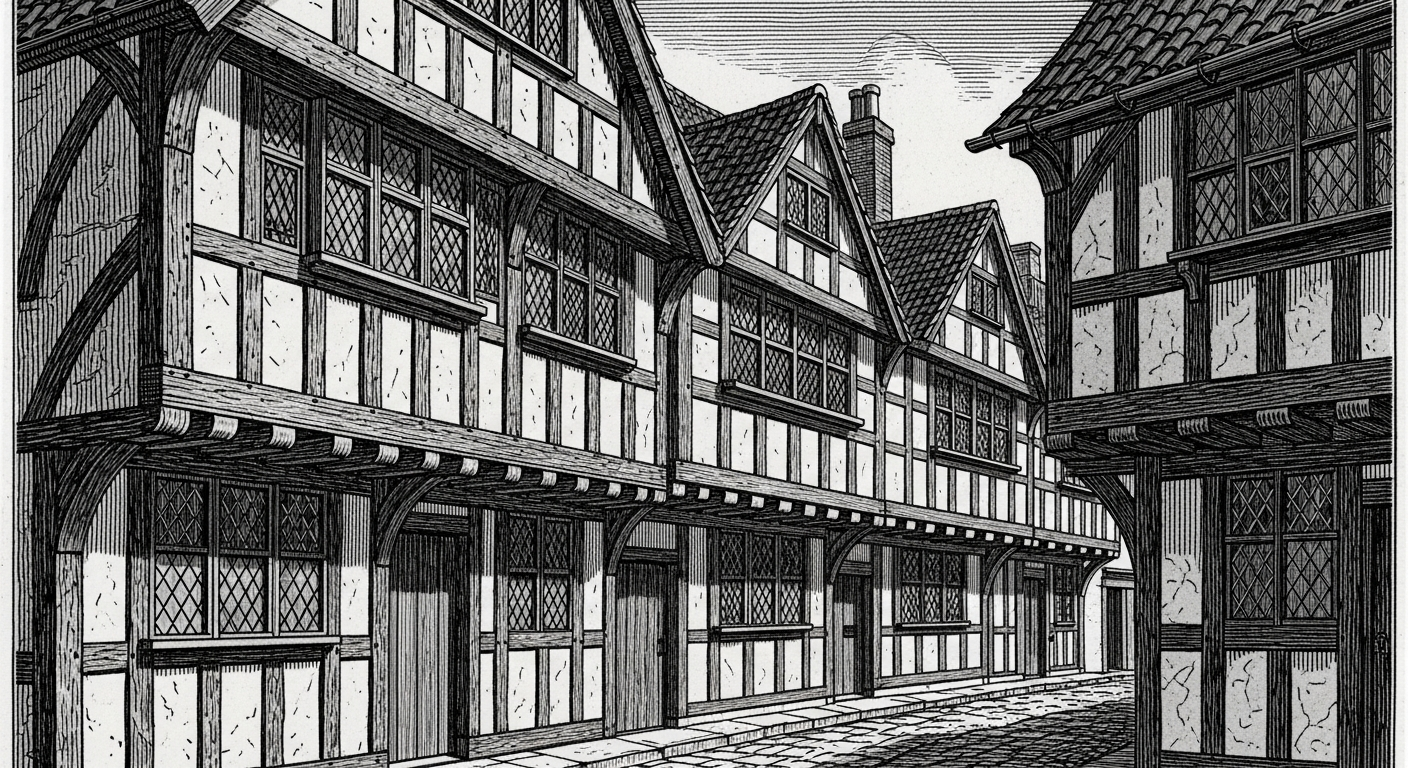
Before September 1666, ordinary Londoners still lived much as their Tudor ancestors had done, in timber-framed houses with their characteristic overhanging upper floors, diamond-paned windows, and creaking wooden galleries. The fire didn’t just destroy buildings; it severed the last tangible connection between Restoration England and the world of Henry VIII, Elizabeth I, and Shakespeare. This catastrophe marked the true end of the Tudor architectural era, transforming London from a medieval city into a Georgian prototype.
Understanding this transformation reveals not only how dramatically London changed in the 17th century, but also how architectural heritage shapes our connection to the past. The Great Fire represents one of history’s most complete urban renewals, and its impact on Tudor London’s streetscape tells a fascinating story of loss, change, and rebirth.
Historical Background
The Great Fire began in the early hours of Sunday, 2nd September 1666, in Thomas Farynor’s bakery on Pudding Lane. Samuel Pepys, whose diary provides our most vivid contemporary account, initially dismissed it as just another fire: ‘Jane comes and tells us that she hears that above 300 houses have been burned down to-night by the fire we saw, and that it is now burning down all Fish-street, by London Bridge.’ By the time Pepys realised the fire’s severity, it was already consuming the Tudor heart of London.
The fire spread with terrifying speed through the densely packed timber-framed buildings that had characterised London since medieval times. These Tudor-era structures, with their overhanging jetties and narrow gaps between buildings, created perfect conditions for the flames to leap from house to house. The very architectural features that made Tudor London so distinctive – the close-set timber frames, the thatched or wooden-shingled roofs, and the narrow medieval street layout – became instruments of the city’s destruction.
Within the old Roman walls, where London’s wealthiest merchants and craftsmen had lived for centuries, entire parishes vanished. The fire consumed 13,200 houses, 87 churches, and most of the City’s public buildings. Areas like Cheapside, with its magnificent Tudor merchants’ houses, and the ancient Guildhall district were completely obliterated. By Thursday, 6th September, when the fire finally abated, the medieval and Tudor London that had survived the Reformation, the English Civil War, and the Restoration was gone forever.
The human cost was relatively low – perhaps only six confirmed deaths – but the cultural and architectural loss was incalculable. Pepys captured the scale of destruction when he wrote: ‘All the sky was of a fiery aspect, like the top of a burning oven, and the light was so great round about, that I could see it plain at Whitehall, and could see more of it than ever I could of the City in a clear day.’ This wasn’t just urban destruction; it was the erasure of a civilisation’s physical memory.
Significance and Impact
The fire’s destruction of Tudor London’s housing stock had profound implications for English architectural history. The timber-framed houses that burned had been built using construction techniques passed down through generations of craftsmen. These buildings represented an unbroken tradition stretching back to the medieval period, incorporating Tudor innovations like the distinctive diamond-paned casement windows and elaborate carved barge-boards that adorned the overhanging upper floors.
More significantly, these buildings housed London’s social memory. The Great Fire destroyed not just structures, but entire neighbourhoods where families had lived for generations. The narrow courts and alleys, the ancient parish boundaries, and the organic street patterns that had evolved over centuries were swept away. When London was rebuilt, it emerged as a fundamentally different city, with wider streets, brick construction, and classical proportions that looked forward to the Georgian era rather than backward to the Tudors.
The fire also accelerated changes in English building practices that had been slowly developing since the early 17th century. The post-fire Building Acts mandated brick construction and regulated building heights and street widths, effectively outlawing the picturesque but fire-prone Tudor building style. This legislation didn’t just affect London; it influenced building practices across England, as provincial towns sought to modernise their appearance and reduce fire risk.
From a cultural perspective, the fire’s destruction of Tudor London marked a psychological break with the past. The generation that rebuilt London after 1666 consciously rejected medieval and Tudor architectural traditions in favour of classical styles inspired by continental European models. This architectural revolution reflected broader cultural changes, as Restoration England sought to position itself as a modern, sophisticated European power rather than an insular medieval kingdom.
Connections and Context
The timing of the Great Fire was historically significant. Coming just one year after the Great Plague of 1665, the fire struck a city already traumatised and depleted. Many of the Tudor-era tenements that burned had been plague houses, marked with red crosses and abandoned by their inhabitants. In a grimly ironic way, the fire completed the plague’s work of social disruption, forcing a complete reconstruction of urban life.
The fire also occurred during a period when England was already distancing itself from its Tudor past. The Restoration of Charles II in 1660 had brought continental influences to English court culture, and there was a growing sense that Tudor architecture appeared old-fashioned and provincial compared to the baroque splendour of Louis XIV’s France. The Great Fire provided an opportunity to rebuild London in a more fashionable classical style, accelerating architectural trends that were already emerging.
Interestingly, while London’s Tudor heritage vanished in the flames, other English cities preserved their Tudor buildings much longer. Towns like Chester, York, and Shrewsbury still boast extensive collections of timber-framed Tudor houses because they escaped both major fires and comprehensive redevelopment. The Great Fire’s destruction of London’s Tudor architecture makes these provincial examples all the more precious as windows into a lost urban world.
Modern Relevance and Fascinating Details
Today’s heritage conservation movement would view the Great Fire’s destruction of Tudor London as an incalculable cultural catastrophe. The 13,000 Tudor and medieval houses destroyed in 1666 would now be listed buildings, protected by law and cherished as irreplaceable historical assets. Modern London pays enormous sums to preserve far fewer historic buildings than were lost in those four September days.
Archaeological excavations in the City of London continue to reveal traces of the Tudor houses destroyed by the fire. Excavations often uncover the charred remains of Tudor timber frames, fragments of diamond-paned windows, and the distinctive red earth floors that characterised Tudor domestic architecture. These discoveries provide poignant evidence of the lost architectural heritage and help historians reconstruct how ordinary Tudors lived.
The fire’s impact on London’s Tudor heritage has become increasingly relevant to historical fiction writers and filmmakers seeking to recreate Tudor London. The almost complete absence of surviving Tudor domestic architecture in London means that productions about Henry VIII or Elizabeth I must rely on buildings in other cities or expensive studio reconstructions. The Great Fire created a gap in London’s architectural record that continues to challenge anyone trying to visualise Tudor urban life.
Did you know that some Tudor London survived the Great Fire? A few buildings just outside the fire’s path still stand today, including parts of the Middle Temple and several churches. These survivors provide tantalising glimpses of what all of Tudor London once looked like, with their timber galleries, overhanging upper floors, and intimate medieval scale.
Conclusion
The Great Fire of London destroyed far more than buildings; it obliterated the physical setting of Tudor England and severed London’s connection to its medieval past. The 13,000 Tudor and medieval houses that vanished in September 1666 took with them centuries of architectural tradition, social memory, and urban culture. In their place rose a new London that looked resolutely forward to the Georgian future rather than backward to the Tudor past.
This transformation reminds us how fragile architectural heritage can be and how quickly the physical traces of past civilisations can disappear. The Tudor Londoners who lived through the Great Fire witnessed not just urban destruction, but the end of their world’s visual and spatial identity. Understanding this loss helps us appreciate both the magnitude of the Great Fire’s impact and the precious value of the Tudor buildings that survive elsewhere in England, carrying forward the architectural memory that London lost forever in those four devastating days in 1666.