
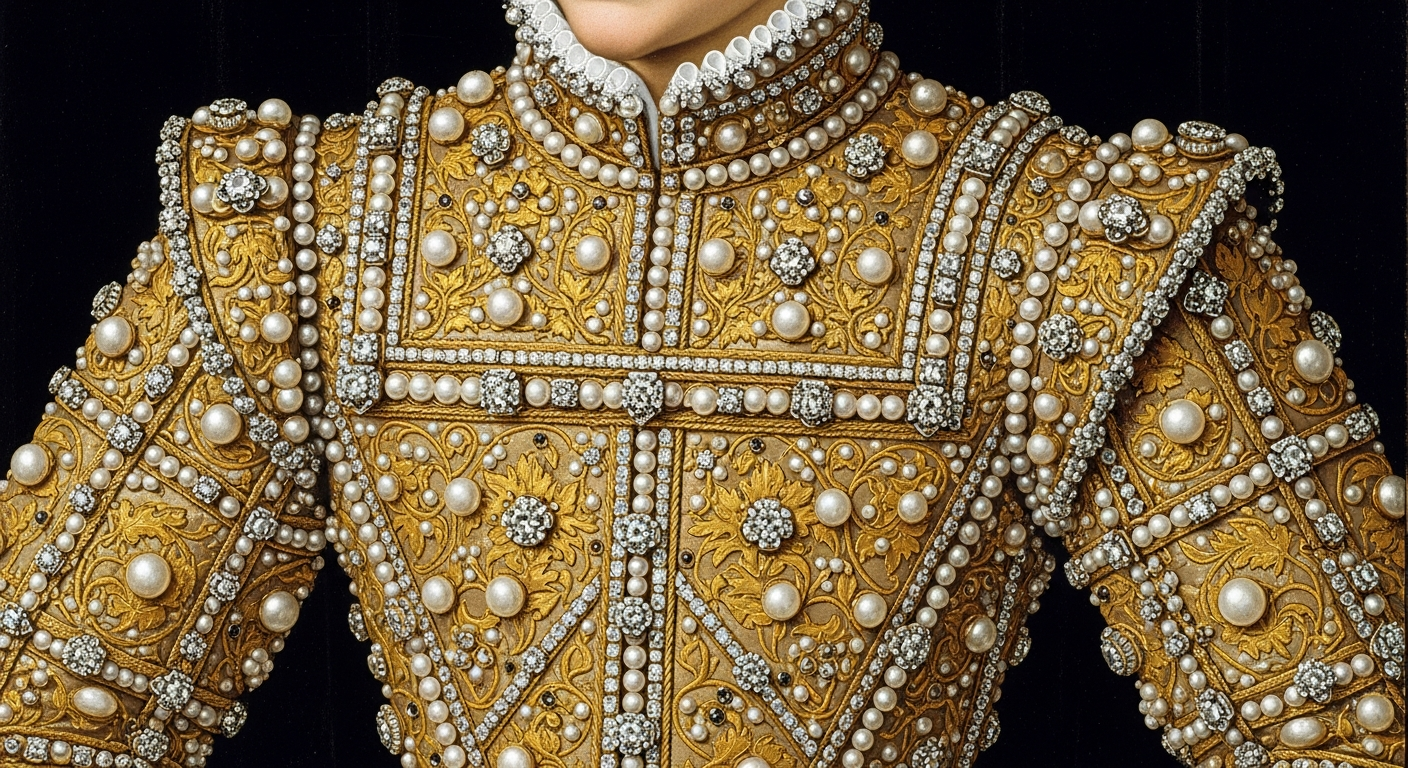
The Most Expensive Royal Outfit in History: Henry VIII’s Coronation Splendour
When eighteen-year-old Henry VIII stepped into Westminster Abbey on 24th June 1509, he wasn’t merely accepting a crown – he was making the most expensive fashion statement in English royal history. His coronation doublet, crafted from cloth-of-gold and encrusted with over 2,000 pearls and diamonds, cost approximately £4,000. To put this staggering sum into perspective, it represented more money than most nobles earned in an entire year, and would be equivalent to several million pounds in today’s currency.
This wasn’t simply royal vanity or youthful excess. Henry’s coronation costume represented a calculated political statement, designed to announce England’s arrival as a major European power and to distance his reign from the perceived parsimony of his father, Henry VII. The young king understood that in Tudor England, image was power, and power required the most spectacular display imaginable.
The story behind this extraordinary garment reveals not only the craftsmanship and wealth of early Tudor England, but also the sophisticated propaganda machine that Henry VIII would employ throughout his reign to project strength, legitimacy, and divine approval.
The Making of a King’s Wardrobe
The Great Wardrobe accounts, preserved in the National Archives as document E 101/417/6, provide fascinating details about the preparation for Henry VIII’s coronation. The planning began months before the ceremony, with master craftsmen across London working tirelessly to create garments worthy of England’s new monarch. The doublet that would become the centrepiece of royal legend was commissioned from the finest tailors in the realm, who had previously served Henry VII but had never been asked to create anything quite so magnificent.
Cloth-of-gold, the primary material for Henry’s doublet, was itself a luxury beyond the reach of all but the wealthiest individuals. This fabric combined silk threads with actual gold wire, creating a material that literally shimmered with precious metal. The technique for creating cloth-of-gold had been perfected in Italian workshops, particularly in Florence and Venice, making it an import that demonstrated England’s growing trade connections with European centres of luxury craft production.
The 2,000 pearls and diamonds adorning the doublet were sourced from across Europe and beyond. Pearls came primarily from the waters around Scotland and Ireland, though some may have been imported from the Persian Gulf through Venetian merchants. The diamonds, a relatively new addition to European royal regalia, were likely acquired through the expanding trade networks that connected England to the diamond mines of India via Portuguese and Italian intermediaries.
According to dress historian Maria Hayward’s authoritative study ‘Dress at the Court of King Henry VIII’ (2007), the construction of the coronation outfit required the skills of embroiderers, goldsmiths, jewellers, and tailors working in unprecedented collaboration. The project represented not just a single garment, but an entire industry mobilised to clothe a king.
Power Dressing: The Political Impact of Royal Magnificence
Henry VIII’s extravagant coronation costume served multiple political purposes that extended far beyond mere ceremonial requirements. Most immediately, it announced a dramatic break from his father’s reign. Henry VII, whilst successful in establishing the Tudor dynasty, had been known for his careful management of royal finances and relatively modest personal display. The new king’s willingness to spend lavishly on his appearance signalled that England now had a monarch ready to compete with the grandest courts of Europe.
The timing of this display was particularly significant. In 1509, England was still considered something of a peripheral power compared to the great continental kingdoms of France and Spain, or the Holy Roman Empire. Henry’s coronation magnificence sent a clear message to foreign ambassadors present at the ceremony: England possessed both the wealth and the confidence to challenge European hierarchies.
Contemporary accounts from foreign diplomats reveal the impact of Henry’s strategy. The Venetian ambassador reported back to the Doge that the English king appeared ‘more magnificent than any prince in Christendom’, whilst Spanish observers noted with some concern the obvious prosperity that such display represented. These reports would have been carefully studied by rival courts, contributing to England’s growing reputation as a power that demanded respect.
The coronation costume also served domestic political purposes. English nobles attending the ceremony could not fail to notice that their king possessed resources that dwarfed their own. The £4,000 doublet cost more than the annual income of all but the wealthiest earls, effectively demonstrating royal supremacy through sartorial means. This display helped establish the tone for Henry’s reign, in which the monarchy would consistently outshine even the most ambitious noble households.
Coronation Connections: Henry’s Reign in Context
Henry VIII’s coronation took place during a period of significant European political upheaval. In 1509, the League of Cambrai had recently formed against Venice, Pope Julius II was pursuing aggressive territorial policies, and France under Louis XII was expanding its influence in Italy. Henry’s magnificent coronation costume can be understood as England’s announcement that it intended to play a major role in these continental power struggles.
The young king’s investment in royal display proved prescient. Within five years of his coronation, Henry would be leading English armies in France, competing directly with Francis I of France for the title of Europe’s most magnificent monarch. The famous Field of the Cloth of Gold in 1520 can be seen as the logical extension of the display principles established at Henry’s coronation, where competitive magnificence between England and France reached almost absurd heights.
Interestingly, Henry’s coronation occurred just months after his marriage to Catherine of Aragon, and the joint coronation ceremony was designed to establish both monarchs as divinely appointed rulers. The cost of Catherine’s coronation attire, whilst substantial, was significantly less than Henry’s, establishing a pattern of male sartorial dominance that would characterise much of his reign, despite his later marriages to women who were themselves notable for their fashion choices.
Legacy and Modern Fascination
The story of Henry VIII’s coronation doublet continues to fascinate modern audiences, partly because it represents such an extreme example of conspicuous consumption. In our current era of billionaire luxury, the idea of spending millions on a single garment resonates with contemporary discussions about wealth inequality and the display of power through material possessions.
Historical fiction authors, including myself, often struggle to convey to modern readers just how extraordinary such displays would have appeared to Tudor audiences. The coronation doublet represents a useful benchmark: when describing royal magnificence in Tudor novels, writers can refer to this documented example of extreme luxury to ground fictional descriptions in historical reality.
Did you know that the techniques used to create Henry’s cloth-of-gold doublet were so specialised that they began to disappear from English workshops within a century? The English Civil War and subsequent changes in royal ceremonial meant that the demand for such extreme luxury textiles declined, and the skills were gradually lost. Modern attempts to recreate Tudor cloth-of-gold for museum exhibitions require extensive research into historical techniques that were once common knowledge among London’s craftsmen.
The coronation costume also raises fascinating questions about the survival of royal garments. Unlike many European courts, which preserved coronation regalia for centuries, most of Henry VIII’s personal wardrobe has been lost to time. The famous Whitehall Palace fire of 1698 destroyed many royal textiles, meaning that we must rely on written accounts and paintings to understand the full magnificence of Tudor royal dress.
Understanding Tudor Magnificence
Henry VIII’s £4,000 coronation doublet represents more than just royal extravagance – it embodies the political, economic, and cultural ambitions of early Tudor England. This single garment demonstrates how the young Henry understood the connection between visual magnificence and political power, establishing patterns of royal display that would influence European court culture for generations.
The story of this extraordinary costume also reveals the sophisticated luxury trade networks that connected Tudor England to craftsmen and materials across Europe and beyond. From Italian cloth-of-gold to Scottish pearls and Indian diamonds, Henry’s coronation outfit represented a truly international collaboration in the service of English royal prestige. For modern readers interested in exploring Tudor history further, the intersection of fashion, politics, and international trade offers a fascinating window into the complexities of early sixteenth-century European society.