
Introduction
Among the many scandalous tales of Henry VIII’s matrimonial adventures, none quite matches the extraordinary story of his marriage to Anne of Cleves in 1540. What began as one of the most diplomatically important unions of the Tudor era quickly descended into what the King himself described as an unmitigated disaster, leading him to cruelly dub his new bride a ‘Flanders mare’. Yet this tale of royal rejection contains one of history’s most surprising plot twists.
The marriage that lasted a mere six months and was never consummated would ultimately transform into one of the most successful relationships of Henry’s reign. Anne of Cleves, the woman Henry claimed was too unattractive to bed, would become his ‘beloved sister’ and the only one of his ex-wives to outlive him, dying peacefully in her own bed in 1557. Her story challenges everything we think we know about survival in Henry VIII’s dangerous court.
This remarkable transformation from discarded wife to trusted family member reveals fascinating insights into Tudor marriage politics, the art of diplomatic survival, and the complex personality of England’s most infamous monarch. How did Anne of Cleves turn what appeared to be devastating royal rejection into a position of unprecedented security and comfort?
Historical Background
Anne of Cleves was born around 1515 in Düsseldorf, the daughter of John III, Duke of Cleves, a strategically important Protestant ruler in the fragmented landscape of 16th-century Germany. Her selection as Henry VIII’s fourth wife in 1539 had nothing to do with romance and everything to do with realpolitik. Following Henry’s break with Rome and his excommunication by Pope Paul III, England found itself diplomatically isolated and potentially vulnerable to Catholic invasion.
Thomas Cromwell, Henry’s chief minister, orchestrated the Cleves marriage as part of a Protestant alliance designed to counterbalance the Catholic powers of France and the Holy Roman Empire. The negotiations were conducted entirely through portraits and diplomatic correspondence, with Hans Holbein the Younger commissioned to paint Anne’s likeness for the King’s approval. The resulting portrait, now in the Louvre, shows a dignified woman in elaborate German dress, though it would later become a source of bitter dispute.
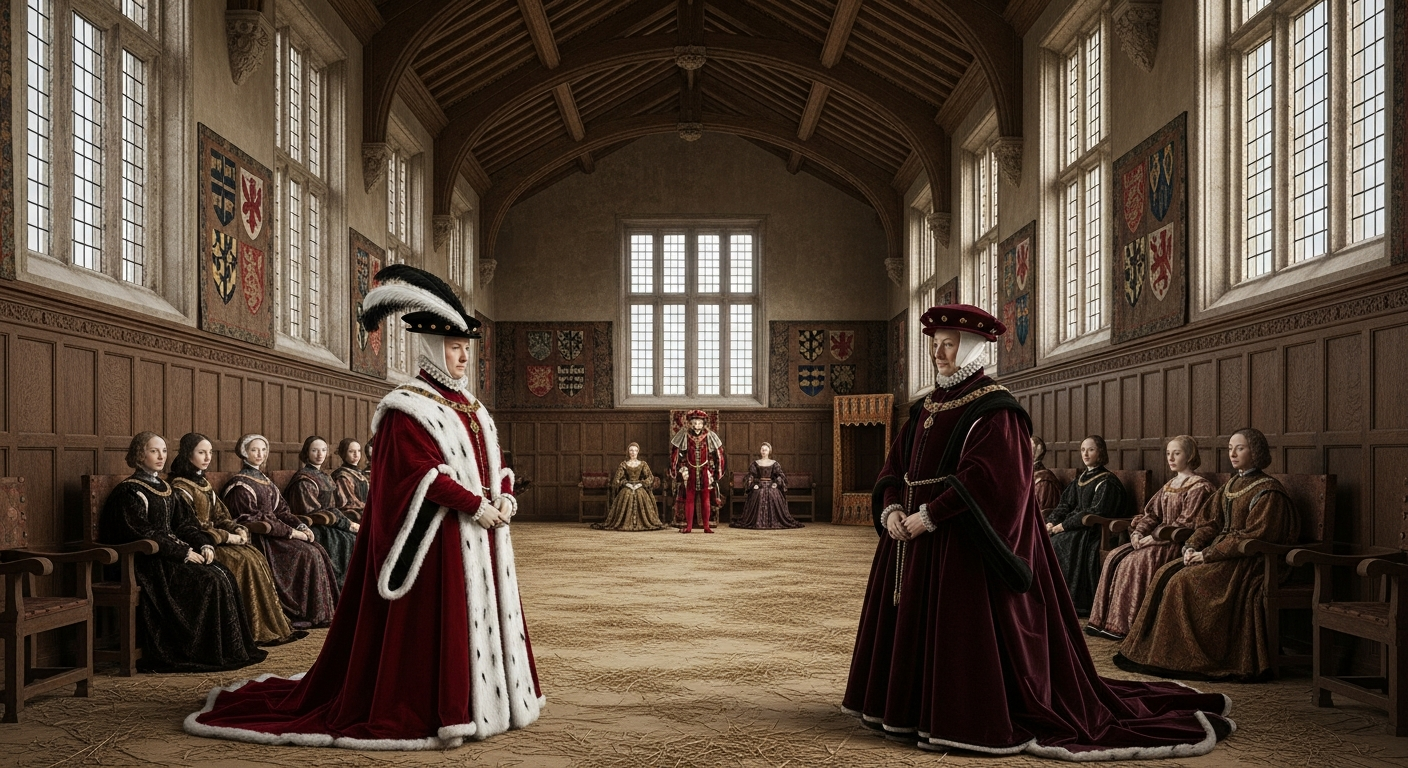
Anne arrived in England in December 1539, and the couple first met at Rochester on 1st January 1540. According to contemporary accounts in the Calendar of State Papers, the meeting was catastrophic. Henry, who had disguised himself to surprise his bride-to-be in a romantic gesture typical of courtly literature, was reportedly appalled by Anne’s appearance and demeanour. The reality, it seems, bore little resemblance to Holbein’s flattering portrait or Cromwell’s glowing reports.
Despite his private reservations, diplomatic necessity forced Henry to proceed with the wedding ceremony at Greenwich Palace on 6th January 1540. However, the King’s revulsion was so profound that he confided to Cromwell his inability to consummate the marriage, describing Anne in the cruellest terms as resembling a ‘Flanders mare’. The marriage was doomed from its very first night, though it would take six months of political manoeuvring before Henry could extricate himself from this diplomatic disaster.
Significance and Impact
The Anne of Cleves debacle had profound and far-reaching consequences that extended well beyond the personal embarrassment of an awkward royal marriage. Most immediately, it provided Henry with the excuse he needed to destroy Thomas Cromwell, who had orchestrated the entire Cleves alliance. By July 1540, Cromwell found himself charged with treason, his decades of loyal service forgotten in the face of royal displeasure over the failed marriage and conservative politicking. His execution marked the end of one of the most significant ministerial careers in Tudor history.
The annulment proceedings, which began almost immediately after the wedding, also established important precedents in English matrimonial law. Unlike Henry’s previous marital difficulties, this case was resolved with remarkable speed and efficiency. Anne’s compliance was crucial to this success. Rather than fighting the annulment as Catherine of Aragon had done, Anne demonstrated remarkable political acumen by accepting the King’s wishes gracefully, thereby transforming potential disaster into unexpected opportunity.
The resolution of the Cleves marriage also marked a significant shift in Henry’s foreign policy. The failure of the Protestant alliance forced England to recalibrate its diplomatic relationships, ultimately leading to a rapprochement with the Catholic powers that Henry had been trying to counter. This realignment would have lasting consequences for English foreign policy throughout the remainder of Henry’s reign and beyond.
Perhaps most significantly, Anne’s successful negotiation of her annulment established a new model for royal divorce that prioritised mutual consent and generous compensation over bitter legal battles. Her willingness to accept the title of ‘the King’s beloved sister’ and a substantial financial settlement created a template that would influence royal separations for generations to come.
Connections and Context
The timing of the Cleves marriage placed it at a crucial juncture in Henry VIII’s reign, coming just two years after the traumatic execution of Anne Boleyn and less than two years after Jane Seymore’s death in childbirth. Henry was increasingly desperate for male heirs, and his advancing age made the succession question ever more pressing. The failure of the Cleves marriage therefore represented not just a personal disappointment but a dynastic crisis that would drive the King’s subsequent matrimonial adventures.
The Cleves affair also occurred during a period of significant religious upheaval in England. Henry’s break with Rome was still relatively recent, and the country was experiencing considerable tension between Protestant reformers and Catholic traditionalists. The failure of the Protestant alliance symbolised by the Cleves marriage gave ammunition to Catholic factions at court and contributed to the conservative reaction that would characterise the later years of Henry’s reign.
Interestingly, Anne of Cleves’s successful adaptation to English court life provides a fascinating contrast to the fates of Henry’s other wives. While Catherine Howard, whom Henry married just twenty days after his annulment from Anne was finalised, would lose her head within eighteen months, Anne was building the foundations of a comfortable and secure life that would outlast the King himself. Her story intersects intriguingly with those of Catherine Parr, Henry’s final wife, with whom Anne maintained cordial relations throughout the remainder of Henry’s reign.
Modern Relevance and Fascinating Details
What makes Anne of Cleves’s story particularly compelling to modern audiences is her remarkable transformation from victim to victor in the dangerous game of Tudor court politics. In an era when royal wives faced execution, exile, or disgrace, Anne managed to negotiate a position of unprecedented security and comfort. Her annual income of £4,000 made her one of the wealthiest women in England, and she lived in considerable style until her death in 1557.
Recent scholarship, including Retha M. Warnicke’s detailed analysis in ‘The Marrying of Anne of Cleves’, has challenged many traditional assumptions about this marriage. Modern historians question whether Henry’s objections to Anne were really about her physical appearance or whether they masked deeper political calculations about the value of the Cleves alliance. Some scholars suggest that the famous ‘Flanders mare’ comment may have been exaggerated or even invented by later chroniclers seeking to explain the marriage’s failure in terms that a male-dominated society could understand.
Did you know that Anne of Cleves was the only one of Henry’s wives to receive a state funeral? When she died in July 1557, during the reign of Henry’s daughter Mary I, she was accorded honours typically reserved for members of the royal family. This remarkable tribute speaks to the genuine affection and respect she had earned during her years as the King’s ‘beloved sister’. Her tomb in Westminster Abbey stands as a testament to one of the most successful survival stories in Tudor history.
In popular culture, Anne of Cleves has often been portrayed as a plain, dowdy figure whose only claim to fame was her rejection by Henry VIII. However, contemporary accounts suggest a more complex figure: an intelligent, politically astute woman who spoke multiple languages and successfully navigated one of the most treacherous courts in European history. Her story has been reimagined by historical fiction authors, including this author’s own work, as a tale of female agency and resilience in an age when women had few options for independence.
Conclusion
The marriage of Henry VIII and Anne of Cleves represents one of the most fascinating paradoxes in Tudor history. What began as a diplomatic disaster and personal humiliation was transformed, through Anne’s remarkable political intelligence and Henry’s pragmatic nature, into one of the most successful relationships of his reign. Anne’s ability to turn rejection into security, disgrace into dignity, challenges our assumptions about power, gender, and survival in the 16th century.
Her story reminds us that Tudor history is far more complex and nuanced than popular portrayals often suggest. Behind the headlines of executions and divorces lie stories of remarkable individuals who found ways to thrive even in the most challenging circumstances. Anne of Cleves’s transformation from unwanted wife to beloved sister offers hope that even in the most dire situations, intelligence, grace, and political acumen can triumph over seemingly insurmountable obstacles. For anyone interested in exploring the complex dynamics of Tudor court life, the remarkable journey of the ‘Flanders mare’ who became a beloved royal sister provides an endlessly fascinating starting point.