
Introduction
When examining the surviving suits of armour belonging to Henry VIII, one feature immediately commands attention: the dramatically pronounced codpiece that projects boldly from the king’s metal attire. Far from being merely a curious quirk of Tudor fashion, these exaggerated additions to royal armour served as carefully calculated symbols of monarchical power, designed to communicate Henry’s virility, strength, and fitness to rule to anyone who encountered him.
The codpiece, that peculiar garment that covered and enhanced the male groin area, reached its zenith of importance during Henry VIII’s reign in the 16th century. What began as a practical solution to a wardrobe problem evolved into one of the most potent visual statements of masculine authority in European royal courts. Henry’s armoured codpieces, measuring up to eight inches in projection and often padded to extraordinary proportions, were not accidents of fashion but deliberate tools of statecraft.
This exploration reveals how Henry VIII transformed an intimate article of clothing into a weapon of diplomatic intimidation, a symbol of dynastic legitimacy, and a reflection of the complex relationship between personal image and political power in Tudor England.
Historical Background
The codpiece emerged in the late 15th century as European men’s fashion underwent a significant transformation. As doublets became shorter and hose began to be worn as separate leg coverings, a gap appeared in men’s clothing that required covering. Initially, the codpiece served this practical purpose, but it quickly evolved into something far more significant, particularly in the hands of Henry VIII, who ruled England from 1509 to 1547.
Henry VIII’s relationship with his codpieces must be understood within the context of his desperate need to project an image of robust masculinity and fertile kingship. Throughout his reign, Henry’s ability to produce a male heir remained his paramount concern, driving his six marriages and his break with Rome. In an era where a monarch’s physical presence was believed to reflect their divine right to rule, every aspect of Henry’s appearance became a matter of state importance.
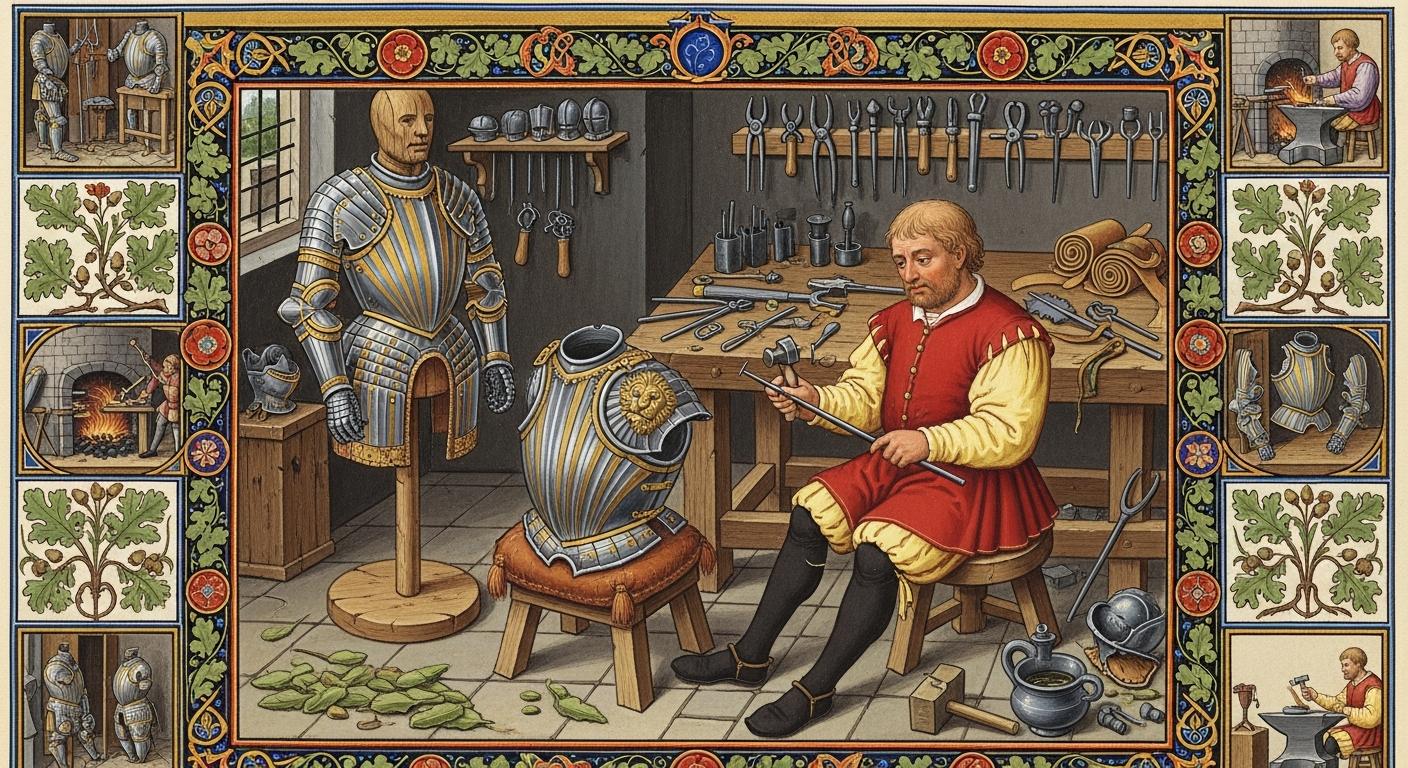
The king’s armourers, working at the Royal Workshops at Greenwich and collaborating with master craftsmen from Milan and Augsburg, created increasingly elaborate suits of armour for Henry throughout his reign. According to records held by the Royal Collection Trust, these suits featured codpieces that were not merely functional protective gear but were deliberately oversized and often heavily padded. The most extreme examples projected up to eight inches from the body, creating an unmistakable silhouette that announced the king’s presence before he even spoke.
Contemporary accounts suggest that Henry was acutely aware of the psychological impact of his appearance on foreign dignitaries. Spanish and French ambassadors wrote detailed descriptions of their audiences with the English king, often noting with a mixture of awe and bewilderment the imposing nature of his attire. These diplomatic encounters took place in the great halls of Hampton Court, Whitehall Palace, and other royal residences, where Henry’s dramatically enhanced silhouette would have been impossible to ignore.
Significance and Impact
The symbolic importance of Henry VIII’s codpiece extended far beyond personal vanity into the realm of international diplomacy and domestic governance. In Renaissance political theory, a king’s physical body was understood to represent the body politic of the entire nation. Therefore, any sign of weakness, impotence, or inadequacy in the monarch’s physical presentation could be interpreted as a reflection of the kingdom’s strength or vulnerability.
Maria Hayward’s seminal work ‘Dress at the Court of King Henry VIII’ demonstrates how the king’s clothing choices were integral to his political strategy. The exaggerated codpiece served multiple diplomatic functions: it intimidated foreign ambassadors by presenting an image of overwhelming masculine authority, it suggested the king’s capacity for producing heirs (crucial for dynastic stability), and it reinforced Henry’s break from the more restrained sartorial traditions associated with medieval kingship and clerical influence.
The impact on Tudor court culture was immediate and far-reaching. Courtiers and nobles began adopting similar fashions, though none dared to match the scale of the king’s own codpieces. This created a visual hierarchy at court where proximity to royal favour could be measured partly through the boldness of one’s attire. The codpiece became so associated with masculine authority that its absence or modest proportions could be read as a sign of political weakness or lack of royal favour.
Furthermore, Henry’s codpiece choices reflected and reinforced the changing nature of English kingship during this period. As Henry transformed England from a relatively minor European power into a significant player on the continental stage, his personal presentation evolved to match these ambitions. The codpiece became part of a broader program of royal self-fashioning that included magnificent palaces, elaborate court ceremonies, and increasingly autocratic governing style.
Connections and Context
Henry VIII’s famous codpieces cannot be understood in isolation from other significant developments of his reign. The period during which these garments reached their most exaggerated proportions, roughly 1515 to 1540, coincided with some of the most turbulent and transformative years in English history. This was the era of Henry’s break with Rome, his marriage to Anne Boleyn, and his establishment of the Church of England.
The timing is significant because Henry’s enhanced masculine display served to counteract potential criticism of his unprecedented actions. By projecting an image of overwhelming virility and power, Henry sought to deflect questions about his fitness to lead both church and state. The codpiece became part of his answer to those who questioned whether a king should also serve as Supreme Head of the Church of England.
Contemporary European fashion also played a crucial role in Henry’s choices. The courts of Francis I of France and Holy Roman Emperor Charles V were engaged in their own forms of sartorial competition, with each monarch attempting to outdo the others in magnificence and display. Henry’s codpieces must be seen as part of this broader European contest for prestige and recognition. Did you know that inventories from the period show Henry owned over 50 different suits of armour, each designed for specific occasions and audiences?
The influence extended beyond the English court to affect broader European fashion trends. Foreign visitors to Henry’s court returned home with detailed accounts of English styles, contributing to the spread of codpiece fashion across continental Europe. However, few monarchs adopted the extreme proportions favoured by Henry, making the English king’s silhouette distinctively recognisable across European diplomatic circles.
Modern Relevance and Fascinating Details
The story of Henry VIII’s codpiece continues to fascinate modern audiences because it reveals the timeless connection between clothing, power, and identity. In an era of carefully managed political image-making, Henry’s approach to personal presentation feels remarkably contemporary. The strategic use of clothing to project strength, authority, and capability remains a crucial aspect of political leadership today.
Popular culture has embraced the visual drama of Henry’s codpiece, with historical dramas like ‘The Tudors’ and films such as ‘The Other Boleyn Girl’ making the exaggerated garment a key element in their portrayal of the king. However, these representations often focus on the comedic or shocking aspects while missing the sophisticated political calculation behind Henry’s choices. As a historical fiction author, I find that readers are often surprised to learn that what appears to be vanity or excess was actually a carefully considered strategy of statecraft.
Perhaps most fascinating is the technical craftsmanship involved in creating these garments. Surviving examples in the Royal Collection demonstrate extraordinary skill in metalworking, with articulated joints that allowed for movement while maintaining the dramatic silhouette. The padding systems used in cloth codpieces were equally sophisticated, using techniques borrowed from military armour-making to create shapes that would hold their form under the weight of heavy court robes.
Modern conservation efforts have revealed additional details about construction techniques and materials. X-ray analysis of surviving garments has shown the complex internal structures used to achieve the desired projection, while fabric analysis has identified the luxury materials involved, including silk padding and velvet coverings that cost more than most people’s annual income.
Conclusion
Henry VIII’s legendary codpiece represents far more than a curious historical footnote or an example of Tudor excess. It stands as a remarkable example of how personal presentation and political power intersected in Renaissance monarchy, demonstrating the sophisticated ways in which clothing could serve diplomatic and dynastic purposes. The eight-inch projection of Henry’s armoured codpieces was not mere vanity but a calculated assertion of royal authority designed to intimidate, impress, and inspire.
Understanding this aspect of Henry’s reign illuminates broader themes about power, masculinity, and visual culture in Tudor England. For modern readers seeking to comprehend the complex personality of one of England’s most famous monarchs, the codpiece offers a unique window into Henry’s understanding of kingship as performance and his masterful manipulation of every available tool of royal authority. The next time you encounter an image of Henry VIII, remember that every element of his appearance, down to the most intimate details, was carefully designed to communicate his fitness to rule an empire.