
Introduction
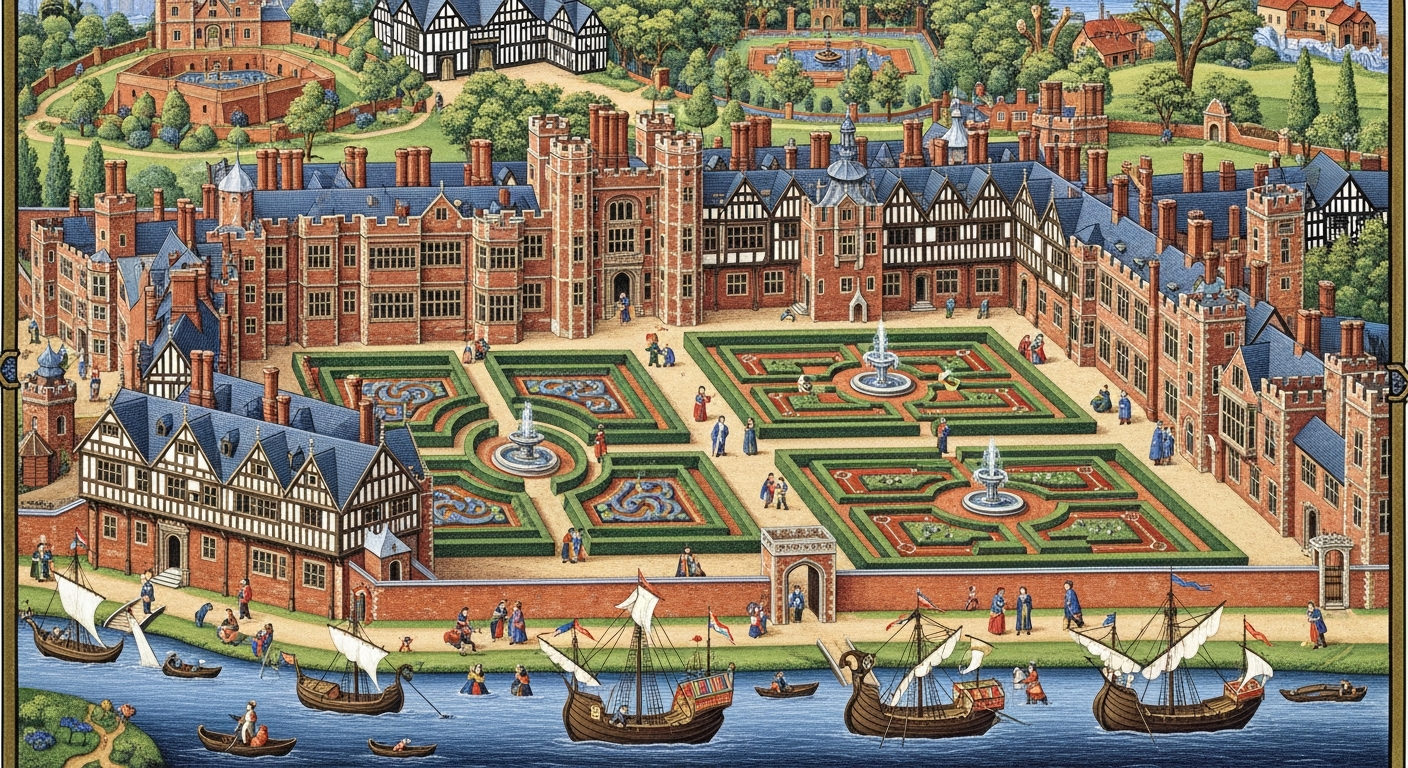
Imagine a palace so vast it contained more rooms than most modern hotels, sprawling across an area larger than twenty football pitches. This was Whitehall Palace, the magnificent royal residence that served as the beating heart of Tudor power for over 150 years. Built on the bones of Cardinal Wolsey’s confiscated mansion and expanded into Europe’s largest palace complex, Whitehall witnessed the most pivotal moments of English history, from Henry VIII’s six marriages to Elizabeth I’s Golden Age.
Covering an astounding 23 acres and boasting over 1,500 rooms, Whitehall Palace wasn’t merely a residence but a statement of royal supremacy that dwarfed Versailles and rivalled the greatest palaces of Europe. From 1530 until its destruction by fire in 1698, this architectural marvel served as the primary seat of English monarchs, hosting everything from marriage ceremonies and executions to diplomatic negotiations that shaped the future of Britain and Europe.
This is the story of how a disgraced cardinal’s mansion became the most powerful address in Europe, and why understanding Whitehall Palace is crucial to grasping the full scope of Tudor ambition, politics, and cultural transformation.
Historical Background
The origins of Whitehall Palace lie in the spectacular rise and fall of Cardinal Thomas Wolsey, Henry VIII’s once-powerful Lord Chancellor. Between 1514 and 1529, Wolsey had transformed a modest medieval property called York Place into one of England’s most luxurious residences. However, when Wolsey fell from grace due to his failure to secure Henry’s annulment from Catherine of Aragon, the King seized the property through the legal mechanism of forfeiture, as documented in the Letters and Papers, Foreign and Domestic, Henry VIII, Volume 4: 1524-1530.
Henry VIII officially took possession of the property in 1530, immediately recognising its potential as a grander royal residence than the existing palaces of Westminster or Greenwich. The King renamed it Whitehall Palace, derived from a great hall with white stone walls that formed part of the original complex. What followed was one of the most ambitious building projects of the Tudor era, as Henry expanded Wolsey’s mansion into a sprawling complex that would eventually eclipse every other royal residence in Europe.
The palace’s strategic location proved crucial to its importance. Situated between the Cities of London and Westminster, Whitehall occupied the perfect position for a monarch who needed to balance court life with governmental duties. The complex stretched from modern-day Trafalgar Square south to Westminster Abbey, incorporating existing buildings whilst adding entirely new wings, courtyards, and ceremonial spaces. According to architectural historian Simon Thurley’s comprehensive study Whitehall Palace: An Architectural History, the final complex contained over 1,500 rooms arranged around multiple courtyards, making it larger than Vatican City.
Construction continued throughout Henry’s reign and beyond, with each subsequent Tudor monarch adding their own modifications. The palace incorporated a fascinating mix of architectural styles, from medieval remnants of the original York Place to cutting-edge Renaissance designs that reflected the latest Continental fashions. Notable additions included the famous Holbein Gate, tennis courts, a cockpit for entertainment, extensive gardens, and even a tiltyard where the King could indulge his passion for jousting.
Significance and Impact
Whitehall Palace represented far more than royal extravagance; it embodied the transformation of English monarchy from medieval kingship to Renaissance absolutism. The sheer scale of the complex served as a powerful statement of Henry VIII’s break with Rome and his establishment of an independent English church. By creating Europe’s largest palace, Henry was declaring England’s equality with, if not superiority to, the great Catholic powers of France and Spain.
The palace’s impact on Tudor politics cannot be overstated. Within its walls, Henry VIII married three of his six wives, including the secret ceremony with Anne Boleyn in 1533 that precipitated England’s break with Rome. The palace witnessed the rise and fall of court favourites, the planning of military campaigns, and the delicate negotiations that shaped England’s foreign policy. Every major decision of the Tudor era, from the Dissolution of the Monasteries to the defeat of the Spanish Armada, was planned and coordinated from Whitehall’s corridors of power.
Culturally, Whitehall became the epicentre of English Renaissance art and learning. The palace housed Henry VIII’s magnificent collection of tapestries, paintings, and manuscripts, whilst its great halls hosted theatrical performances, musical concerts, and scholarly debates. Hans Holbein’s famous portrait of Henry VIII, which created the iconic image of the Tudor king that persists today, was painted as a mural for Whitehall’s Privy Chamber, demonstrating how the palace served as both political centre and artistic showcase.
The economic impact of maintaining such a vast complex was enormous, requiring hundreds of staff from grooms and cooks to musicians and scholars. The palace operated like a small city, complete with its own workshops, kitchens, chapels, and even a pharmacy. This concentration of employment and economic activity around Whitehall helped transform the surrounding area into London’s governmental district, a role it maintains to this day with Downing Street and the Treasury occupying nearby sites.
Connections and Context
Whitehall Palace’s construction coincided with the most tumultuous period in English religious and political history. As Henry VIII expanded the palace throughout the 1530s, he was simultaneously dismantling the medieval Catholic Church in England, dissolving monasteries, and executing those who opposed his religious reforms. The palace thus became a symbol of the English Reformation, representing the new order that Henry was creating to replace centuries of Catholic tradition.
The palace’s relationship with other Tudor residences reveals the sophisticated nature of sixteenth-century royal administration. While Whitehall served as the primary seat of government, the royal court remained itinerant, moving seasonally between palaces such as Greenwich, Richmond, Hampton Court, and Windsor. This system allowed monarchs to maintain personal relationships with nobility across the realm whilst ensuring that no single location became overly powerful or independent.
During Elizabeth I’s reign, Whitehall witnessed some of the most dramatic moments in English history. It was here that the Queen received news of Mary Queen of Scots’ execution in 1587, and where she planned England’s response to the Spanish Armada threat in 1588. The palace’s great halls hosted the elaborate court ceremonies that became central to Elizabethan propaganda, reinforcing the image of the Virgin Queen as a semi-divine ruler blessed by God to govern England.
Modern Relevance and Fascinating Details
Today, only one building survives from Henry VIII’s vast palace complex: the Banqueting House, built by James I in 1622 to replace an earlier Tudor hall. This surviving structure, with its magnificent Rubens ceiling celebrating royal power, provides our only physical connection to what was once Europe’s grandest royal residence. The irony is particularly poignant, as it was from a window of the Banqueting House that Charles I stepped onto the scaffold for his execution in 1649.
Archaeological excavations during twentieth-century construction work have revealed fascinating details about daily life in the Tudor palace. Excavations have uncovered everything from Tudor-era shoes and jewelry to the remains of the palace kitchens, providing insights into both royal luxury and the working conditions of palace staff. These discoveries have revolutionised our understanding of Tudor domestic life and the complex logistics required to maintain such an enormous royal household.
The influence of Whitehall Palace on popular culture remains profound. Historical novels from Jean Plaidy to Hilary Mantel have used the palace as a setting for their Tudor fiction, whilst television series such as The Tudors and Wolf Hall have attempted to recreate its grandeur for modern audiences. The challenge for historical fiction writers lies in conveying the sheer scale and complexity of a building that contained more rooms than most modern shopping centres whilst serving as both private residence and seat of government.
Conclusion
Whitehall Palace stands as perhaps the greatest symbol of Tudor ambition and achievement. From its origins as Cardinal Wolsey’s confiscated mansion to its development into Europe’s largest royal residence, the palace embodied the transformation of England from a medieval kingdom into a Renaissance power. Its 23 acres and 1,500 rooms witnessed every major event of the Tudor dynasty, from Henry VIII’s marriages to Elizabeth I’s diplomatic triumphs.
Understanding Whitehall Palace is essential for anyone seeking to comprehend the Tudor era’s political, cultural, and social complexities. The palace was simultaneously a home, a government building, an artistic showcase, and a statement of royal power that proclaimed England’s place among Europe’s great nations. Though fire destroyed this magnificent complex in 1698, its legacy lives on in the governmental district that still bears its name, and in our continued fascination with the dynasty that made it the centre of their world.