
Introduction
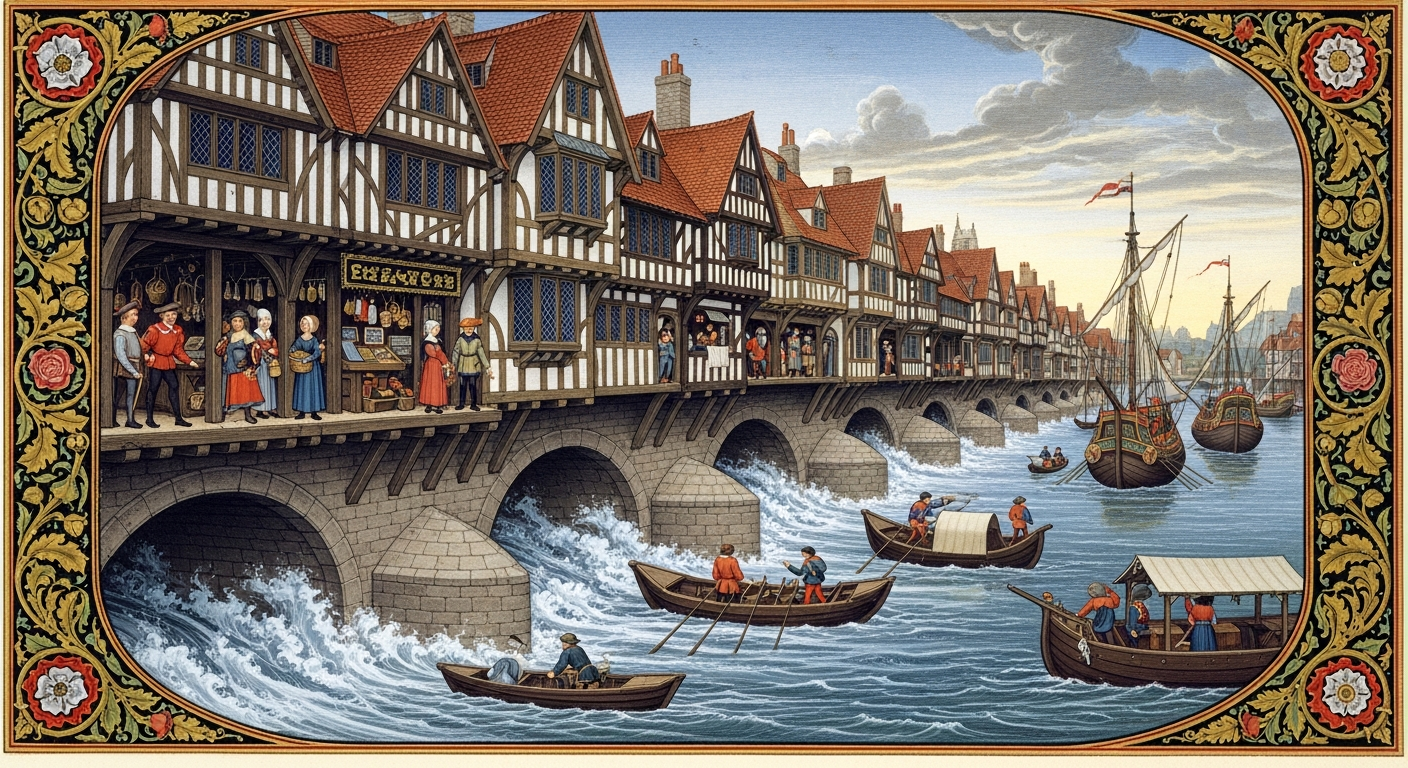
Imagine crossing a bridge where you could buy bread, have your teeth pulled, purchase silk ribbons, and witness the severed heads of traitors all in a single journey. This was the extraordinary reality of Tudor London’s Old London Bridge, a medieval marvel that defied every modern conception of what a bridge should be. Far from being merely a river crossing, Old London Bridge was a thriving vertical city that stretched across the Thames for nearly a thousand feet, packed with over 200 shops, houses, and businesses that made it one of the most densely populated areas in all of England.
Between 1485 and 1603, during the Tudor dynasty’s reign, this remarkable structure served as the beating heart of London’s commercial life. Its 19 massive stone arches didn’t just support a community above the water; they created such violent currents below that navigating beneath the bridge became a life-or-death gamble known as ‘shooting the bridge’. For Tudor Londoners, the bridge represented both the pinnacle of medieval engineering and a daily reminder of the thin line between prosperity and peril that defined their age.
What made this bridge so special that it captured the imagination of chroniclers like Raphael Holinshed, survived for over 600 years, and continues to fascinate historians and fiction writers today? The answer lies in understanding how Old London Bridge became not just a crossing, but a complete urban ecosystem that reflected the ambitions, innovations, and contradictions of Tudor England.
Historical Background
Old London Bridge began its life in 1176 under the direction of Peter of Colechurch, a priest and engineer who envisioned something far grander than the wooden bridges that had previously spanned the Thames. By the time the Tudors came to power in 1485, this stone masterpiece had already been serving London for nearly three centuries, but it was during the Tudor period that it reached its full glory as a commercial and residential hub.
The bridge’s construction was a triumph of medieval engineering that took over 30 years to complete. Stretching 926 feet across the Thames, it was supported by 19 pointed stone arches of varying sizes, with the central arches spanning up to 34 feet. What made it truly unique, however, was what happened above the waterline. The entire length of the bridge was lined with buildings, creating a continuous street in the sky that connected the City of London to Southwark.
During the Tudor era, these buildings housed an incredible variety of establishments. The ground floors typically served as shops selling everything from books and haberdashery to food and household goods, whilst the upper floors provided living accommodation for shopkeepers, craftsmen, and their families. The bridge even boasted its own chapel, dedicated to Thomas Becket, positioned on one of the central piers. Raphael Holinshed, writing in his Chronicles of England, Scotland and Ireland in 1577, marvelled at how the bridge resembled ‘a continual street, well replenished with large and stately houses on both sides’.
The most infamous feature of Tudor London Bridge was undoubtedly the Great Stone Gateway at the Southwark end, topped with a display of traitors’ heads preserved in tar. This grisly spectacle served as both a warning to potential rebels and a stark reminder of royal power. Visitors to London, including foreign dignitaries and merchants, would encounter this macabre welcome as they entered the city, making the bridge not just a commercial centre but also a stage for political theatre.
Significance and Impact
The commercial importance of Old London Bridge to Tudor England cannot be overstated. As the only bridge crossing the Thames in London until 1750, it held a complete monopoly on foot traffic between the north and south banks. This strategic position made the shops on the bridge some of the most valuable commercial real estate in the entire kingdom. Merchants paid premium rents for the privilege of trading in this captive market, where every traveller was essentially a forced customer.
The bridge’s unique geography created a distinctive social ecosystem that reflected Tudor England’s complex class structure. Wealthy merchants occupied the prime central positions, their elaborate shop signs jutting out over the Thames, whilst humbler traders clustered near the approaches. The residential quarters above the shops housed everyone from prosperous goldsmiths to struggling apprentices, creating a vertical community where social mobility was quite literally measured in floors.
Perhaps most significantly, the bridge’s 19 arches created what modern engineers would recognise as a serious hydraulic problem. The narrow gaps between the massive stone piers accelerated the Thames’ flow so dramatically that the water level could differ by up to six feet between the upstream and downstream sides. This phenomenon made ‘shooting the bridge’ by boat an extremely hazardous endeavour that claimed numerous lives throughout the Tudor period. Many prudent Londoners chose to disembark at the Old Swan stairs upstream, walk across the bridge, and rejoin their waterman at Billingsgate, a practice that further concentrated foot traffic and commercial activity on the bridge itself.
The dangers of shooting the bridge became so legendary that it gave rise to the saying ‘London Bridge was made for wise men to go over and fools to go under’. This wasn’t mere superstition; the turbulent waters genuinely posed mortal danger, and the Thames watermen who successfully navigated these rapids were considered among the most skilled boatmen in Europe. The bridge thus shaped not only London’s physical geography but also its maritime culture and the daily rhythms of Tudor life.
Connections and Context
Old London Bridge played host to many pivotal moments in Tudor history, serving as both witness and participant in the dynasty’s great dramas. When Henry VIII’s marriage to Anne Boleyn was publicly celebrated in 1533, the bridge was decorated with pageants and displays of loyalty. Conversely, just three years later, Anne’s supporters would have seen her alleged accomplices’ heads adorning the Great Stone Gateway, a grim reminder of how quickly fortunes could change in Tudor politics.
The bridge’s role extended beyond mere symbolism into practical governance. The income from bridge rents and tolls helped fund various civic projects and charitable institutions throughout London. The Bridge House Estates, established to maintain the structure, became one of London’s most important charitable foundations, supporting schools, almshouses, and public works. This financial model demonstrated how Tudor England’s emerging capitalist economy could serve both private profit and public good.
During the same period that Old London Bridge flourished as a commercial centre, London was experiencing unprecedented growth and transformation. The Tudor period saw London’s population swell from around 50,000 to over 200,000 inhabitants, making it one of Europe’s largest cities. The bridge’s concentrated commercial activity both reflected and contributed to this urban expansion, serving as a prototype for the kind of intensive development that would characterise London’s later growth.
Modern Relevance and Fascinating Details
The story of Old London Bridge offers remarkable insights into how urban communities adapt to challenging physical constraints. Modern urban planners and architects studying sustainable development often look to historical examples like the bridge to understand how limited space can be maximised through vertical integration and mixed-use development. The bridge’s combination of commercial, residential, and civic functions in a confined space prefigured many concepts that contemporary city designers consider innovative.
Some of the most fascinating details about the bridge emerge from archaeological evidence and historical records that reveal the intimate daily life of its inhabitants. Residents had to contend with unique challenges: their homes swayed slightly in strong winds, the sound of rushing water was constant, and the risk of fire was ever-present due to the close-packed wooden buildings. Despite these inconveniences, demand for bridge accommodation remained high throughout the Tudor period, testament to the commercial advantages that outweighed the physical discomforts.
The bridge’s influence on literature and popular culture extends far beyond the familiar nursery rhyme ‘London Bridge is Falling Down’. Shakespeare’s audiences would have been intimately familiar with the bridge’s sights, sounds, and smells, and references to it appear throughout Tudor and Jacobean drama. Modern historical fiction continues to find rich material in the bridge’s unique social dynamics, from the wealthy merchant families in their grand houses to the apprentices and servants who kept the commercial machinery running. As a historical fiction author, I find the bridge offers an perfect microcosm of Tudor society, where all the era’s tensions between tradition and innovation, wealth and poverty, safety and danger played out within a few hundred yards.
Conclusion
Old London Bridge stands as one of the most remarkable achievements of medieval engineering and Tudor commerce, a structure that successfully combined practical necessity with urban innovation for over six centuries. Its transformation into a vertical city demonstrates the ingenuity with which our ancestors approached challenges of space, economics, and civic planning. The bridge’s story, from its engineering marvel spanning the Thames to its role as a stage for Tudor politics and daily life, reveals how infrastructure can become much more than mere functionality.
For modern readers fascinated by Tudor history, Old London Bridge offers a unique window into how ordinary people lived, worked, and navigated the opportunities and dangers of their world. Whether you’re drawn to the engineering achievements, the commercial innovation, the social dynamics, or the political symbolism, the bridge provides a tangible connection to Tudor England that goes far beyond the usual focus on courts and nobles. Next time you cross any bridge, consider how Old London Bridge elevated the simple act of river crossing into an urban adventure that captured the imagination of an entire age.