
Introduction
In 1564, when England’s future greatest playwright drew his first breath in Stratford-upon-Avon, the entire town could have gathered in a single field. With a mere 1,500 residents, this Warwickshire market town was the sort of place where everyone knew precisely which families were thriving, which were struggling, and which had secrets they’d rather keep buried. For young William Shakespeare, growing up in such an intimate community meant that his family’s later financial troubles would become very public indeed, shaping both his worldview and perhaps his understanding of human nature that would later illuminate the stages of London.
Tudor England was a patchwork of such small market towns, each serving as vital economic and social centres for the surrounding countryside. These communities operated on intricate networks of reputation, credit, and social standing that could elevate a family to prominence or cast them into disgrace with remarkable speed. The Shakespeare family’s rise and fall within Stratford’s social hierarchy offers us a fascinating window into how Tudor society functioned at the local level, far from the glittering courts of Greenwich and Whitehall.
By examining the intimate world of Shakespeare’s birthplace, we can better understand not only the forces that shaped England’s most celebrated writer but also the daily realities of Tudor life for ordinary families navigating the complex social and economic challenges of the sixteenth century.
Historical Background
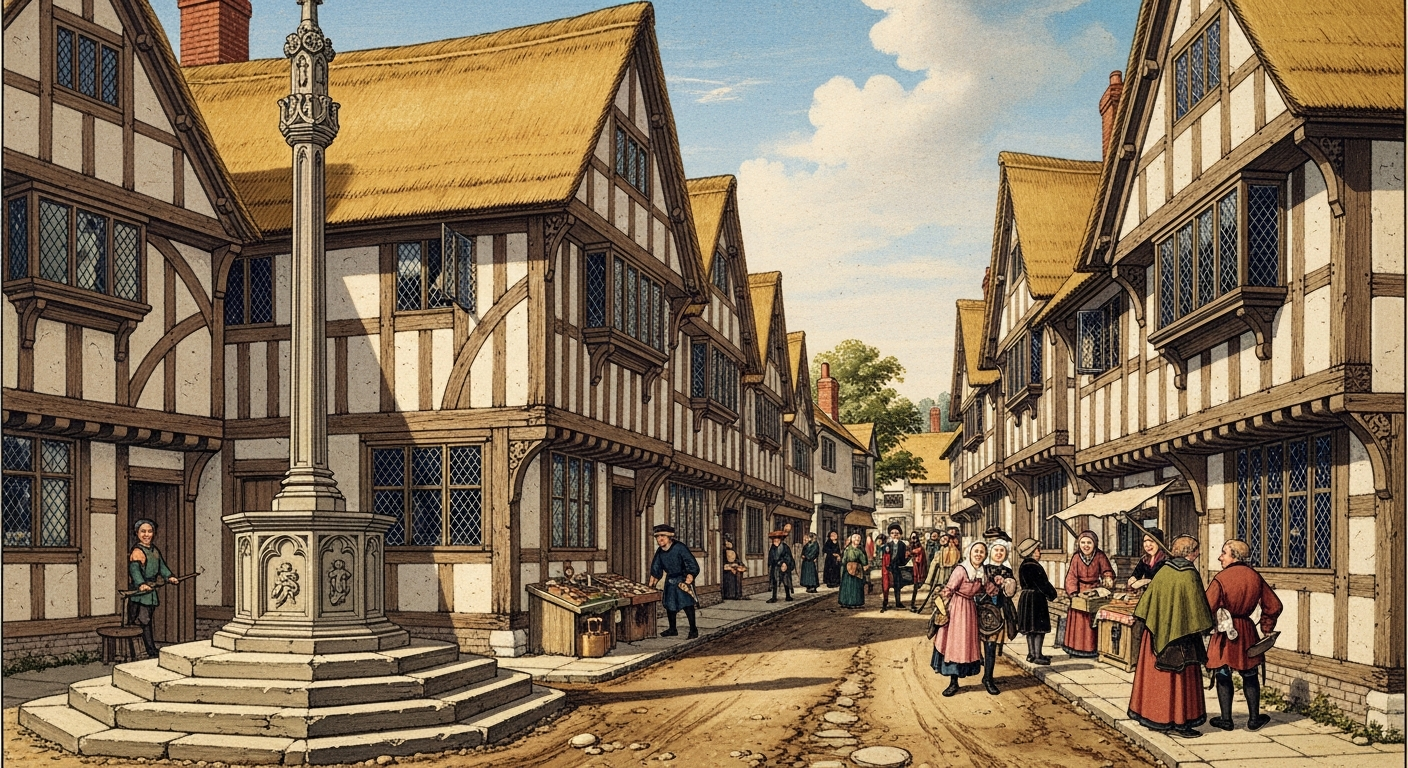
When William Shakespeare was born on or around 23rd April 1564, Stratford-upon-Avon was a prosperous market town that had received its royal charter in 1196. The town’s strategic position along the River Avon made it an essential trading hub for Warwickshire’s agricultural produce, whilst its weekly markets and annual fairs drew merchants and farmers from across the region. According to the Stratford-upon-Avon Borough Records held at the Shakespeare Birthplace Trust Archives, the town’s population had remained relatively stable throughout the early Tudor period, hovering around 1,500 souls who lived in timber-framed houses clustered along streets that remain largely unchanged today.
The Shakespeare family had established themselves as respectable members of this close-knit community well before William’s birth. His father, John Shakespeare, had arrived from the nearby village of Snitterfield in the 1550s and quickly made his mark as a successful glover and leather worker. By 1565, just a year after William’s birth, John had been elected to serve as an alderman, one of the most prestigious positions in Tudor local government. This role placed him among Stratford’s elite, responsible for maintaining law and order, overseeing trade standards, and representing the town’s interests to county authorities.
The alderman position was no mere honorary title in Tudor England. These men wielded considerable power within their communities, settling disputes, licensing trades, and determining which families could operate businesses within the town’s jurisdiction. For a man like John Shakespeare, who had arrived as an outsider from rural Snitterfield, achieving alderman status represented a remarkable social ascent that would have been noticed and discussed throughout Stratford’s narrow streets and market squares.
However, John Shakespeare’s fortunes began to decline dramatically during the 1570s and 1580s. The Borough Records reveal that he started missing council meetings regularly from 1576 onwards, and by 1586, he had been removed from his alderman position entirely. Contemporary documents suggest that mounting debts were the primary cause of his downfall, with creditors pursuing him through local courts for various unpaid obligations. In a community of just 1,500 people, such financial difficulties could not be hidden, and the Shakespeare family’s reduced circumstances would have been common knowledge among their neighbours.
Significance and Impact
The intimate scale of Tudor market towns like Stratford-upon-Avon created unique social dynamics that profoundly influenced family life and individual development. In larger cities such as London or Norwich, families might weather financial storms with relative anonymity, but in a community where everyone knew everyone else’s business, social disgrace carried much more significant consequences. For the young William Shakespeare, watching his father’s public fall from grace during his formative teenage years would have provided an education in human nature that no grammar school could offer.
This experience of observing how quickly social status could crumble likely influenced many themes that would later appear in Shakespeare’s works. The playwright’s acute understanding of debt, social climbing, and the fragility of reputation that permeates plays such as The Merchant of Venice and Timon of Athens may well have originated from these early observations of his father’s struggles. As Robert Bearman notes in his scholarly analysis ‘Shakespeare’s Money: How Much Did He Make and What Did This Mean?’ published in Shakespeare Quarterly in 2016, the playwright’s later obsession with financial security and his careful accumulation of property and wealth suggests that these childhood experiences of economic instability left lasting psychological marks.
The small-town environment also meant that William would have witnessed firsthand how local government operated and how power dynamics shifted within established hierarchies. Tudor aldermen like his father were expected to maintain certain standards of dress, behaviour, and financial stability that reflected well on the town’s reputation. When John Shakespeare could no longer meet these expectations, his removal from office sent ripples throughout Stratford’s social fabric that affected not just him but his entire family.
Moreover, the interconnected nature of Tudor market town society meant that John’s business difficulties likely affected numerous other families who had extended him credit or relied on his trade. In communities where economic relationships were often based on personal trust rather than formal contracts, one family’s financial collapse could trigger wider hardships. This web of mutual dependence and vulnerability would have been clearly visible to young William as he grew up in Stratford’s narrow streets.
Connections and Context
The Shakespeare family’s troubles occurred during a particularly challenging period for English market towns. The 1570s and 1580s witnessed significant economic pressures across Tudor England, including poor harvests, monetary inflation, and disruptions to traditional trading patterns. Many established families found themselves struggling to maintain their social positions as economic conditions shifted beneath their feet. The Shakespeares were far from alone in their difficulties, but in a town of 1,500 people, their particular struggles were perhaps more visible than most.
This period also coincided with important religious and political changes that affected local communities throughout England. The Elizabethan Religious Settlement was still relatively new, and many families were navigating the complex transition from Catholic traditions to Protestant practices. Some historians have suggested that John Shakespeare’s withdrawal from public life might have been influenced by religious as well as financial concerns, as families with Catholic sympathies sometimes found it prudent to maintain lower profiles during this period of religious consolidation.
The intimate scale of Stratford-upon-Avon during this era reflects the broader reality of Tudor England, where the vast majority of people lived in small rural communities rather than major urban centres. London, with its population approaching 200,000 by the 1590s, was exceptional rather than typical. Most English people lived their entire lives within a radius of just a few miles, making local reputation and community standing matters of paramount importance for family survival and prosperity.
Modern Relevance and Fascinating Details
The claustrophobic nature of Tudor small-town life offers striking parallels to modern small communities where everyone knows everyone else’s business. Just as social media can amplify personal difficulties today, the gossip networks of sixteenth-century market towns ensured that family troubles became public knowledge with remarkable speed. For the young Shakespeare, growing up under such scrutiny may have fostered both his psychological insight into human behaviour and his eventual desire to seek his fortune in London’s more anonymous crowds.
Did you know that Stratford-upon-Avon’s population in Shakespeare’s youth was roughly equivalent to a single large secondary school today? Yet this tiny community produced not only England’s greatest playwright but also supported a grammar school sophisticated enough to provide William with the classical education evident in his later works. The town’s remarkable cultural achievements relative to its size demonstrate how Tudor market towns could serve as intellectual and artistic centres despite their modest populations.
Archaeological evidence and surviving Tudor buildings in modern Stratford-upon-Avon provide tangible connections to Shakespeare’s world that continue to fascinate visitors and scholars alike. The house where William was born still stands on Henley Street, its timber frame and small rooms offering physical reminders of the intimate domestic spaces where Tudor families lived, worked, and weathered their various crises. Walking through these preserved spaces, one can easily imagine how quickly news of John Shakespeare’s mounting debts would have spread through the community and how the family’s reduced circumstances would have affected their daily interactions with neighbours and former friends.
Conclusion
The story of Shakespeare’s early years in tiny Stratford-upon-Avon illuminates crucial aspects of Tudor social life that often remain hidden behind the grand narratives of royal courts and international politics. In a community of just 1,500 people, every family’s fortunes were intertwined with their neighbours’, creating a social ecosystem where reputation, credit, and mutual support formed the foundation of daily existence. The very intimacy that made John Shakespeare’s financial troubles so publicly humiliating also provided his son with an unparalleled education in human psychology and social dynamics.
Understanding the small-town origins of England’s greatest playwright reminds us that Tudor history encompasses far more than the dramatic events surrounding Henry VIII’s marriages or Elizabeth I’s military victories. For most Tudor English people, life unfolded in communities much like Shakespeare’s Stratford-upon-Avon, where local relationships, economic pressures, and social hierarchies shaped individual destinies in ways that continue to resonate through the centuries. Perhaps it was precisely because William Shakespeare understood so intimately how society functioned at this fundamental level that his works continue to speak to audiences across cultures and centuries, revealing universal truths about human nature that transcend the specific circumstances of any single time or place.