
Introduction
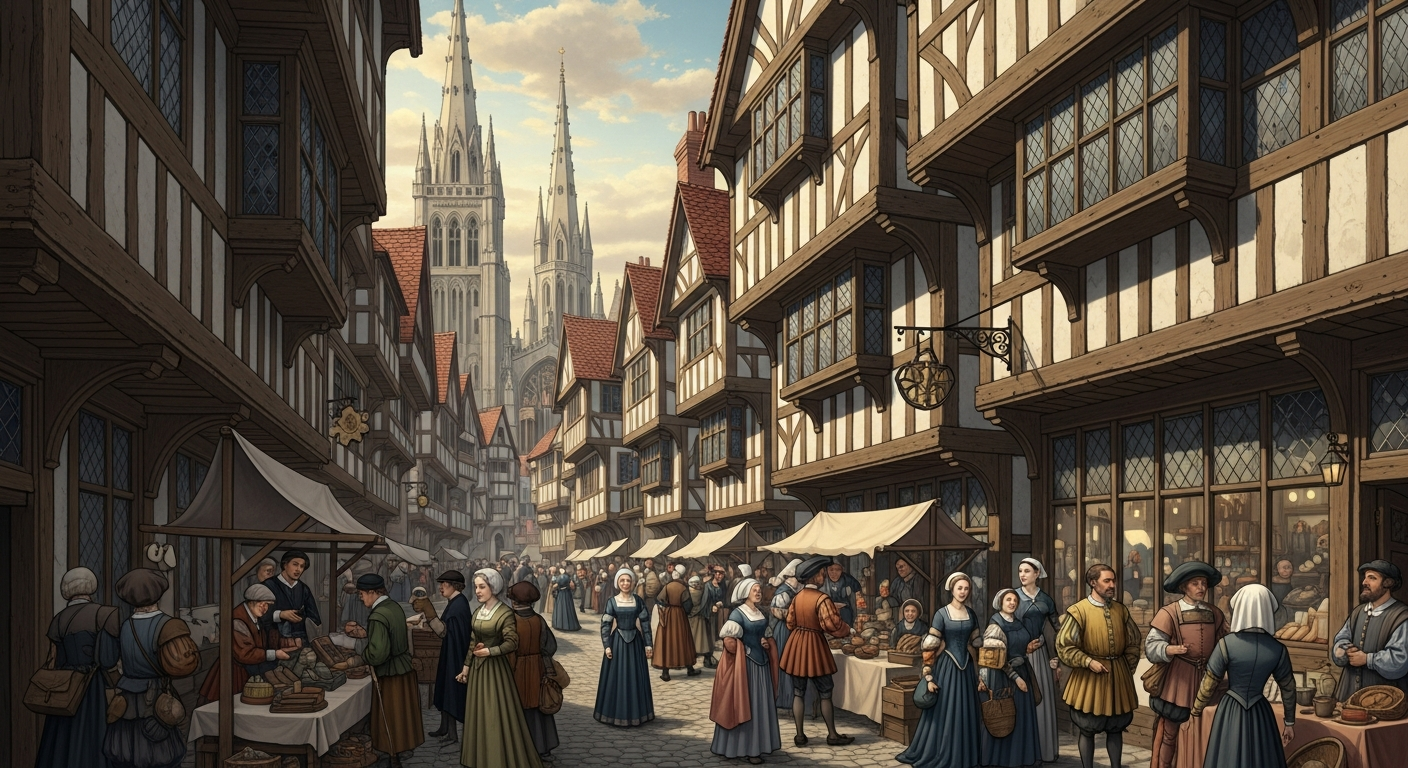
Imagine standing on London Bridge in 1500, gazing across the Thames at a modest city of roughly 50,000 souls. Then step forward a century and witness one of the most dramatic urban transformations in European history. By 1600, that same vista would reveal a sprawling metropolis teeming with 200,000 inhabitants, making Tudor London not merely England’s largest city, but one of Europe’s great urban powerhouses. This extraordinary quadrupling of population represents far more than mere numbers on a census; it tells the story of religious upheaval, economic opportunity, and social revolution that defined the Tudor age.
The streets that once echoed with familiar English voices now buzzed with the accents of French Huguenots, Flemish weavers, and German craftsmen. These weren’t merely economic migrants seeking fortune, but refugees fleeing the religious persecution that plagued continental Europe throughout the 16th century. Their arrival would reshape London’s character forever, creating a cosmopolitan hub that would lay the foundations for the global city we recognise today.
This remarkable century of growth reveals how London transformed from a regional English town into an international centre of commerce, culture, and craftsmanship. Understanding this population explosion helps us grasp not only the Tudor period’s social dynamics but also the religious, economic, and political forces that shaped early modern Europe.
Historical Background
The Tudor dynasty’s reign, spanning from Henry VII’s victory at Bosworth in 1485 to Elizabeth I’s death in 1603, coincided perfectly with London’s most dramatic period of expansion. When Henry VIII ascended the throne in 1509, London remained a compact medieval city contained largely within its ancient Roman walls. The population clustered around familiar landmarks: the Tower of London, St Paul’s Cathedral, and the bustling markets of Cheapside and Eastcheap.
Several key factors converged to trigger this unprecedented growth. The dissolution of the monasteries under Henry VIII between 1536 and 1541 released vast tracts of urban land for development, whilst simultaneously displacing thousands of religious communities and their dependents. This created both opportunity and necessity, as former monastic lands became available for housing whilst displaced populations sought new livelihoods in the expanding city.
Perhaps most significantly, the religious wars and persecution sweeping continental Europe sent waves of refugees across the Channel. The French Wars of Religion (1562-1598) drove thousands of Huguenots from their homeland, whilst the Dutch Revolt against Spanish rule (beginning in 1566) displaced skilled Flemish artisans and merchants. These weren’t destitute masses but often prosperous, educated individuals who brought valuable skills, capital, and international connections to their adopted city.
Contemporary observer John Stow, whose comprehensive Survey of London published in 1598 provides invaluable insights into Tudor urban life, documented this transformation firsthand. Stow noted how areas beyond the old city walls, particularly in the eastern parishes of Whitechapel and Stepney, swelled with new inhabitants. The western suburbs around Westminster and Holborn similarly expanded as courtiers, lawyers, and merchants established residences closer to the centres of political and economic power.
Significance and Impact
This demographic revolution fundamentally altered London’s social fabric, economic structure, and cultural identity. The influx of skilled foreign craftsmen revolutionised entire industries, with Flemish weavers enhancing English textile production and French goldsmiths raising standards in luxury goods. These immigrants didn’t simply fill existing roles but created entirely new economic sectors, establishing London as a centre for innovative craftsmanship that could compete with the finest European cities.
The religious dimension of this migration proved equally transformative. Protestant refugees found sanctuary in a nation that had broken with Rome, but their arrival also tested England’s religious settlement. Different Protestant traditions, from French Calvinism to Flemish reformed churches, created a more diverse religious landscape within London. Elizabeth I’s government, whilst generally welcoming to Protestant refugees, had to carefully balance their integration with the concerns of native English craftsmen who feared economic competition.
Socially, this population explosion created new urban challenges that would shape London’s development for centuries. Housing shortages led to the subdivision of existing properties and the rapid construction of new suburbs beyond traditional city boundaries. Sanitation, food supply, and public order all came under unprecedented strain. The government responded with new regulations attempting to control building standards and limit immigration, though these proved largely ineffective against the powerful economic and religious forces driving population growth.
The demographic shift also transformed London’s political significance within England. With roughly 200,000 inhabitants by 1600, London contained approximately 5% of England’s entire population, creating an unprecedented concentration of economic power, political influence, and cultural innovation. This concentration would prove crucial during the coming Stuart period, as London’s size and wealth enabled it to challenge royal authority in ways previously impossible.
Connections and Context
London’s population explosion cannot be understood in isolation from broader European developments. The same religious conflicts driving refugees to English shores were reshaping cities across the continent. Antwerp, previously northern Europe’s greatest commercial centre, saw its population decline as Amsterdam and London gained prominence. This shift reflected not only religious persecution but also the changing patterns of international trade following the discovery of Atlantic trade routes.
The timing of London’s growth also coincided with England’s emerging maritime ambitions. The establishment of trading companies like the Muscovy Company (1555) and the Levant Company (1581) created new commercial opportunities that attracted both English entrepreneurs and foreign merchants to the capital. Francis Drake’s circumnavigation (1577-1580) and the defeat of the Spanish Armada (1588) enhanced England’s international prestige, making London an increasingly attractive destination for continental Europeans seeking new opportunities.
Did you know that by 1600, London’s foreign-born population may have comprised up to 10% of the total inhabitants? This proportion wouldn’t be matched again until the late 20th century, making Tudor London remarkably cosmopolitan by historical standards. Parish records from areas like Aldgate and Bishopsgate reveal christenings recorded in French, Dutch, and German, testament to the diverse communities establishing themselves within the ancient city walls.
Modern Relevance and Fascinating Details
The parallels between Tudor London’s experience and modern urban migration patterns are striking. Just as 16th-century refugees brought skills, capital, and cultural diversity to London, contemporary cities grapple with similar questions about integration, economic impact, and cultural change. The Tudor government’s attempts to regulate immigration and control urban development echo modern policy debates, whilst the economic benefits that skilled migrants brought to Tudor London mirror arguments made today about immigration’s positive economic effects.
For historical fiction writers, this population explosion provides rich material for authentic period detail. Characters might realistically encounter French-speaking silversmiths in Cheapside, Flemish weavers in Spitalfields, or German printers near St Paul’s Cathedral. The linguistic diversity, religious tensions, and cultural exchanges of Tudor London offer endless possibilities for compelling historical narratives that reflect the period’s genuine complexity.
Archaeological evidence continues to illuminate this transformation. Recent excavations in areas like Crossrail’s route through central London have revealed the material culture of Tudor expansion: pottery fragments showing continental European styles, coins from various European territories, and building foundations reflecting the rapid construction boom that accommodated London’s swelling population. These discoveries provide tangible evidence of the cosmopolitan character that literary sources like Stow’s Survey describe.
Conclusion
London’s extraordinary population growth during the Tudor period, from 50,000 to 200,000 inhabitants, represents far more than demographic statistics. This transformation reflected and shaped the religious, economic, and political upheavals that defined 16th-century Europe. The refugees fleeing continental persecution didn’t merely seek sanctuary but actively participated in creating a new kind of city: cosmopolitan, economically dynamic, and culturally diverse in ways that prefigured London’s eventual emergence as a global metropolis.
Understanding this Tudor population explosion helps us appreciate both the period’s unique challenges and its enduring relevance. The questions Tudor Londoners faced about immigration, urban development, religious diversity, and economic change continue to resonate today. For anyone seeking to understand how London became one of the world’s great cities, the Tudor century of growth provides essential insights into the forces that shaped not only England’s capital but the character of early modern urban life itself.